Image of the day

Captured by
Lawrence Parchman

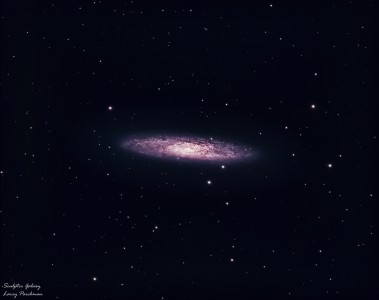
Sculptor Galaxy (NGC 253)

My Account

New to Astromart?

Register an account...

Need Help?

Posts Made By: Doug Scobel

October 11, 2005 08:40 PM Forum: Beginning Astronomy?

Is there an "Idiot's Guide To Backyard Optics"?

Posted By Doug Scobel

Raleigh,

Here's a short article on the subject I wrote for our club newsletter a couple years ago:

http://www.umich.edu/~lowbrows/reflections/2003/dscobel.12.html

And a follow-up article:

http://www.umich.edu/~lowbrows/reflections/2003/dscobel.13.html

There are numerous other articles by our club members on that web site as well. Hopefully you find them helpful.

Doug


October 21, 2005 07:29 PM Forum: Equipment Talk

How many degrees to rotate Dob focuser?

Posted By Doug Scobel

Erik, I built my 13" f/4.5 with the focuser around 20 degrees, and it works well for me. I would not want it rotated any more than that when near the zenith, and at low altitudes it's comfortable when the chair is at its lowest setting. Your 12.5" f/5 will be similarly sized to mine, so I would expect it would work well for you too.

I am not positive on the angle, so I'll try to remember to measure it and I'll repost with a more exact number.

[edit] I just measured it and indeed it is 20 degrees.

Good luck,
Doug

November 9, 2005 09:32 PM Forum: Reflectors

Question about Silicon

Posted By Doug Scobel

David, you said that you're using "stacks of pennies" as spacers. How thick will these silicone pads be? i.e., how many pennies? Too thick and they will still have some give to them, even with a fresh tube of silicone glue.

Doug

December 22, 2005 02:54 PM Forum: Telescope Making

Curved spider question

Posted By Doug Scobel

Mike, in my experience you will see no difference in planetary contrast between properly designed and executed curved and straight vane spiders, especially the single arch type sold by Protostar. I have tried both in my 8" f/8 Newt, a Novak straight four-vane and a Protostar single arch, and I see no difference in planetary detail. My guess is that they both generate about the same amount of total diffraction, but the single arch throws it around the entire field while with the straight vane it's concentrated in the spikes. Aesthetically, the view looks better to me without the spikes so I prefer the single arch.

Note that I said "properly designed and executed". Which means thin vanes, perfectly (or nearly so) aligned with the optical axis, single arch (curved vanes have more total length than an equal number of straight vanes), etc.

Do a search through the Telescope Making and Equipment Talk forums and you'll see numerous discussions on the subject. You'll also find that there is not a lot of consensus.

Doug

January 4, 2006 06:03 AM Forum: Reflectors

Mirror coating ?

Posted By Doug Scobel

Hi, Matt, if you do decide to recoat, I would advise you to search the forum archives for discussions involving Clausing coatings. There's a lot of variation in different folks' experience, some good, some bad. But I can tell you that in the club I belong to, none of the coatings we've had Clausing do for us over the past few years (and there have been several) have lasted more than a year.

Doug

February 28, 2006 03:40 PM Forum: Telescope Making

Is There Anything More Beautiful Than....

Posted By Doug Scobel

I agree, Bill. Especially when you consider that if it is a good mirror then it is accurate over its entire face to within about a millionth of an inch. A real thing of beauty!

Doug

March 1, 2006 01:08 PM Forum: Telescope Making

Mirror making - how to remove central hole?

Posted By Doug Scobel

I decided that deforming the lap was too scary, so I'm going with the 1/3 COC strokes, MOT. After an hour's worth of work (actual polishing time) last night it's leveling out nicely. I figure another two hours or so will do it.

Doug

March 4, 2006 02:07 PM Forum: Telescope Making

Mirror making - how to remove central hole?

Posted By Doug Scobel

I've made a few mirrors over my lifetime, but it seems that they're getting more and more difficult for me, rather than easier. It's not the grinding and polishing, it's figuring. The lap just doesn't want to do anything I want it to. The first two mirrors I made (in my teens) were in the summertime in my garage. I never had the kind of problems I have now. Those two mirrors, a 6" f/9 and a 6" f/4.5, polished out nicely, and parabolizing with the full size lap was a snap – worked just like the books described. But now, I have a devil of a time getting the lap to do anything reasonable. For instance, using a 1/3 diameter W stroke always results in a flat edge zone, and a large central hill. The flat zone's width is about the same as the overhang, about 3/4 inch on a 6" mirror. Longer strokes with more overhang just result in a wider "flat" outer zone, but still with a central bump. Forget parabolizing with a full size lap – I have to get way too aggressive with the strokes and then end up digging a deep, ugly hole in the middle. I had to resort to a 4" lap to parabolize my last mirror, an 8" f/8. But getting a decent sphere first was problematic. Now I'm having similar problems with my current project, a 6" f/4.5 (see earlier posts).

Knowing that my earlier mirrors were done in much warmer temperatures and higher humidity, could the low temperature and humidity in my house be making the lap too hard? With the price of natural gas these days, I simply can't afford to keep the house any warmer than 70 degrees. And with forced air heat, the humidity is way low, even with a whole house humidifier. I think I'm maintaining good contact, I hot press, cold press, use netting, warm the lap and start polishing before it has cooled off all the way, etc., and the lap's action feels smooth, not jerky. But still I end up with weird results. I'm using Gugolz 64 pitch, but I'm wondering if it is still too hard. But even if it is hard, shouldn't that be conducive to getting a good sphere? If I could get a good sphere I'd be happy. I'm fine with using a 3" lap to parabolize – the sub-diameter lap worked great on my 8" mirror.

I'm tempted to make a new lap, adding some turpentine to soften it up. Or I could order some Gugolz 55. Or try raising the house temperature by maybe five degrees, at least temporarily. (Yeah, try rationalizing that to my wife, who is always complaining that the house is too cold. "But it's for my mirror". Yeah, that will fly.) Or maybe I've just developed some unorthodoxy in my technique that I'm not even aware of.

This is getting really frustrating. :C Any and all suggestions are welcome.

Thanks,
Doug
March 9, 2006 10:29 PM Forum: Telescope Making

Curved or Straight Spider Vanes

Posted By Doug Scobel

Jason, this subject comes up every so often - here's a thread you should probably read through:

http://www.astromart.com/forums/viewpost.asp?forum_post_id=400684&poll_id=&news_id=&page=2

You'll see that I chimed in a couple times. The bottom line IMHO is that it's more an aesthetic issue - it has little or no bearing on how much detail you actually see.

What size scope? More importantly, what size secondary mirror?

Doug

March 14, 2006 06:43 PM Forum: Telescope Making

In search of a good coater

Posted By Doug Scobel

Michael Connelley said:

*snip*
I've heard good things about Spectrum Coatings. I've tried to contact them, but haven't heard back.
*snip*

Cheers
Mike Connelley

Call him (Paul Z.). He will answer his phone. He seldom answers emails.

Good choice IMO - he does a superb job.

Doug
