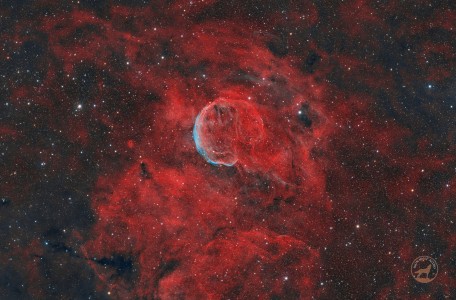
Image of the day

Captured by
Douglas Rollain

LBN 576 - The Garlic Nebula

My Account

New to Astromart?

Register an account...

Need Help?

Posts Made By: Alan French

March 28, 2004 10:46 PM Forum: Telescope Making

mirror making

Posted By Alan French

Todd,

Either Pyrex or plate will work fine. A bigger issue might be starting with a thin blank. One inch would be OK, but 3/4 inch might be pressing your luck. For an 8" mirror, the difference in cooling between a standard thickness blank and a thinner one is not huge. Thin blanks become more desireable in larger apertures.

As to a 1/20 wavefront mirror, I think the vast majority of these are little more than pipe dreams (I assume you are talking PTV). A true 1/8 - 1/10 wavefront mirror, with a nice smooth figure, leaves little to be desired.

Clear skies, Alan

April 2, 2004 03:47 PM Forum: Telescope Making

4" F15 Refractor Should I?

Posted By Alan French

Bill,

If possible, have someone check the lens before spending a lot of money to mount it. Like many other companies, the quality of the Jaegers lenses varied. The figure on yours could be fine, but there is no quarantee.

You will obviously have the secondary color appropriate to a 4" f/15 achromat. I used a 4" f/15 Clark for two years, and, while the color was there, I did not find it too objectionable, and the lens provided fine lunar and planetary views.

Clear skies, Alan

April 3, 2004 02:42 PM Forum: Equipment Talk

Beginner EP question

Posted By Alan French

Eyepieces can certainly be confusing, and the number of makes and types intimidating. There are a few things to keep in mind.

First, the eyepiece is not as important as the optical system you are using it in. The differences between the various quality eyepieces tend to be subtle, and you are unlikely to go too far wrong with almost any of them.

In general, for expensive eyepieces, you are paying for either a wider, better corrected field of view, or, in the case of the specialized "planetary" eyepieces, for better (longer, more expensive) polish, better glass, and better coatings.

Clear skies, Alan

April 14, 2004 12:09 AM Forum: Telescope Making

Focuser placement - 90 or 45 deg

Posted By Alan French

Personally, I find having a focuser parallel to the ground (your 90 degree) VERY uncomfortable if the eyepiece is below eye height. It is difficult to squat down and try to look straight ahead. It is much easier, IMHO, to bend downward and look downward into the eyepiece.

Clear skies, Alan

April 15, 2004 10:12 PM Forum: Equipment Talk

Re: Skunk Chaser?,

Posted By Alan French

Bill,

I think a bear would worry me a bit, but they are not too common in this neck of the woods. I did hear from a friend that her sister found one in the garage one morning. She left it alone and it went on its way.

Clear skies, Alan

April 19, 2004 10:09 PM Forum: Telescope Making

Fast Mak-Newts?

Posted By Alan French

Lee,

I had the good fortune to play with the AP Fastmax, a 9.25" f/4.3 Mak-Newt quite a bit at WSP several times. It was a wonderul scope, providing reasonably wide fields - especially for a 9.25" - and great views of Saturn and Mars.

Clear skies, Alan

April 25, 2004 12:06 PM Forum: Equipment Talk

Mirror Quality

Posted By Alan French

David,

I suggest you get a copy of the article "Optical Quality in Telescopes," by Peter Ceravolo, Terence Dickinson, and Doug George, from the March, 1992, issue of Sky & Telescope. If you don't have a friend with a copy, many college libraries have a good collection of Sky & Telescope.

Another good article is "Testing Paraboloidal Mirrors (What Every Telescope Maker Should Know about Testing Telescope Optics)," in issue 32 of Telescope Making. This magazine is not generally available in the library, but someone could probably dig up a copy of the article for you.

The bottom line is that even a true 1/4 wave mirror, if it's smoothly figured, works well. A true 1/8-1/10 wave mirror is a superb performer. Claims of mirrors much exceeding 1/10th wave, especially if the results are based on Foucault data, should be taken with a grain of salt. I have an 8" f/9 that the Foucault readings claim is 1/54th wave at the wavefront, but it is utter fiction, and I'd be foolish to claim the mirror is that good.

The proper measure of a mirror's quality is a value that reflects the entire mirror surface - RMS or Strehl. Doing some math to produce these numbers from the Foucault test is not that same as actually testing the entire mirror with interferometry. The Foucault numbers I have seen for RMS and Strehl seem very optimistic, and I would not trust them.

The real test of a telescope is its performance under the night sky. Does it provide nice, detailed views of the Moon and planets? Under good seeing at high power, are the star images nice, tight Airy disks, with a nice uniform first ring of the diffraction pattern visible, without extra light floating around? (Because the disk goes to a minimum intensity as you reach the edge, and it does not have a hard edge, brighter stars will show a slightly larger Airy disk than fainter stars.)

Numbers can actually be dangerous. I have heard of perfectly happy telescope owners becoming unhappy owners simply because an optical expert star tested their telescope and put a number on it. Then there are folks who like to wave "optical certification" around, even if it has numbers that are far too accurate and have far too much precision for the test methodology.

Clear skies, Alan


April 27, 2004 09:42 PM Forum: Telescope Making

Priming/Painting aluminum tube?

Posted By Alan French

I suggest you give some consideration to leaving it unpainted. An unpainted aluminum tube has better thermal characteristics (low emissivity), and you don't have to worry about scratching your fine paint job. You can give it a "jeweled" finish, which is simply overlapping circular swirls added with steel wool or a sanding disk. It is fairly easy to do with a simple jig.

A friend has been building Newts and trying various tubes for three decades, and he wouldn't use anything other than unpainted aluminum lined with flocking.

Clear skies, Alan


April 28, 2004 02:13 AM Forum: Equipment Talk

HELP!!! A SPIDER !!

Posted By Alan French

It seems that different cleaners work well on different things. I'd start with a dilute soap mixture, and see how that works. If there is no luck with that, try isopropyl alcohol, acetone, or lens cleaner. A little Windex might work too (but don't use it on mirrors).

Clear skies, Alan

May 4, 2004 01:16 AM Forum: Telescope Making

12.5 mirror grinding dilema

Posted By Alan French

David,

Portability is certainly a concern. Longer tubes are tougher to manage, but you're the one who has to decide what is manageable. Aside from handling the size and bulk, there is storage to think about, transportation if you need to travel with the scope, and, especially, the greater difficulty of providing a solid mount for a longer tube (greater toque and greater wind loading). The picture improves if you are putting it in an observatory.

Personally, I'd aim for the best darn f/6 mirror I could manage. If you get it right, and keep the secondary down to 25 percent or less, you should be in good shape.

Clear skies, Alan