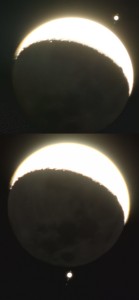
Image of the day

Captured by
John Greenlee

Before and after

My Account

New to Astromart?

Register an account...

Need Help?

Posts Made By: Mike Alexander

April 10, 2007 01:39 AM Forum: Deep Sky Observing

Do any of these improve night vision?

Posted By Mike Alexander

Does melatonin, beta-carotene and/or zinc improve night vision for DSO's???


Enjoy the night.......Mike

April 17, 2007 03:17 PM Forum: Deep Sky Observing

Field of view for averted vision

Posted By Mike Alexander

In street language - simple percent of actual field of view, not exit pupil- how much field of view should I allow for averted vision of details in galaxies?

For example, M51 has dimensions of 11.2 by 6.9 arc minutes.

Should I allow a field of view of eg 15, 20 25 or more arc minutes?

Enjoy the day........Mike

April 24, 2007 01:57 PM Forum: Deep Sky Observing

Galaxy filters: intensity of emission/adsorption

Posted By Mike Alexander

With regards to the latest series of posts entitled "What is the latest word on galaxy filters?", speaking as a chemist with nearly 40 years experience - much of it related to spectroscopy - it is a know fact that ANY object - be it a galaxy or a street light, for example, CAN and DOES emit light at different intensities at different wavelength of both the visible and UV spectra.

In similar fashion, ANY filter CAN and DOES absorb different amounts of light at any given wavelength,(nm).

IMHO, to say that no filter will improve the visibility of galaxies ignores the above laws of physics.

Furthermore, although all galaxies visually appear white - due to our insensitivity to color in the dark - there are hundreds of Hubble telescope pictures which show that galaxies are not only colored, but multi-colored with different intensities of colors.

At the same time, to say that any one filter works best at suppressing light pollution and sky glow from all areas of the world ignores the facts that: 1. Viewing sights differ in both the color and intensity of light pollution and sky glow. 2. Atmospheric moisture and pollutant chemical and levels can and do change on a daily basis for any location and these pollutants can and do absorb more light at different wavelengths. 3. All of this can change in intensity from one night to the next - for the exact same location.

We don't make the laws of physics, but I think we would be wise to heed by them.


Clear skies.........Mike


May 26, 2007 09:21 PM Forum: Solar System Observing

TMB 9 mm planetary or UO 9 mm HD

Posted By Mike Alexander

Trying to get a consensus here:

In your opinion, which EO would be beter for planetary viewing with a 12 inch LX90, (f/10)?


Clear skies........Mike

June 4, 2007 10:30 AM Forum: Deep Sky Observing

Declination and Galaxy details?

Posted By Mike Alexander

I know that dark skies and surface brightness are necessary for seeing details in galaxies, but just how important is declination?


Thanks........Mike

August 11, 2007 03:01 PM Forum: Deep Sky Observing

Astigmatism and galaxy details

Posted By Mike Alexander

I am trying to get a consensus of opinions on this question: would an astigmatism value of + 1.00 have an effect on seeing details in galaxies?


Cealr skies.........Mike

August 17, 2007 06:22 AM Forum: Deep Sky Observing

Confused about declination

Posted By Mike Alexander

The books say that M81 and M82 have declinations of 69 degrees and that M51 has a declination of 47 degrees.

Yet when I look in the night sky these days the Big Dipper is angled such that M51 is actually higher above the horizon than either M81 or M82.

I thought that the greater the delination, the higher a galaxy will be above the horizon? Please clarify.

Thanks........Mike

August 24, 2007 02:12 PM Forum: Eyepieces

University Optic 1.25 inch 80 degree ocular

Posted By Mike Alexander

Has anyone used the 1.25 inch University Optics 80 degree ocular, and, if so, what are your thoughts on it, particularly its performance with galaxies and other DSO's?

Thanks.......Mike

August 25, 2007 12:02 AM Forum: Solar System Observing

Culmination dates for planets

Posted By Mike Alexander

Is there a source or link where I get get the culmination dates for the various planets? I live in CT at 41 degrees latitude - if that matters


Thanks........Mike

August 25, 2007 12:05 AM Forum: Deep Sky Observing

Surface brightness values of nebulas

Posted By Mike Alexander

The surface brightness values for galaxies, though varied at times, can be obtained from several resources.

Why hasn't anyone compiled data on the surface brightness of nebulas?.........yet


Thanks.......Mike
