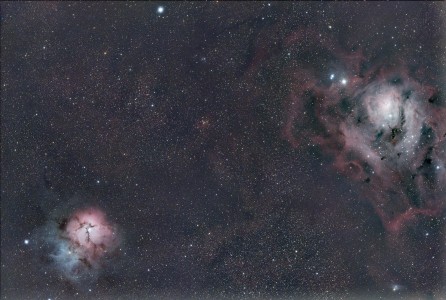
Image of the day

Captured by
Michael Scherman

Lagoon and Triffid Celestron C6 Hyperstar4

My Account

New to Astromart?

Register an account...

Need Help?

Posts Made By: Lonnie Puterbaugh

January 6, 2003 02:57 AM Forum: Equipment Talk

Laser Vision Correction & Astronomy

Posted By Lonnie Puterbaugh

Try searching the archives. This has been discussed several times in the observing forum.

--Lonnie

January 17, 2003 09:42 PM Forum: Equipment Talk

Radio Astronomy

Posted By Lonnie Puterbaugh

Chris,

While the standard AM broadcast band may be possible, higher frequencies will work much better due to lower noise levels and interference. I believe the best range is in the 18Mhz-30Mhz range of a short wave receiver with decent sensitivity. You'll need something much better than a standard ferrite rod or short whip antenna also. Try searching "Radio Jove" for more info. The radio Jove receiver works close to the 20.0Mhz time standard frequency in Boulder, CO.

I have a Sun/Jupiter setup using my amateur radio gear, but I haven't tried it out yet. Another place to search, if you're really interested in radio astronomy, is SARA. It's the Society of Amateur Radio Astronomers.

--Lonnie, WD8MCY


March 12, 2003 12:37 AM Forum: CCD Imaging and Processing/Solar System

Messier Marathon

Posted By Lonnie Puterbaugh

This is good, especially considering that the objects are in color. I know this may sound strange to most of you guys, but I image this many DSO objects easily (in monochrome) on a normal night of about 3 hours using video technology. If I get a good clear night this year at the end of the month, I am planning on breaking the 100-count Messier barrier in one night using only video technology. I have webcams, video, film, and an integrated ccd at my disposal to apply to this task and I just can't think of a better tool to apply than video. I'll let you know of the outcome. The following image is about 2 1/2 minutes of video in a 4" scope at f5. I will be using a C11 at f3 for the marathon this year just so I can get some pretty good images. I would like to try an 80mm short-tube at f3. I know it is capable of this task. I hope to try that next year. Video works well because the image is "live" on your monitor and it's easy to center the image quickly.

--Lonnie

March 18, 2003 05:43 PM Forum: Coronado-Lunt-DayStar Solar Filters

Massive filament (H-a image)

Posted By Lonnie Puterbaugh

Paul,

I take it that each of your excellent images is actually two separate images that are layered. Are you taking one image for the prominences and one for the disk surface detail and adding them with Photoshop? I don't believe this amount of detail can be gotten in one image, but my H-alpha scope has not arrived yet to try it. I know you are using digital cameras. I have several video and webcams to try as well as an integrated ccd camera. I believe the webcam may do the best job, but the chip is probably too small for a full disk shot. I can easily get the full disk on my grayscale Stellacam or my HX-916 and then color the shot myself. I'm just seeking some advice in advance.

Thanks,

Lonnie

March 29, 2003 03:25 PM Forum: CCD Imaging and Processing/Solar System

Video Imaging-- Getting Started

Posted By Lonnie Puterbaugh

Ed,

I have been using a Stellacam EX for over a year now. I have even imaged Jupiter's moons in daylight with it!

I find that switching the AGC to manual and setting it at about half of maximum (to start) helps. I also switch the ELC to ALC and adjust the shutter manually. For Jupiter, I might use somewhere around 1/250 second. I am unsure of the exact settings, but start here and adjust the shutter to where Jupiter looks best, then go back to the manual gain for fine adjustment. You might also try the electronic zoom feature at about 2/3 to 3/4 of maximum to help during the adjustments and focus. Make sure to have the sense up turned off for solar system work.

I currently own (6) cameras, three of which are video. I also own an astronomical ccd camera. I find that the Stellacam EX is the most useful astronomy device I own. It's actually worth more than my Tak-106 or any of my OTA's in what it can do. You ought to see it with just a 9 volt battery and a 12mm c-mount f1.0 lense attached! I can take video at star parties with no lights. I do an immense amount of public outreach and these cameras are incredible in that role.

I don't know if you live anywhere near Nashville, TN, but if you do, consider attending the Astronomical League convention in July. I will be speaking and conducting a workshop there on the topic of "Video Astronomy -- Observing & Imaging".

Video Astronomy is still in it's infancy, but nearly everyone will be doing it within ten years. I've rarely used any of my Nagler eyepieces or my 16" scope, since I discovered the Stellacam. I've been quoted in Sky & Telescope as saying that, "I can see nearly as much in my 4" scope with the Stellacam as I can see in my 16" with an eyepiece". I've seen the Horsehead Nebula using an 80mm Orion short-tube and an f3 reducer in my mag 4 driveway. I've also seen the central star in M57 in my 4" scope under the same conditions.

Keep playing. I think that you'll become another video camera ambassador if you do.

Lonnie (aka Captain Video)

January 18, 2004 02:12 PM Forum: CCD Imaging and Processing/Solar System

straight wall

Posted By Lonnie Puterbaugh

Thanks Paul, Ivan, and Jim. I will try the grey scale trick and take a look at the results. There's some excellent images being posted here by many people (including yourselves) and I wanted some advice on improving my results. I am also going to try going to f25 soon. I know that I can get better resolution at that sampling, but I have to get my EQ platform aligned really well to keep the image on the 4mm chip.

--Lonnie

May 19, 2004 04:44 PM Forum: Deep Sky Observing
