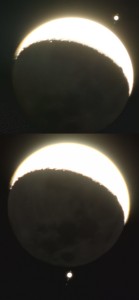
Image of the day

Captured by
John Greenlee

Before and after

My Account

New to Astromart?

Register an account...

Need Help?

Posts Made By: Darren Crooks

September 5, 2003 03:06 PM Forum: Deep Sky Observing

The Last ErieView StarParty?

Posted By Darren Crooks

Observing Report 08/31/03
Equipment: Heep ('umble 4.5" DS Newtonian on EQ mount, 900mm, f/8), 16x50 bino's
Eyepieces: 20mm, 10mm, 6.7mm Meade Plossls
Location: Port Stanley, Ont. (approx. 43n, 81w)
Time: 2300 - 0630 UT
=============================================================

The occasion was the annual Erieview Star Party. Frankly, it's not much of a party - it's open to members of the York Simcoe Amateur Astronomers, and a few friends and neighbours of the host, Scott, who is also president of the YSAA. There were four telescopes, including my own. Scott has his 8" Meade SCT, Glen (another member) set up his 8" f/6 dob, and Trevor (yet another member) has a Celestron (I think) 4" GOTO. Various neighbours arrived with their lawn chairs, waiting for a view of "the Mars Show".

As the sun set and the twilight began to deepen, we tuned up on the slim crescent moon, about four days old, slowly retreating towards the horizon. I still enjoy looking at the moon -- as long as it's fairly new and sets early.

We all watched Mars rise like a bright red beacon in the southwest over the cornfields, and the assembled guests were eager for a view. Scott obliged, but I waited until it was well above the horizon. By 0300, it was an amazing sight. Several features were very prominent, such as Sinus Sabaeus, Sinus Meridiani, Mare Erythraeum, and Hellas. There was a slight breeze off the lake which caused Heep some distress, but not much.

High thin cirrus cloud slowly advanced on us from the west, but it wasn't much of a problem until later on. The skies at this location are spectacular, the darkest I've seen. I was able to make out much detail in M8, even at this late date, due to a completely unobstructed southern horizon. M22 (my favourite glob) was breathtaking at 90X, even more so at 135X, with perhaps three dozen stars resolved. I got a terrific view of M25 as well, which is a beautiful object at low power.

We took a break at around midnight local time for coffee and a bite, and most of the neighbours drifted off by that point, having ooh-ed and aah-ed sufficiently at the moon and Mars. Trevor packed it in, because his GOTO wouldn't. Apparently he has intermittent difficulty with this computer.

It was time for some serious observing. The Ring was very sharp, and somewhat egg-shaped, at 135X, with the ring structure quite evident. M11 (maybe my favourite open cluster) was strewn with brilliant gems at 90X. I am always floored by the beauty of this cluster from a dark site. At that point, Scott tapped me on the shoulder. A huge, bright, fireball was plummeting from Perseus to the northern horizon. It was a vivid green and bright like a firework. What a spectacle.

(To be continued)

September 10, 2003 08:19 PM Forum: Solar System Observing

Colour in Mars?

Posted By Darren Crooks

Hey guys, quick question:

In general, what size scope do you need to be able to see colour in the features on Mars? I usually get maybe three or four different hues: Bright white for the SPC, dark brown/gray for the darker features, and something approximating peach or salmon pink for the rest. But last night I was watching Syrtis Major appearing 'round the preceding limb, and I noticed a decidedly turquoise cast to it, although it was admittedly faint. I'm using Heep (my 'umble department store 4.5" f/8 Newtonian). Is such a thing possible? Or was I imagining it?

Clear nights ... dark sites,
Darren

October 10, 2003 05:16 PM Forum: Solar System Observing

Mars 10/09/03

Posted By Darren Crooks

Mars Observing Report 10/09/03
Equipment: Heep ('umble 4.5" DS Newtonian on EQ mount, 900mm, f/8)
Eyepieces: 20mm, 10mm, 6.7mm Meade Plossls
Location: Newmarket, Ont. 44 degrees N, 79 degrees W

The conditions were ideal for viewing Mars last night. A skiff of thin, high cloud covered the sky, which improves the iamge of Mars. Albedo features are much clearer when Mars is filtered by a bit of cloud. It lessens the glare of the planet, so detail is not washed out. Several features were visible in Heep, such as Sinus Sabaeus, Sinus Meridiani, Syrtis Major, and Hellas. But the image began to break down and turn to mush by around 0230 UT (10:30 PM local).

I find it interesting that the same phenomenon took place on Tuesday evening, Oct. 7. The image of Mars was clear and steady until about 0230 UT, then turned into a blurry soup. Is this just a coincidence? Or as the object travels west, is it passing through an unstable air mass or jet stream or something? Because it happened at exactly the same time and exactly the same spot.

Sigh. After three solid weeks of rain and cloud, we finally get beautiful weather and pristine skies in southern Ontario... just in time for a full moon bright enough to read by.

This Sunday, I'm bringing my telescope up to my parents' for Thanksgiving, to give the family a peek at some sights... Guess what the forecast is? Just guess! Oh well. Que sera, sera.

Clear nights ... dark sites,
Darren

October 29, 2003 04:37 AM Forum: Deep Sky Observing

Messiers in Winter ...

Posted By Darren Crooks

Observing Report 10/27/03
Equipment: Heep ('umble 4.5" DS Newtonian on EQ mount, 900mm, f/8)
Eyepeices: 20mm, 10mm, 6.7mm Meade Plossls
Location: Newmarket, Ont. (approx. 44n, 79w)
Time: 0230 - 0730 UT
=======================================================

Night after night, the story is the same. I venture outside, searching for any token that the clouds will part and clear skies prevail. Every night I am disappointed. Two weeks since the last half-decent night, and that was a day after the full moon. Over three weeks since viewing anything other than the moon and Mars was possible. No sign of letup in the pervasive gloom. The forecast? Unremitting rain. I breathe a deep sigh, resign myself to my fate, and trudge back indoors.

Last night I peer out of my front window. What's this? Mars? A break in the clouds? Will it metamorphose into a sucker hole big enough to set my scope up for even an hour of observing? Yes. Clouds dissipate, skies slowly clear from horizon to horizon. I hurl the garage door open and rouse Heep from its slumber, and set up outside on my light-bathed driveway. Auriga rising in the east, but not quite high enough yet. It's about 8:30 PM local (0130 UT). Head back inside for an hour of sitcom inanity.

Return at 0230. Capella high in the eastern sky. Tonight is the night to find the Messiers in Auriga. My first target is M37, just below the easternmost side of the lopsided pentagon formed by Auriga's brightest stars. M37 is an oval patch of grainy light with the 20mm (45x), with perhaps a dozen stars clearly resolved. With the 10mm, the image is resolved into dozens of beautiful, close set gems on a black velvet-clothed bosom.

Next target is M36. Larger and looser than M37, with perhaps two dozen stars resolved at 45x. No faint glow present, so I decide that dropping in a larger EP would not reveal significantly more detail. Somewhat rectangular in shape, with a very close double near the center.

Last, find M38 very close to M36, about 2 FOV's northwest of M36. Largest of the three. Stars are not as bright or crisply defined as M36, but there are many more of them, accompanied by a background haze. The brightest stars form two lines that cross each other at nearly right angles to form a ragged "X" shape at 45x. The 10mm (90x) resolves few of additional stars in the background haze. From a dark site, this must be a beautiful object.

I see Saturn and Castor through the branches of my neighbour's trees, and further south, Orion struggling to free himself from the muck on the horizon. Dew having started to form on Heep, I return it to the garage and head indoors to await Orion's and Gemini's ascent.

After about 90 minutes, I head back out, like a photographer for the Enquirer, to track the stars. Orion is high in the southeast, but still reclining somewhat, while Gemini is much higher in the east, and the Pleiades almost at the zenith.
(To be continued)

October 29, 2003 04:40 AM Forum: Deep Sky Observing

...and the Luminous Rose

Posted By Darren Crooks

It's time for M42 ... the first time since late last winter, and the first time with decent EP's. I get the belt in the finder, and slowly ratchet my way over to the hazy blob in the middle of the sword, and peer into the eyepeice.

Oh ... My ... GOD.

I was completely unprepared for the view I got. I had seen M42 only once before in this scope, and it was using the horrid eyepeices that came with the scope, so it wasn't terribly impressive. But the excellent seeing, coupled with superior eyepeices made this far and away the most beautiful DSO I'd ever seen, in any scope, any time. Even at 45x, four trapezium stars were visible in a bright (and I mean bright) cloud of gas that looked like a bent rectangle with a bite taken out of the side. Tendrils of luminous gas blossomed outward from this glowing cloud like the delicate petals of an ethereal rose. M43 appeared as a bright haze around a fairly bright star near M42.

At 90x, I can see a couple of faint stars near the trapezium, and three more just ouside the nucleus of the nebula. The image almost fills the eyepeice, and there is a suggestion of yet another layer of fainter luminescence surrounding the rose that extends beyond the eyepeice. At 135x, the image has diminished not in the slightest, and I detect much detail along the edges of the nebula, and the dark dust cloud that separates it from M43 and forms the "bite" in the rectangle, has a distict, substantial shape, not just a dark patch of space.

Each time I peer into the EP, more detail becomes visible. Subtle ectoplasmic eddies swirl sinuously through the nucleus. I gaze for a few moments each time, then step back and shake my head. I am reeling, punch drunk, like an aging boxer who keeps going back to the well. And I keep going back to my dark well, to gaze, awestruck, one last time.

I turn my attention to Saturn and Gemini, and realize that I should have ended with M42, not started with it. Even my first good view of Saturn since the spring is a denouement. Saturn is quite pretty, the Cassini division clearly visible, as well as (another first!) the inner C ring, visible againt the planet's surface. A light surface band is apparent near the equator, as well as a darker south polar region. Two moons at least are visible, that line up roughly with the planet, and perhaps a third, forming a right triangle with the other two and Saturn in the midst of them.

I swing over to M35, my last stop on my ghostly journey. I am able to get it in my finder, and drop in the 20mm. What a gorgeous cluster, filling the eyepeice with a trove of dazzling jewels. Unfortunately, I am unable to locate its dimmer companion, NGC 2158.

Wanting to end the evening on a high note, I return to M42. It's stunning. It's like Seinfeld describing the Soup Nazi's broths to Elaine: "You can't eat it standing up. Your knees give out."

This punch-drunk fighter is knocked senseless by a luminous rose.

Clear nights ... dark sites,
Darren

November 21, 2003 08:12 PM Forum: Equipment Talk

Lousy Seeing ... Or bad collimation?

Posted By Darren Crooks

This isn't really an observing report ... more of a question. Last night (Thu. Nov 20) was the first clear night in southern Ontario since the lunar eclipse. I had my scope out to cool at about 0230 UT (9:30 local). Started observing at 0330. I noticed that stars were not coming to focus. Couldn't split Castor cleanly at 135x. Nor could I make out the Cassini division, which is usually very sharp at 90x. Wealth of detail visible in M42 (beautiful!) and even a hint of dark greenish-turquoise, but Trapezium was not sharp (one of the eclipsing binaries was also in mid eclipse, it being much dimmer than the other three). At 45x, stars did not come to pinpoint, no Airy disk. In fact, they looked rather like slightly elongated diamonds than pinpoints with diffraction spikes (which is what they usually look like).

So my question is this: Was this really awful seeing? Even M42 and Castor were boiling away. Or bad collimation? I had the scope out a week ago for a quick peek at Saturn, and it was fine then. Can a scope lose collimation that quickly? I hope it's the former rather than the latter, because my club is having its monthly observing session tonight. This scope has held collimation for a year. This is the absolute worst time it could have picked to go out on me, because I don't know the first thing about collimationg a scope. BTW, it's a classical long-focus Newtonian, 4.5" spherical mirror at f/8.

Interestingly enough, there was a beautiful aurora display that reached almost to Orion last night. About the same time (0500), the images in my scope began to improve somewhat. Saw a really nice fireball just before I packed it in. A portent of improvement in conditions perhaps? One can only hope ...

BTW, I'm in southern Ontario. So if anyone was observing last night in the neighbourhood, could you comment on how you found the conditions? I would appreciate it.

Clear nights ... dark sites,
Darren

November 25, 2003 10:24 PM Forum: Deep Sky Observing

Observing Log 11/21/03 - Part 2

Posted By Darren Crooks

Observing Report 11/21/03 (cont'd)

Spent much of the evening being struck dumb by M42, which from a dark site is beyond description. (So much so that I forgot to check out M36 and M38.) It nearly filled the EP at 90x, and the hints of colour that had mere suggestions before were clearly discernable, a greenish-turquoise at the centre and a deeper blue along the edges. M42 was particularly stunning using a friend's Meade 6.7 UWA ... it was like looking out a porthole in a spaceship. I could literally get the entire sword in the EP. I gotta get me one of these!

Later in the evening, I used a buddy's 32mm to hit the Pleiades, always a beautiful sight. (Gotta get me one of these, too!) Used the same EP to good effect on M35, which is another of my favourite clusters. But I still couldn't locate NGC2158, its small companion. Had made plans to view the Clown Face nebula in Gemini ... It's supposed to be the brightest planetary out there ... but forgot. The clouds began to roll in again by 0600, so I didn't get more than three hours at the eyepiece. I might have remembered if I'd stayed up longer.

Later in the evening, I wanted to check out M33, but again, couldn't locate it. But I did locate the cluster Messier forgot: NGC 752. What a gem in a low-power EP. Dozens of stars resolved. Easily the equal of M35. By this time Sirius was high in the southeast, so I made an attempt at M41, which I had tried to find last winter from my front yard, but couldn't. This time I just pointed the scope about 5 degrees due south of Sirius, and there it was ... quite a bright cluster, showing about three dozen fairly bright stars in a loose configuration.

But the highlight of the evening was M1. Had tried to find it last April; no luck. This time I used the method suggested in Turn Left; lined up Zeta Tauri at the top right corner of the finder, and it was sitting in the middle of the EP, an elongated, shapeless glow. Not much to look at, but so far, the only supernova remnant I've seen.

Now, I just hope it doesn't take a year to find M2 ... smile

November 25, 2003 10:26 PM Forum: Deep Sky Observing

Observing Log 11/21/03 - Part 1

Posted By Darren Crooks

Observing Report 11/21/03
Equipment: Heep ('umble 4.5" DS Newtonian on EQ mount, 900mm, f/8)
Eyepieces: 20mm, 10mm, 6.7mm Meade Plossls
Location: Goodwood, Ont. (approx. 44n, 79w)
Time: 0230 - 0730 UT
=======================================================

The York Simcoe Amateur Astronomers observing session was at a farm owned by one of the members. There were seven of us altogether, although there were only five scopes. Two were Meade 8" SCT's on fork mounts, one a Megrez-80 on a simple camera tripod, an 8" Orion dob, and 'umble Heep. A new member, also was on hand with his 10x50 bino's. He had wisely decided to defer the purchase of a scope until after having done some comparative observing.

My planned target list included some pretty obscure and challenging objects, at least for a 4.5" scope: I wanted to get NGC 7331 before Pegasus disappeared for the year; also M74 and M77, both of which, I've heard, are pretty faint. Also wanted to try for M76. M74 and M77 are getting close to the western horizon by 9:00 PM local (0200 UT), and M76 is pretty near the zenith by that time. I have trouble viewing near the zenith, it gets difficult to point the scope.

So much for plans: intermittent high clouds hampered the viewing; was forced to view between the holes. Besides, by the time I got there, Pisces and Cetus were already speeding towards the western horizon, and the clouds didn't clear out until 0400 or so.

So most of my targets were in the south and east this night. I wasn't complaining; there are so many beautiful objects in winter. I started with M37 in Auriga. What a gorgeous sight from a dark location! I had seen it from my light-strewn front yard, but it look like little more than a smudge. Here, I was able to discern at least two dozen stars in a hazy background; almost like a miniature M11.

Saturn was my next stop ... I showed it to Jamie (the new member), who had never seen it in a scope before. You can guess his reaction. If your first view of Saturn doesn't blow you away, check your pulse.

(cont'd)

December 19, 2003 10:33 PM Forum: Solar System Observing

Sucker Hole!

Posted By Darren Crooks

Observing Report 11/26/03
Equipment: Heep ('umble 4.5" DS Newtonian on EQ mount, 900mm, f/8)
Eyepeices: 20mm, 10mm, 6.7mm Meade Plossls, 2x Orion Shorty Barlow
Location: Newmarket, Ont. (approx. 44n, 79w)
Time: 0300 - 0400 UT
=======================================================

Thank God, a sucker hole! After literally weeks of cloud, Sunny Southern Ontario was treated to a night of ... well, more cloud, but interspersed with brief spells of clear skies. Just to put this in perspective, here we have had six clear nights since Thanksgiving. Count 'em six. And BTW, for those of you from America, our Thanksgiving took place on Oct. 13. And three of those nights were under a gibbous, nearly full moon. So I've been suffering through a dry spell of epic proportions.

So, last night at around 0300 UT (10:00 PM local), I look up from my kitchen window, where I was allegedly preparing to make shortbread, and I see Saturn, Castor, and Pollux. Yes, to my astonishment, the clouds have parted. A perfect opportunity to test my latest toy: an Orion Shorty barlow I purchased from Astromart. Actually, I had purchased it about two weeks ago, but never had the opportunity to use it, considering the weather coditions.

So I raced outside and set up Heep, dropped in the 20mm EP (45x), and took a look. The image was still a little wobbly, but the scope was already pretty cool because I keep it in my garage. Seeing was excellent, because within 15 minutes, the view was razor sharp. Cassini Division, plus a couple of surface bands, were visible in the 10mm EP, as well as at least three moons.

I then dropped the 10mm into the Barlow, for a screaming 180x view. Wow. The image dimmed a little, but the planet is so bright to begin with that I didn't lose any detail, in fact the south polar region showed a distinct colour difference between the very center of the cap and the outside fringe; and I got a faint view of the inner "C" ring just at the ansae. I don't think I've seen Saturn as sharp in my life.

I moved on to M42, which was very bright in the 20mm, a bright cloud around the Trapezium, and delicate swweps of cloud extending into space. But as always, the best view was with the 90mm. The image filled the eyepeice and showed a wealth of detail. Again, I bumped up the magnification to 180x using the Barlow, in an attempt to see the E and F stars of the Trap, but couldn't find them.

I wanted to wander back to Gemini, to try nail down NGC 2158, M35's ghostly and distant companion, but by that time clouds had moved in again, and stayed for the duration. Total viewing time: 50 minutes. It wasn't much, but I got my fix. Judging by the weather recently, it may have to last me a while.

Clear nights ... dark sites,
Darren

January 14, 2004 03:00 PM Forum: Pictures of Me and My Telescope and........

Me and Heep

Posted By Darren Crooks

Yup, that's Heep, looking so very 'umble. His vital stats are: 114mm aperture, 900 mm focal length, f/7.9. Note rickety EQ1 mount.Heep comes from a rather dubious lineage, being 1) bought in December 2) from Walmart and 3) made by Bushnell. In spite of all this, he and I have seen dozens of breathtaking sights. My next project is to give him a proper mount. (Maybe an EQ3?)

Clear nights ... dark sites,
Darren
