Image of the day

Captured by
Michael Scherman

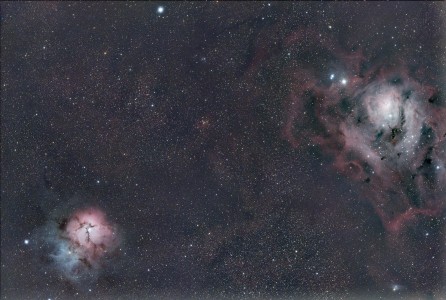
Lagoon and Triffid Celestron C6 Hyperstar4

My Account

New to Astromart?

Register an account...

Need Help?

Posts Made By: Bruce Housey

November 17, 2003 07:08 PM Forum: Solar System Observing

What's going on in Hellas?

Posted By Bruce Housey

Has anyone noticed a bright area in the northern part of Hellas lately? For the first time in a week or so I observed Mars last friday night, and Hellas appeared very bright. The picture I took shows a brightening in the northern portion (although it's hard to tell as the image scale is small because I accidentally had my focal reducer in place).

Frost? Dust? It would be nice to see a dust storm develop now that we've all got our detailed surface viewing in!

Bruce.

December 28, 2003 02:15 AM Forum: Solar System Observing

Io transit this morning

Posted By Bruce Housey

I had a really nice morning with Jupiter today, excellent seeing and comfortable temperature (about 40 degrees with no breeze). I'm determined to see Io visually crossing the planet... although I caught it in the attached picture, it was still elusive visually. Great to have Jupiter back, though!

January 2, 2004 01:45 AM Forum: Solar System Observing

A whole day on Jupiter

Posted By Bruce Housey

I got a little carried away yesterday morning and got over 5 hours of Jupiter pictures. Someone on the "surface" of Jupiter near the GRS would be in darkness at the first frame, see the sun high in the sky during the later frames, and see a sunset at the last frame.

Bruce.

ps: identical processing was done on all pictures... the low quality of the first frames is due to Jupiter's low altitude at that time.

pps: these pictures do not represent a complete rotation, just sunrise to sunset for the GRS, or just the "day" (not night).

August 1, 2005 08:26 PM Forum: Solar System Observing

Mars this morning (Aug 1)

Posted By Bruce Housey

Although I had my watch set for 3:30, I happened to wake up around 3:00 and stepped outside. Although the sky was milky, I could see Mars and some brighter stars and so set up for some morning observing.

I recently purchased a Celestron Advanced Series GOTO mount with the new metal legs in an attempt to lighten the early morning setup effort from my 40 pound Losmandy GM8 to this 30 pound mount. Yesterday, I decided the next time I would try the GOTO mount on the aluminum legs from my 5-year-old Celestron CG5 mount. Pulling out the 15 pound mount was fantastic at 3am, but the resulting views were shaky. Although surprisingly passable for visual use, I was unable to move around at all when the webcam was in place without making the image jump all over the screen. Even the dog in her area about 30 feet away frequently made the image bounce around. I'm still undecided whether the much lighter load is worth the occasional annoyance.

Anyway, while I was setting up, I heard thunder in the north from over the lake, so I realized my session might get cut short and that I might best spend the time getting a quick picture. With only a brief peek at Mars before the camera went in, I went straight to taking two 2-minute movies, and then one infrared-only image. This is my first attempt at trying IR on Mars, and if it came out well I may use it for the luminance channel (p.s. it turned out to be of no use).

After the webcam was set up, I took to viewing with the binoviewer and magnifications between 200 and 400, with 200 being way too small and bright, 300 the best, and 400 being pretty good. The whole southern hemisphere was notably darker, with mottling in which I had difficulty finding a pattern. The best I could do after a half hour was to detect two darker areas within it, and also possibly one isolated dark area on the north side.

With a CM from 100 to 110 during my viewing time, Solis Lacus was apparently near the terminator, although I could not make out any darker concentration there visually. The dark diagonal zone near the limb is Mare Sirenum, with Chrysokeras hugging the polar cap. I cannot identify the isolated dark area I perceived in the north. Perhaps it was a combination of shadows from one or more of the Tharsis volcanoes, or just a relative darkening between possible clouds over them.

After processing the movies, the resulting picture clearly shows Solis Lacus and additional surrounding detail. If only I could train my eyes to do this level of detail extraction! Also shown in the photo are some dark spots in the Tharsis area... volcano shadows?

August 11, 2005 02:02 AM Forum: Solar System Observing

Mars this morning - Aug 10

Posted By Bruce Housey

I was having a difficult time sleeping last night and went out around 2:00, earlier than ideal for Mars but I figured it would be high enough. While setting up, I realized that it was still REALLY HOT outside for being so late. Also, the sky was very murky; for example, only three of the stars in Cassiopeia's "M" shape were visible! Still, I've had really good planetary views under such conditions and so I continued setting up.

As usual, I set up the camera first to get the picture taken care of so I would be able to relax with the view after. The first view on the computer screen was discouraging, as the resulting picture here demonstrates. That's too bad, because Sinus Sabaeus and Meridiani are potentially rather photogenic.

The good news was that the visual impression was at least as good as that seen by the camera, which is hardly ever the case. The north polar hood's blue cast was obvious, the outline of the south polar cap was clearly delineated, the limb brightening clearly yellow, and Mare Erythraeum showed a notably darker area near it's center. I started with 14mm Plossls in the binoviewer (about 270x) and moved up to 11mm Plossls (about 360x). Knowing that Sabaeus was crossing my view, I tried really hard to detect it visually but to no avail.

By 4:00, I was sufficiently wet with sweat and ready to try getting some sleep, and so packed up. With visions of Mars in my head, I ended up being awake until 5:00, making work today more than a little challenging!

August 13, 2005 03:00 PM Forum: Solar System Observing

Mars this morning, August 10th - Altitude Matters!

Posted By Bruce Housey

Altitude, Aperture, and Atmosphere... I increased all three relative to my last view days ago and WOW! The details:

I happened to roll over and see the clock this morning at 4:10; I walked to the glass door but couldn't see outside because it was fogged up (must be humid!) and so took a step outside to see Mars HIGH overhead. After my poor viewing a couple of days ago, I was anxious to get a better view of this side of Mars, and I had already put my 9.25" SCT in the tool shed yesterday evening to be ready for use. I was dressed and had the SCT mounted on the driven CG5 on steel tripod by 4:30 (not bad for having been in bed at 4:10!). After using my 8" f/5 reflector a lot recently, I noticed during setup how pleasant an SCT can be with it's smaller tube mounted HIGHER which leads to less bending for balancing and alignment.

Not being used to photographing with the SCT, indeed being my first Mars photograph with this particular SCT ever, I took three photographs instead of my usual one: 1/5 second exposures at 5 frames per second, 1/10s at 10fps, and 1/25s at 15fps. Even with the extra exposures, I was completely done with the photographing and had the computer packed up again by 4:50. Already I was really excited since the view on the screen was SOOOOO much nicer than my view 3 days ago, which had Mars about 20 degrees lower in a much murkier sky.

While the computer was doing it's thing, I got to spend some time staring at the sky since the Perseids are peaking today. I did get to see one bright meteor streaking down toward the Eastern horizon, not bad I guess for my light-polluted yard. This was the only one observed during my cumulative skygazing of maybe 3 minutes.

I immediately went to putting in the binoviewer which I yesterday reconfigured for 2x use instead of the 4x configuration I had been using for the f/5 Newt. This is really convenient since I get similar power with the same eyepieces in both scopes since both systems effectively run at f/20 (f/5 x 4, or f/10 x 2). The 11mm Plossls were too much power at 440x, but the 15mm's seemed just right at 320x.

My first impression was shock and amazement: Sinus Sabaeus just popped out so clear and immediate I thought it was my imagination. It was clearly separated from the Erythraeum/Margaritifer area, and even more surprising was that dark Oxus extension coming down from Margaritifer. Niliacus Lacus also showed up nicely next to the blue north polar hood. All this from a still very small disk since opposition's still 3 months away! During sketching I did also notice some more mottling at the Chryse edge of Margaritifer Sinus, while continuing to be surprised whenever Oxus popped clearly into view again. Niliacus Lacus continued to be surprisingly muted; possibly the NPH extended further than it's obvious portion to where it slightly obscured features further out.

A couple more closing comments about the SCT, since it was it's first planetary use for a while: the viewing position is really noticably more comfortable than with the Newt, but the mushy focusing is aesthetically distateful although it does not detract from the final view. Also, I was disturbed when unmounting the SCT at 5:10 that it was badly dewed up, to the point where some larger drops were starting to form; I have NEVER seen dew on my Newt's primary or secondary! This would have caused me to have to put on the dew control strips if I had planned on observing longer, but this time caused me no problem since I took it inside the cooler house immediately and left the cover off so the dew could dry (which it did within minutes). But I'll cut it some slack this time since it was really damp tonight, which I had noticed by the fog on the window before even going out!

October 8, 2005 01:46 PM Forum: Solar System Observing

Mars Oct 1 - Back after Katrina

Posted By Bruce Housey

Hurricane Katrina damaged much of New Orleans, forcing me to be evacuated for two weeks and then having to remain away because no schools were open until a month later. Basically all of September was lost.

I got back out on the morning of October 1st to see my favorite area of Mars, Mare Cimmerium. I was surprised how much the south polar cap had shrunk, indeed being challenging to even locate. Mare Cimmerium was noticably distinct from Mare Tyrrhenum, with Syrtis Major along the preceeding limb appearing of similar darkness as Tyrrhenum. Hellas was large and bright, trying to act like it was the SPC! With the SPC so small, Mare Australe is clearly seen left of (preceeding) Hellas, and even Palinuri Fretum stood out clearly.

The north side is sporting a bright polar hood. For some reason it seems less obvious to me than it did a month ago, possibly because Mars is larger and brighter now. Still one isolated dark area stood out, which I believe is Nodus Alcyonus (the precision of my drawing leaves something to be desired!).

October 26, 2005 12:03 AM Forum: Solar System Observing

Mars Dust Storm Update - Oct 25th

Posted By Bruce Housey

Being windy all day, I figured the SCT would fare better than my 4-foot-long Newt tonight and got it set up before sunset. It just sat there until almost midnight when Mars was high enough up for a good observation. I first took my usual quick picture, then sat down and got my own look.

I was once again disoriented by the dust changing the features; on top of this I'm not used to the mirror-image view from using a diagonal, but Sinus Sabaeus and Meridiani made reorienting pretty painless. Ok, there's Syrtis Major on one limb, and the tiny white South Polar Cap at the top. Wow, the North Polar Hood is really spreading out, and turning a little whiter at the same time, the color now resembling that of a blue star, more white with a bluish intensity to it.

I was expecting that the dust storm would be off the limb at this time, but was surprised to see a large, very bright, yellow area on the southern hemisphere near the limb. It's size didn't dawn on me until sketching it... probably about the same size as the NPH! In fact, looking back and forth between the two really brought out the contrast of the bright yellow and bright blue of the respective clouds.

The windy night made for poor seeing, with fine detail only being visible on a couple of occasions over an hour of viewing. Still this was an exciting and worthwhile session very much due to the fast-changing dust storm and North Polar Hood. The wind got tiring by 1:30, and I went to bed.

September 20, 2002 12:05 AM Forum: Equipment Talk

Vixen GP-DX or Losmandy GM-8

Posted By Bruce Housey

Paul and Jim:

Well, after reading even moooooorrre all over the web, considering what the two of you have said, and thinking really good about what I want, I just returned the GPDX and ordered a GM8. The reasons for my change of mind are:

- I have read many regrets over getting a GPDX instead of GM8, but never the opposite
- your scope can never be too stable, can it?
- it doesn't seem the GM-8 will be that much heavier (same as GPDX plus 1 counterweight)
- I'm annoyed I still haven't been able to get drives for the GPDX
- I just can't get the clutches off my mind

I'm really happy about my decision, which says a lot in itself (as you can tell, I've been doubting my previous decision even after getting the GPDX). The main lesson learned is "no more impulse purchases"... maybe I have to put my credit card in a timed-release safe. ;^)

Thanks again,
Bruce.

February 19, 2003 06:25 PM Forum: Equipment Talk

Dobs planetary nudging?

Posted By Bruce Housey

Or get a Newtonian you can put on your equatorial mount and track like you do now. Also, I like to find objects by sweeping right-ascension and declination, which you lose with alt-ax mountings.

I took a couple of pictures last night with my equatorially mounted 6" f/8 reflector last night (above). This scope is a nice compromise between my TV85 (smallish aperture) and C8 (long cooldown).

Bruce Housey.