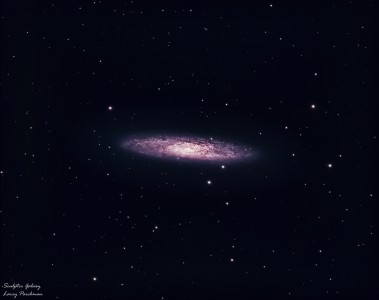
Image of the day

Captured by
Lawrence Parchman

Eastern Veil Nebula

My Account

New to Astromart?

Register an account...

Need Help?

Posts Made By: Alan French

June 16, 2005 01:50 AM Forum: Equipment Talk

A Lesson in Low Powers

Posted By Alan French

I had a chance to do an informal experiment today. It was time for my annual eye exam, and my pupil was still dilated to about 8mm when I came home. It was a rather cloudy day, but I still needed my sunglasses. It was also quite obvious that my visual acuity suffered greatly with the large pupil opening.

I have a pair of 7x42 binoculars that "snap" nicely into focus, and it is obvious when they are correctly focused. During the day, of course, the pupil of my eye stops their 6mm exit pupil down to probably 3mm or less. Out of curiosity, I tried them with my dilated pupil.

No longer did they seem to "snap" into focus. It seemed like I would approach focus, but not quite get there, and then a little more motion of the focus knob in the same direction would make it worse. I also tried my 12x36 binoculars. Their 3mm exit pupil provided a more obviously focussed view. They did not seem quite as sharp as in normal use, and I suspect I did not have their exit pupil quite centered in my eys's pupil.

At any rate, it was a nice demonstation that with large exit pupils and a dark adapted eye you are limited by the eye, and not the aberrations of the eyepiece/telescope.

Clear skies, Alan

July 26, 2005 02:08 AM Forum: Telescope Making

Telescopes and Screen Houses

Posted By Alan French

We generally are annoyed by mosquitos during the summer here in upstate NY, but some years they are much worse than normal. This is one of those years. I am thinking a fixed eyepiece scope with the eyepiece in a small screen house would be really nice to have. So, what to build in the way of scopes?

A Springfield does not seem too agreeable to the screen house plan. Perhaps a polar mounted refractor? A Grubb modified Coude? Or maybe I can buy the Porter Turret and put in a screen door . Does anyone have any other, reasonable suggestions?

Clear, bug free skies, Alan


September 9, 2005 12:34 AM Forum: Solar System Observing

Exit Pupil and Visual Acuity

Posted By Alan French

I often hear or read that with a magnification yielding an exit pupil of 2mm, the image resolution is matched to the eye's resolution and all the detail available in the image should be visible. Added to this is usually the comment that the detail is easier to see with a magnification yielding a 1mm exit pupil. Texereau recommends an exit pupil of 1.0 to 0.8mm for planetary work. Some folks like to go even smaller (but floaters become an increasing problem).

After a bit of a wait, I managed to get a copy of "The Human Eye - Structure and Function," by Clyde W. Oyster through interlibrary loan. It has far, far more information about the structure and workings of the eye than most of us would ever need, but there are quite a few tidbits of interest to folks using their eyes for critical observations.

One very interesting graph shows the MTF of the eye as a function of pupil opening. The eye is not diffraction limited even at its mimimum 2mm opening, and gets worse rather rapidly with larger pupils. With a telescope yielding a 1mm exit pupil you are really stopping down your eye to 1mm, and almost certainly reducing the eye's aberrations and improving the MTF. This may partly explain why a 1mm exit pupil provides more detail than a 2mm exit pupil, although the inceased image scale would also help. (Another point in the discussion of various types of eyes is that larger eyes with larger images on the retina work better.)

Clear skies, Alan


November 1, 2005 11:32 PM Forum: Reflectors

Re: Ed Stevens Optics

Posted By Alan French

"....wide field eyepiece is used is see if the entire field comes to focus at the same time,..."

Mike,

I am not sure what point this part of your testing addresses. Most eyepieces have aberrations off-axis that swamp to coma of the Newtonian primary (and coma is not something the optician has any control over anyway). Your eye enters the picture in a rather big way with exit pupils of 5mm and above. I can't see where this says anything about the primary mirror.

Clear skies, Alan

November 2, 2005 11:01 PM Forum: Telescope Making

Now Here is a Newtonian!

Posted By Alan French

I was just reading about William Lassell's 48" f/9.4 Newtonian. Now there is a telescope I'd like to have in the Florida Keys!

Now out to my lowly little 10" f/9.5.

Clear skies, Alan

January 15, 2006 12:50 AM Forum: Astro-Physics

Pssst...

Posted By Alan French

Check out "What's New" on the AP web site. We need wonder about the new mount no longer.

Under snowy skies, Alan

January 16, 2006 01:35 PM Forum: Refractors

ETX60

Posted By Alan French

Anyone here have a Meade ETX60? I have a couple of questions about the OTA, which I hope will help me fix one that someone dropped off here.

Thanks!

Clear skies, Alan

January 30, 2006 12:49 AM Forum: Equipment Talk

Breaking the Diffraction Limit

Posted By Alan French

The mention of the TOA-150 elsewhere got me curious about this scope, so I did a little rumaging around the web. I was surprised to find this in the TOA-150 Product Manual...

"The TOA-150 can produce an image of 1 micron in the center in 4 colors, which is far smaller than the diffraction limit of the airy disc [sic] ."

It must be magic to subvert the nature of light!

Clear skies, Alan

February 16, 2006 04:13 AM Forum: Refractors

Why Do Doublets Have Secondary Color?

Posted By Alan French

A gentleman named Chester Moor Hall made the first achromatic lens in 1729, by combining a concave flint element with a convex crown element. He reasoned that combining two glasses of opposite powers would eliminate the primary color error of a single lens. We know the result wasn't perfect, and resulted in secondary color - a difference of about 0.05 percent in the blue and red focus and the minimum focus in green.

A typical achromat is made with BK7 (crown) glass and F2 (flint) glass. If you made prisms of the two glasses, the F2 prism would spread out the spectrum about 75 percent more than the BK7 prism.

Why does the pair not provide perfect color correction? If you put the two spectra from the prisms side by side, and stretched the smaller BK7 spectrum to match the length of the F2 spectrum you would see the answer - the two do not match perfectly. Dispersion does not vary in a uniform manner, and varies from glass to glass. (I've seen this called the "irrationality of dispersion.")

For perfect color correction, you need glasses where the two spectrums would match exactly along their length when stretched to the same scale.

Clear skies, Alan

February 18, 2006 01:51 AM Forum: Refractors

Reference in The Adjustment & Testing Of Telescope

Posted By Alan French

Does anyone have a copy of Dennis Taylor's "The Adjustment & Testing Of Telescope Objectives?"

If so, would you mind looking to see if it has anything about the 6" Cooke refractor at Vanderbilt Observatory? (Focal length, field of view, anything along these lines.)

Thanks.

Clear skies, Alan