Image of the day

Captured by
Michael Scherman

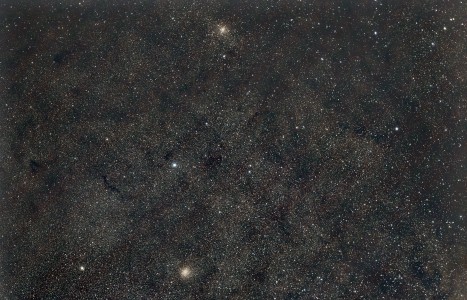
Dual Clusters near Antares

My Account

New to Astromart?

Register an account...

Need Help?

Posts Made By: Curt Renz

October 20, 2009 02:19 AM Forum: Solar System Observing

Apparition of Mars and its Beehive Passage

Posted By Curt Renz

Mars is returning to our evening skies! It is now rising before midnight daylight time for most observers. All of my following calculations are true for both UT and American Central Time dates.

Mars will achieve western quadrature (90° from Sun) on 2009 OCT 29. On that date it will appear as a gibbous 88.6% illuminated with a magnitude of +0.5 and an angular diameter of 7.8 arcseconds. Apparent retrograde movement will commence on DEC 20. Its closest approach for this apparition will occur on 2010 JAN 27 at 0.66396 AU with an angular diameter of 14.1 arcseconds. Greatest brilliance with magnitude -1.3 along with greatest elongation and the opposition in longitude with declination of N 22.2 ° will occur on JAN 29. Opposition in right ascension will occur on JAN 30. Apparent direct motion will resume on MAR 10. Mars will achieve eastern quadrature on MAY 04. On that date it will appear as a gibbous 89.7% illuminated with a magnitude of +0.8 and an angular diameter of 7.1 arcseconds. Conjunction with the Sun in longitude will occur on 2011 FEB 04.

On Halloween (the night of 2009 OCT 31/NOV 01) Mars (mag +0.4) will appear to move through the Beehive (M44 Praesepe) cluster in Cancer. I predict that early on NOV 01 Mars will pass 4.1 arcminutes south of 39 Cancri (mag +6.4) at 07:14 UT, and 2.2 arcminutes south of 40 Cancri (mag +6.6) at 08:42 UT. Be careful regarding the timing, since it will be the night of the change from daylight time back to standard time in America.

I’ve created a graphic demonstrating the current apparition of Mars, including its passage through the Beehive. It can be seen by clicking: http://www.curtrenz.com/astronomical

Photos and descriptions of Mars (including the Beehive passage) would be welcome additions to this thread.


November 13, 2009 05:53 PM Forum: Solar System Observing

Europa Annularly Transits Ganymede - Nov 16

Posted By Curt Renz

I predict that Jupiter’s Galilean satellite Europa will appear in annular transit across Ganymede during the evening of 2009 NOV 16. At the same time Callisto will be in transit across Jupiter. I’ve created two diagrams. The first is a view from above Jupiter’s north pole, and the second is a view from Earth. They can be seen by clicking: http://www.curtrenz.com/astronomical . Below is my timetable.

Europa Annularly Transits Ganymede
2009 NOV 16 CST (UT-6)

19:19:28 CST Partial Transit Begins
19:21:48 CST Annular Transit Begins
19:22:32 CST Minimum Separation between Satellite Centers
19:23:16 CST Annular Transit Ends
19:25:36 CST Partial Transit Ends

Photos, descriptions and timings of this event would be welcome additions to this thread.

November 25, 2009 12:53 AM Forum: Solar System Observing

Mercury as Holiday Season Evening Star

Posted By Curt Renz


The elusive little planet Mercury has begun its apparition as an evening star following its superior conjunction behind the Sun on 2009 NOV 05. This should be a fine apparition for observers in the southern hemisphere, and somewhat challenging for those of us in the north.

I’ve created two graphics illustrating Mercury’s evening apparition as viewed from Chicagoland and Sydney. They should well serve observers in the two respective hemispheres. They can be seen at: http://www.curtrenz.com/astronomical

All dates given here are based on CST (UT-6). Mercury will achieve its greatest eastern elongation of 20.3° from the Sun on DEC 18. It will reach its greatest altitude at 30 minutes after sunset from Chicagoland on DEC 21 at 7.9°. It will achieve dichotomy (50% illuminated like a Half Moon) also on DEC 21. Before that date it will appear gibbous and afterward a crescent. While decreasing in brightness, it will then fall to inferior conjunction between Earth and Sun on 2010 JAN 04.

The waxing crescent Moon will pass about 1° north of Mercury early on DEC 18.

Photos and descriptions of Mercury during the current evening apparition would be welcome additions to this thread.

December 1, 2009 11:01 PM Forum: Digital SLR AstroPhotography

Early December Full Moon Rising

Posted By Curt Renz

Below is a photo I took today 2009 DEC 01 at 16:06 CST from Arlington Heights, Illinois of the Full Moon rising. That was 29 minutes after moonrise and 15 minutes before sunset, with the Moon above the horizon by 3.7° and the Sun by 1.9°. I used my Sony Cyber-shot DSC-F717 at ISO-100, f/2.4, 1/640 sec and 5x zoom.


December 1, 2009 11:02 PM Forum: LUNATICS

Early December Full Moon Rising

Posted By Curt Renz

Below is a photo I took today 2009 DEC 01 at 16:06 CST from Arlington Heights, Illinois of the Full Moon rising. That was 29 minutes after moonrise and 15 minutes before sunset, with the Moon above the horizon by 3.7° and the Sun by 1.9°. I used my Sony Cyber-shot DSC-F717 at ISO-100, f/2.4, 1/640 sec and 5x zoom.


December 15, 2009 07:41 PM Forum: Meteorites & Meteors

Meteor Shower Timetable - 2010-19

Posted By Curt Renz

I’ve created a timetable for the major meteor showers to be seen during the coming decade. In general any particular meteor shower is best seen in your area during the hours between local midnight* and morning twilight nearest to the time of the global peak. That’s when you’re on the side of the Earth plowing into the meteor stream. A nearly full or waning gibbous Moon causes the most hindrance. My timetable which includes Moon data can be seen at: http://www.curtrenz.com/astronomical

* Local midnight is the time midway between sunset and sunrise.

December 16, 2009 08:31 PM Forum: Solar System Observing

Dual Shadow Transits - Dec 20

Posted By Curt Renz

During the evening of 2009 DEC 20 Galilean satellite Io for awhile will be transiting Jupiter concurrently with its shadow and that of Callisto. Below is my calculated timetable. I’ve created two graphics related to these events. They can be seen at: http://www.curtrenz.com/astronomical

Galilean Satellite Events
2009 DEC 20 CST (UT-6)

17:43:25 CST – Partial Transit by Io Begins
17:46:59 CST – Total Transit by Io Begins
18:50:40 CST – Partial Transit by Io’s Shadow Begins
18:52:44 CST – Total Transit by Io’s Shadow Begins
19:26:57 CST – Partial Transit by Callisto’s Shadow Begins
19:37:59 CST – Total Transit by Callisto’s Shadow Begins
20:01:20 CST – Total Transit by Io Ends
20:04:54 CST – Partial Transit by Io Ends
21:02:58 CST – Total Transit by Io’s Shadow Ends
21:07:39 CST – Partial Transit by Io’s Shadow Ends
23:35:29 CST – Total Transit by Callisto’s Shadow Ends
23:50:03 CST – Partial Transit by Callisto’s Shadow Ends

Photos, descriptions and timings of these events would be welcome additions to this thread.


December 27, 2009 09:07 AM Forum: Solar System Observing

2010 Mercury & Venus Elongation & Altitude Charts

Posted By Curt Renz

I’ve created six charts on one graphic demonstrating the 2010 elongations from the Sun, and altitudes above the horizon for Mercury and Venus. The altitudes are for 30 minutes before sunrise and 30 minutes after sunset as viewed from North 40° latitude. The elongations are for all observers, and the altitudes should well serve most folks north of the tropics. The graphic can be seen at: http://www.curtrenz.com/astronomical

January 1, 2010 08:56 PM Forum: Solar System Observing

2010 Mars Apparition Charts

Posted By Curt Renz

Mars will soon be in opposition to the Sun and out all night! All of my following calculations are true for both UT and American Central Time dates.

Mars achieved western quadrature (90° from Sun) on 2009 OCT 29. Apparent retrograde movement commenced on DEC 20. Its closest approach for this apparition will occur on 2010 JAN 27 at 0.66396 AU with an angular diameter of 14.1 arcseconds. Greatest brilliance with magnitude -1.3 along with greatest elongation and the opposition in longitude with declination of N 22.2 ° will happen on JAN 29. Opposition in right ascension will occur on JAN 30. Apparent direct motion will resume on MAR 10. Mars will achieve eastern quadrature on MAY 04. On that date it will appear as a gibbous 89.7% illuminated with a magnitude of +0.8 and an angular diameter of 7.1 arcseconds. Conjunction with the Sun in longitude will occur on 2011 FEB 04.

I’ve created four charts demonstrating the current apparition of Mars and comparing it with those that follow. Included is a graph of the apparent angular diameter of Mars. They can be seen by clicking: http://www.curtrenz.com/astronomical

Photos and descriptions of Mars would be welcome additions to this thread.

January 6, 2010 07:30 PM Forum: Solar System Observing

Mercury as Winter Morning Star

Posted By Curt Renz

The elusive little planet Mercury has begun its apparition as a morning star following its inferior conjunction between Earth and Sun on 2010 JAN 04. The celestial geometry is mediocre at this time of year for northern hemisphere observers, while somewhat better for those south of the equator. I’ve created graphics that show how the time of year affects the visibility of the morning and evening apparitions of Mercury for both hemispheres. They nicely illustrate what I’ve been talking about here for years regarding good and poor apparitions of Mercury. The patterns traced by the plots are quite interesting. It can be seen that the situation can become more extreme in the south than in the north. The difference is largely a function of Mercury’s rather eccentric orbit.

In addition to those graphics, I’ve created diagrams illustrating Mercury’s entire current morning apparition as observed from Chicagoland and Sydney. However, they should well serve most observers in the respective hemispheres. They can be seen by clicking: http://www.curtrenz.com/astronomical then go to the page for the inferior planets.

All dates given here are based on CST (UT-6). Mercury will reach its greatest altitude at 30 minutes before sunrise from Chicagoland on JAN 20 at 9.4°. It will achieve dichotomy (50% illuminated like a Half Moon) on JAN 21. Before that date it will be a crescent and afterward gibbous. Mercury will reach its greatest western elongation of 24.8° from the Sun on JAN 26. While increasing in brightness, it will then fall to superior conjunction behind the Sun on MAR 14.

The Moon will appear to pass 5.3° south of Mercury on JAN 13, and 1.9° north of Mercury on FEB 11. During this apparition Mercury will not be making any close angular passes by other planets or stars brighter than magnitude +2.5.

Photos and descriptions of Mercury’s morning apparition would be welcome additions to this thread.