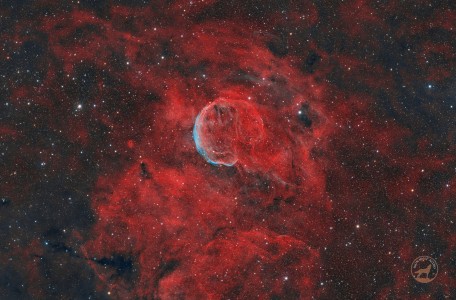
Image of the day

Captured by
Douglas Rollain

LBN 576 - The Garlic Nebula

My Account

New to Astromart?

Register an account...

Need Help?

Posts Made By: Alan French

October 27, 2003 11:21 PM Forum: Equipment Talk

OK To Use Solar Eclipse Glasses To View Sun?

Posted By Alan French

The glasses that came with Astronomy or Sky & Telescope are perfectly safe. A good alternative, for folks who don't have such glasses handy, is to visit your local welding supply store and pick up a shade 14 welder's glass.

November 6, 2003 01:53 AM Forum: Equipment Talk

1.25" vs. 2" eyepieces

Posted By Alan French

The advantage of a 2" eyepiece has nothing to do with how much light it passes. The telescope produces an image at prime focus. Ignoring possible vignetting, each part of the image uses the entire aperture, which is what determines how much light is collected.

Inside the eyepiece is a field stop - a ring that defines the outer edge of the eyepiece's field of view. The diameter of this ring and the focal length of the telescope define the telescope's true field of view. Because a 2" eyepiece is larger than a 1.25" eyepiece, it can have a larger field stop, and provide a larger true field than a 1.25" eyepiece.

November 13, 2003 02:22 AM Forum: Equipment Talk

Light gathering 8" SCT vs 6" apo

Posted By Alan French

Howard,

Rather than running all the different numbers to compare an 8" SCT to a 6" APO, I suggest making an effort to go out and see a 6" APO. Only then can you really decide if it is the scope for you. You've used an 8" SCT, so you should have some idea how it performs on the Moon, planets, and DSOs. Make an effort to see how a 6" APO does. No one should buy an expensive telescope sight unseen.

Clear skies, Alan

November 15, 2003 01:04 AM Forum: Equipment Talk

Nagler eyepiece for a Televue Genesis?

Posted By Alan French

David,

I'm a little unclear on exactly what the problem was. "Pincushion" is a form of distortion, which is a problem with image placement. If you have pincushion, straight lines are bowed inward, and stars move in an odd and, to some, disturbing way as you move the scope.

If you correct for linear distortion (pincushion and barrel), you are left with angular magnification distortion. Round planets would look oblong near the edge of the field, and angular distances would change as you move toward the edge of the field. For astronomical use, you generally want to keep the angular magnification the same across the field.

Is distortion your issue, or is it star images near the edge of the field?

Clear skies, Alan


November 16, 2003 04:13 AM Forum: Equipment Talk

Which 2 of 3 AP scopes you will choose.

Posted By Alan French

105 - widest field, and legal air line carry-on case.
155 - most aperture for best lunar, planetary, and deep sky views.
130 - with the other two "allowed," not much point, IMHO.

December 7, 2003 11:51 PM Forum: Equipment Talk

Color and the Orion 80mm ED - is this normal?

Posted By Alan French

You will see odd color effects if your eye is not properly positioned at the exit pupil.

The color fringing you see on off-axis objects is lateral color in the eyepiece, caused by a variation of magnification with wavelength. I have yet to see an eyepiece with a reasonably wide apparent field that does not show at least a little lateral color.

The test of the objective's secondary color is a bright object, such as Jupiter, centered in the field of view. In an achromat, you will see a purple glow from the out of focus red and blue ends of the spectrum surrounding Jupiter. In a good APO, you should not see this.

Clear skies, Alan

December 8, 2003 10:39 PM Forum: Equipment Talk

Moon Filters

Posted By Alan French

I have both polarizing filters and neutral density filters. I have used both on the Moon, but I really don't like them. The Moon has nice bright, white areas and very dark, black shadows. The filters make the whites a bit muddy and lessen the darkness of the shadows.

If you do a lot of lunar observing you'll get used to the brightness level, and it will cease being a problem. Heck, new folks often complain that Jupiter is too bright.

Clear skies, Alan

December 10, 2003 03:38 AM Forum: Telescope Making

What kind of wood suitable for wood tripod legs ?

Posted By Alan French

You'll find some excellent suggestions about building tripods in "Structural Considerations for Telescope Makers," in the June, 1976, issue of Sky & Telescope. I have made three tripods based on the advice in this article, and they all turned out very well indeed. They all used hardwood dowels for the legs.

Clear skies, Alan

December 12, 2003 01:40 PM Forum: Telescope Making

What kind of wood suitable for wood tripod legs ?

Posted By Alan French

One easy way to make any tripod more stable is to increase the spacing between the legs at the top, where they attach to the tripod. Many tripods make very nice torsional pendulums when you have a long OTA on the mount, and a good, wide triangular pattern for the legs helps insure stability.

Clear skies, Alan

December 20, 2003 02:56 AM Forum: Equipment Talk

5" for the price of a 6"

Posted By Alan French

Because they want one? It's a fair amount smaller and easier to mount than a Tak 6" too.

It has always seemed odd that so many people are so concerned about what other folks choose to spend their money on.

Clear skies, Alan