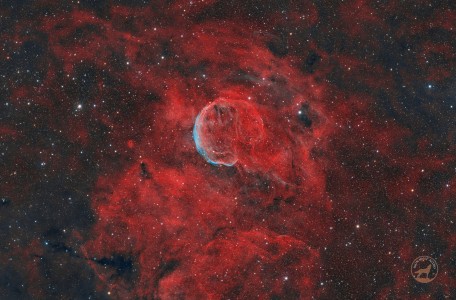
Image of the day

Captured by
Douglas Rollain

LBN 576 - The Garlic Nebula

My Account

New to Astromart?

Register an account...

Need Help?

Posts Made By: Alan French

July 22, 2003 01:29 AM Forum: Equipment Talk

Re: Aperture vs. Seeing - Another Round

Posted By Alan French

Gary's experiences are similar to mine. I made a 6" off-axis mask for my wife's 14.5" f/6 Newt. While I did not test it over the long period Gary did, I observed Saturn and Jupiter on several nights with and without the mask. While the view was sometimes superficially better with the mask, the stopped down scope never showed more detail, and, even when full aperture was seeing limited, there were always moments to minutes when the 14.5" showed more detail.

The larger aperture also revealed planetary colors more vividly, and the larger exit pupil was much appreciated.

We have a number of scopes up to 14.5" aperture, and often have two in use. I have never seen a night where the larger scope did not at times reveal more detail on the Moon and planets.


July 23, 2003 02:42 AM Forum: Equipment Talk

Center Spot a Mirror?

Posted By Alan French

I use a router table to turn a plexiglass disk the same diameter as the mirror. A 1/4" hole in the center of the plexiglass serves as a pivot for turning the disk, and a guide for placing a black hard fiber washer in the center of the mirror. The washer is held with rubber cement. The plastic disk is a nice cover for the mirror when sending for recoating.

July 26, 2003 11:53 PM Forum: Equipment Talk

Spider Diffusion Spijkes?

Posted By Alan French

What you are seeing are diffraction spikes from the spider that holds the secondary. They will definitely show up on bright planets and stars, but are too faint to see on fainter stars. While they are not attractive, they don't really detract from what you can see on Mars.

July 27, 2003 12:35 PM Forum: Telescope Making

Spider Diffusion Spikes?

Posted By Alan French

The diffraction spikes are, as others have mentioned, caused by the spider support for the secondary. The are too faint to see on fainter objects, but, as you see, show up quite vividly on bright planets and stars. While they are unattractive, they really do very little harm to the ability of the scope to show planetary detail.

A three vane spider would show six spikes, although each would be fainter. Some folks use a curved spider to spread out the effect and render it invisible, but that might be difficult with a larger scope if you want to keep the vanes thin. Most folks learn to live with it.

July 27, 2003 10:39 PM Forum: Telescope Making

Fiberglass tube construction

Posted By Alan French

I've done some work with fiberglass, and it was no fun at all. Actually, true Sonotube is quite stiff, and if you add some wooden end rings to both ends, it is extremely stiff.

A good way to finish Sonotube is to leave the outside wax on the tube, and cover it with cloth. Hoffman fabrics makes some very nice fabrics with celestial themes, You can put it on with a thin layer of white glue and the spray it with Scotch Guard. End rings on both ends and you are done. Looks great and is quite easy to do.

The best tubes, IMHO, are unpainted aluminum. You can "jewel" the outside to make it look nice, and you will have no worries about scratching a nice paint job.

July 28, 2003 12:17 AM Forum: Telescope Making

Fiberglass tube construction

Posted By Alan French

Removing the wax is way too much work. Leave it on, cover the tube with cloth, and things are very simple.

July 28, 2003 09:04 PM Forum: Equipment Talk

Strehl ratio

Posted By Alan French

Surface RMS error- 1/96.49
Surface P-V error- 1/29.801
Wavefront P-V error 1/14.9
Wavefront RMS- 1/48.245
Relative tranverse aberration 0.5322

How were these numbers obtained? I can not imagaine that any method had enough precision to allow realistic results to such a number of significant figures.

August 8, 2003 02:10 PM Forum: Equipment Talk

Planetary scopes

Posted By Alan French

Location can make a difference in the decision on a planetary scope. Up here in the northern US, my choice would be an APO in the 6 to 8 inch range, or a quality 8 to 10 inch Newtonian of moderate focal length.

In addition to having better seeing in parts of the southern US, both because of local conditions and because the planets are higher, temperature drops at night are not as big an issue (for the most part, anyway). Up here, where temperatures are often dropping much of the night, the mass and heat content of a large Newtonian primary means it is almost always playing catch up. Closed compound systems are also generally trying to play catch up and do not reach their potential.

Clear skies, Alan

August 17, 2003 12:39 AM Forum: Equipment Talk

Eyepieces, Barlows, New Telescope and Confusion

Posted By Alan French

The advantage to 2" eyepieces is that they allow you to see a larger portion of the sky at once. The downside is that quality 2" eyepieces are expensive.

Deep sky objects, unfortunately, do not look like the photos you see. Imaging can build up light in a way the eye can not.

Stars are too far away to appear as disks in any telescope. In theory, they will actually look smaller in a larger telescope. This is because the image of a star in a telescope is actually a tiny diffraction disk, and larger telescopes produce smaller diffraction disks. Our atmosphere often makes stars, especially bright ones, look a bit more bloated than the telescope alone would make them appear.

You should be able to see some detail on Mars with 100x provided by the 10mm eyepiece. Mars reveals it southern polar cap and some dark albedo features through my little 65mm scope at 60x. Last night, under rather poor seeing, quite a bit of detail was visible in a 10" Newt at a mere 123x. Try observing Mars as often as possible, and you may find you gradually start seeing some detail. Personally, I'd recommend something around 150 power for you next eyepiece or eyepiece/barlow combination. You might get away with a bit more power, but, in my experience, only the very top of the line optics provide improved views at magnifications approaching twice the aperture in millimeters.

August 17, 2003 11:41 PM Forum: Equipment Talk

Is amature astronomy a dieing sport?

Posted By Alan French

The number of folks attending conventions increases all the time. Take a look at all the conventions you could attend these days and you'll see it is hardly a dying hobby. Twenty years ago there were fewer such gatherings.

The number of younger folks in the hobby does tend to be small. Folks in their 20s and 30s are often busy with work and families, and only later do they have the time to get into or back into amateur astronomy - at least that is my impression based on people joining our local club.