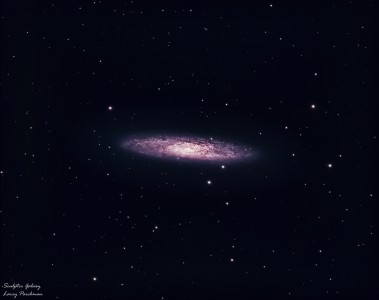
Image of the day

Captured by
Lawrence Parchman

Sculptor Galaxy (NGC 253)

My Account

New to Astromart?

Register an account...

Need Help?

Posts Made By: Ron Wodaski

March 9, 2003 11:37 AM Forum: CCD Imaging and Processing/Solar System

Leo triplet--my turn.

Posted By Ron Wodaski

Nicely done; very sharp and good details. Seems a little low in the red; all of these galaxies have markedly red dust lanes.

Ron Wodaski

March 9, 2003 11:41 AM Forum: CCD Imaging and Processing/Solar System

Hubble's Variable Nebula

Posted By Ron Wodaski

Here is the luminance only version.

Ron W

March 9, 2003 10:52 PM Forum: CCD Imaging and Processing/Solar System

Very appealing target for me...

Posted By Ron Wodaski

This is the way I do it. Makes things pretty simple.

Ron W

March 11, 2003 04:47 AM Forum: CCD Imaging and Processing/Solar System

Sony CCD entry level pic

Posted By Ron Wodaski

Very nicely done. This has great potential for you.

Ron W

March 11, 2003 08:28 PM Forum: CCD Imaging and Processing/Solar System

Jupiter Mar.11.2003

Posted By Ron Wodaski

Really nice detail. A little dark on the edges; might need a little histogram boost - but you might have to cut back on the sharpening if you do that. So you may alrady have the best compromise between brightening and sharpening.

Ron Wodaski

March 11, 2003 08:30 PM Forum: CCD Imaging and Processing/Solar System

M51 in Quickie Mode

Posted By Ron Wodaski

Really nice. Very detailed, excellent focus and processing.

Ron Wodaski

March 11, 2003 08:30 PM Forum: CCD Imaging and Processing/Solar System

M13 in Quickie Mode

Posted By Ron Wodaski

A nice, deep exposure of M13. Your quickies are first rate!

Ron W

March 11, 2003 08:34 PM Forum: CCD Imaging and Processing/Solar System

influence of sky on deep sky imaging

Posted By Ron Wodaski

First, my compliments on the image taken under the Mag 5.5 sky. Really beautiful and detailed.

On the subject of the magnitude difference in sky brightness, the main impact that will have is noise levels. The brighter background sky is going to put more of the dim portion of your image into the noisest zone. I call this the "dark zone," and it is the portion of the image that is so noisy it cannot be salvaged.

The main advantage that an astro CCD camera has in this area is that is has very low noise itself because of the cooling. As a result, while it can't compensate for the noise that results from a brighter sky background, it will contribute much less of its own noise to that problem. That is why astro CCD cameras can handle a bright sky better than film or digital cameras. Your D60 is one of the best (if not the best) with respect to limiting the noise, but it's still a couple of steps behind the cooled cameras.

Ron Wodaski

March 11, 2003 08:37 PM Forum: CCD Imaging and Processing/Solar System

Messier Marathon

Posted By Ron Wodaski

Pretty nifty project you have here. THose are very credible shots; the D60 is the perfect tool for this job.

Ron Wodaski

March 12, 2003 08:06 AM Forum: CCD Imaging and Processing/Solar System

CCD vs Film and resolution?

Posted By Ron Wodaski

No, actually the exact opposite is true: for some time now, CCD has had much better resoulution than film. The additional resolution of CCD has actually caused a bit of a revolution in mount-building. Losmandy and Mountain INstruments, for example, have had to upgrade the way they make gears to provide tracking accurate enough for CCD imaging. I know because I did the tests on Losmandy-made worm/gear sets that showed this.

Film does have some characteristics that make it a good choice. A large piece of film is cheap; a large CCD chip costs a small fortune. So film still has a big advantage for wide-field imaging, at least if you don't have $25k to spend on a large-chip CCD camera.

From a design standpoint, the usual "pixel size" assigned to film is about 20-25 microns. Most CCD chips in use by amateurs have pixels that are much smaller than this (the ST-10 has 6.8-micron pixels). Some films have an effective "pixel" size that is smaller than 20 microns, but not as small as CCD chips.

(as an aside, you really can't assign a true pixel size to film. Film is made up of grains, each of which is either all black or all white. It takes many grains to make up an image, and there isn't a clear cut "pixel" at all. The numbers I am quoting above are for what we would call an "effective pixel size" - what pixel size CCD chip would have about the same resolution as film?)

Ron Wodaski
