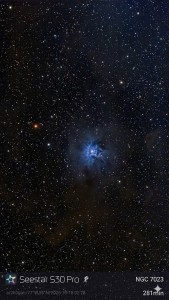
Image of the day

Captured by
Arthur Hogan

Iris Nebula

My Account

New to Astromart?

Register an account...

Need Help?

Posts Made By: Curt Renz

October 9, 2008 04:00 PM Forum: Solar System Observing

Mercury as Autumn Morning Star

Posted By Curt Renz

The elusive little planet Mercury is beginning an apparition as a morning star following its inferior conjunction between Earth and Sun on 2008 OCT 06. This will be a good one for northern hemisphere observers due to the great angle with which the ecliptic strikes the predawn horizon during autumn.

Mercury will achieve dichotomy (50% illuminated like a Half Moon) on OCT 21. Before that date it will be a crescent and afterward gibbous. Mercury will achieve its greatest western elongation of 18.3° from the Sun on OCT 22. That will also be the day of its greatest altitude at 30 minutes before sunrise from Chicagoland of 11.4°. While increasing in brightness, it will then fall to superior conjunction behind the Sun on NOV 25.

I’ve created a graphic illustrating Mercury’s current morning apparition as viewed from Chicagoland, although it should well serve most northern hemisphere observers. It can be seen at: http://www.curtrenz.com/astronomical.html

Photos and descriptions of Mercury during its current apparition would be welcome additions to this thread.

October 15, 2008 05:29 AM Forum: LUNATICS

Hunter's Moon

Posted By Curt Renz

Here’s my capture of the Hunter’s Moon rising through clouds as seen from Arlington Heights, Illinois on 2008 OCT 14 at 18:06 CDT. That was 19 minutes after moonrise and 5 minutes before sunset.


October 23, 2008 02:05 PM Forum: LUNATICS

Late October New Moon Spotting

Posted By Curt Renz

Who will be the first to spot the Late October New Moon with naked eyes after sunset? The Dark Moon will be in geocentric longitudinal conjunction with the Sun on 2008 OCT 28 at 23:14 UT (18:14 CDT). The first opportunity for North Americans will come on October 30. Venus will serve as a guide. Here in the months surrounding the autumnal equinox, young Moon spotting can be difficult for northern hemisphere observers as the twilight ecliptic is tilted toward an unfavorable position.

I’ve created a graphic previewing the western sky as viewed from Chicagoland 25 minutes after sunset on October 30, although it should well serve most North Americans. The Moon will be visible about 15° to the lower right of Venus. The graphic can be seen by clicking: http://www.curtrenz.com/astronomical.html

Photos or descriptions of the Late October New Moon would be welcome additions to this thread. Please include the date, time, time zone and location. Good Luck!

Below is a photo I took 30 minutes after sunset on 2007 SEP 13 of the Moon aged 2.5 days, circumstances similar to what we might expect this year on October 30.


November 15, 2008 05:10 PM Forum: Solar System Observing

Mutual Events Among Jupiter's Great Satellites

Posted By Curt Renz

Get ready for a series of mutual occultations, transits and shadow transits among the four great Galilean satellites of Jupiter. That is to say events that do not involve Jupiter itself. I calculate that these will occur from 2009 JAN 13 through 2010 APR 10. They only happen when Earth is very close to Jupiter’s equatorial plane. That plane is nearly coincident with the orbital planes of those satellites. These events repeat for periods lasting a little over a year which occur twice during Jupiter’s 12-year orbit of the Sun.

The series will begin when Jupiter is close to its 2009 JAN 24 conjunction with the Sun, although daylight telescopic viewing is possible as long as great care is taken to avoid looking at the Sun. The first event on 2009 JAN 13 will be a partial (19%) transit of #2 Europa’s shadow across #3 Ganymede reaching maximum at 14:44:48 UT. That will be quickly followed by a partial (2%) transit of Europa itself across Ganymede reaching maximum at 16:00:30 UT.

Frequently check my astronomical webpage for alerts and graphics related to these events. Currently I’m displaying a graphic previewing the 2009 JAN 13 transit of Europa across Ganymede. It can be seen by clicking: http://www.curtrenz.com/astronomical.html

Photos and descriptions of these events would be welcome additions to this thread.

December 8, 2008 05:50 PM Forum: LUNATICS

Big Bright Full Moon at Perigee on Dec 12

Posted By Curt Renz

Look for an especially large and bright Full Moon later this week. The Full Moon of 2008 DEC 12 will occur very near perigee. That perigee will be the closest between the centers of the Moon and Earth since 1993 and until 2016. The Earth is not far from its early January perihelion. That enhances the brightness of reflected sunlight. The closest perigees occur when they coincide with a Full Moon and the Earth near perihelion. Since this month’s Full Moon will be happening near the Winter Solstice, it will appear especially high near local midnight for observers north of the tropics. Where there is snow on the ground the lighting effect may be breathtaking.

For North Americans the Moon will be fullest and closest during midday on Friday the 12th. But the difference will be barely noticeable during the two nights on either side, so in essence we’ll be seeing the effect twice. The Moon will be in opposition from the Sun on December 12 at 16:37 UT, and I calculate geocentric maximum illumination of 99.9% for 17:02 UT. Geocentric perigee of 356,566 km will occur on the 12th at 21:40 UT.

I’ve created a panoramic graphic that illustrates the declinations, distances and apparent angular diameters of the next 15 Full Moons. Since the distances between Earth and Full Moons repeat within a cycle of about 14 synodic months, the graphic shows a complete cycle with the Full Moon near perigee at each end. It can be seen by clicking: http://www.curtrenz.com/astronomical.html

Photos and descriptions of this month’s Full Moon would be welcome additions to this thread.

December 13, 2008 08:15 PM Forum: Solar System Observing

Mercury as Wintertime Evening Star

Posted By Curt Renz

The elusive little planet Mercury is beginning its apparition as an evening star following its superior conjunction behind the Sun on 2008 NOV 25. This will be a much better one for northern hemisphere observers than we had in the summer.

Mercury will reach its greatest eastern elongation of 19.3° from the Sun on 2009 JAN 04. It will achieve dichotomy (50% illuminated like a Half Moon) on JAN 06. Before that date it will appear gibbous and afterward as a crescent. That will also be the date of its greatest altitude at 30 minutes after sunset from Chicagoland of 9.3°. While decreasing in brightness, it will then fall to inferior conjunction between Earth and Sun on JAN 20.

I’ve created a graphic illustrating Mercury’s current evening apparition as viewed from Chicagoland, although it should well serve most northern hemisphere observers. It can be seen at: http://www.curtrenz.com/astronomical.html

Photos and descriptions of Mercury during its current apparition would be welcome additions to this thread.

December 21, 2008 12:57 AM Forum: Solar System Observing

Moon Occults Jupiter - Australia - Dec 29

Posted By Curt Renz

The 3% illuminated waxing crescent Moon will occult Jupiter for many Australians during the late afternoon or early evening of 2008 DEC 29. Observers between the two graze paths will see a full occultation. Immersion will occur on the dark limb and emersion on the bright limb.

I’ve created a graze map. It can be seen by clicking: http://www.curtrenz.com/astronomical.html

For occultation or graze data for a specific location, reply to this thread with a longitude, latitude, time zone and elevation above sea level.

Photos or descriptions of the event would be welcome additions to this thread.

December 21, 2008 01:27 AM Forum: LUNATICS

December New Moon Spotting

Posted By Curt Renz

Who will be the first to spot the December New Moon with naked eyes after sunset? The Dark Moon will be in geocentric longitudinal conjunction with the Sun on 2008 DEC 27 at 12:22 UT (06:22 CST). The first opportunity for North Americans will come on December 28. We’ve now moved into the half of the year that is more favorable for spotting a young Moon from the northern hemisphere than it has been. Although the best months are those surrounding the vernal equinox, i.e. February through May.

I’ve created a graphic previewing the southwestern sky as viewed from Chicagoland 25 minutes after sunset on December 28, although it should well serve most North Americans. Mercury and Jupiter will serve as nearby guides with Venus further off. The graphic can be seen by clicking: http://www.curtrenz.com/astronomical.html

Photos or descriptions of the December New Moon would be welcome additions to this thread. Please include the date, time, time zone and location. Good Luck!

January 8, 2009 04:23 AM Forum: Solar System Observing

Saturn's 2009 Apparition with Disappearing Rings

Posted By Curt Renz

Saturn has entered the late evening sky. Here in early January it’s rising before 22:00 local time at mid-northern latitudes and will continue to rise about four minutes earlier each evening. It reached western quadrature (90° from Sun) on 2008 DEC 12. It began apparent retrograde motion on DEC 31. Opposition from the Sun will occur on 2009 MAR 08. Apparent direct motion will resume on MAY 16. Eastern quadrature comes on JUN 06, before conjunction with the Sun on SEP 17.

As Saturn orbits the Sun we view its rings from changing perspectives. The rings remain virtually parallel to a single plane, but they appear to wobble due to our changing viewing points. The entire wobble cycle matches Saturn’s orbital period of 29.5 years, although there is an annual sub-cycle due to the Earth’s movement. The apparent tilt achieved a maximum of 27.0° on 2003 APR 07. That will reach zero when we pass through the ring plane on 2009 SEP 04, although the Sun will pass through the plane a little earlier on AUG 10.

The rings appear rather narrow right now, but will widen a bit while the planet remains in retrograde motion and then resume narrowing afterward. Between the dates of the Sun’s and the Earth’s passages through the ring plane, we will be viewing the unlit side of the rings thus making them virtually invisible. Even though the rings would normally return to visibility after we pass through the ring plane, that event will occur so close to conjunction that Saturn will be hard to detect. That will be especially true for northern hemisphere observers due to the celestial geometry near the time of the autumnal equinox.

On my website are three graphics I’ve created to preview the appearance of Saturn and it’s rings over both short and long time frames. They can be seen by clicking: http://www.curtrenz.com/astronomical.html

Photos and descriptions of Saturn and its rings would be welcome additions to this thread.

January 22, 2009 05:34 AM Forum: Solar System Observing

Mercury as Morning Star with many Conjunctions

Posted By Curt Renz

The elusive little planet Mercury has begun its apparition as a morning star following its inferior conjunction between Earth and Sun on 2009 JAN 20. This will be a somewhat challenging apparition for northern hemisphere observers, but will involve fascinating conjunctions with the Moon, Mars and Jupiter.

I’ve created a graphic illustrating Mercury’s morning apparition as viewed from Chicagoland, although it should well serve most northern hemisphere observers. I’ve also assembled an animation video to demonstrate the conjunctions. They can be seen at: http://www.curtrenz.com/astronomical.html

All dates given here are based on CST. Mercury will reach its greatest altitude at 30 minutes before sunrise from Chicagoland on FEB 05 at 7.9°. It will achieve dichotomy (50% illuminated like a Half Moon) on FEB 08. Before that date it will be a crescent and afterward gibbous. The planet will reach its greatest western elongation of 26.1° from the Sun on FEB 13. While increasing in brightness, it will then fall to superior conjunction behind the Sun on MAR 30.

Mercury will appear to pass 4.3° north of Mars on JAN 27. Then a pretty set of conjunctions will be occurring from mid-February through early March. Mars will appear to pass 0.6° south of Jupiter on FEB 17. Late on FEB 23 Mercury will pass 0.6° south of Jupiter. Then Mercury will pass 0.6° south of Mars late on MAR 01. The tightest grouping of the three planets will involve a separation of 3.7° on FEB 23.
The waning crescent Moon will appear to pass near Mars on JAN 24 and near Mercury and Jupiter on JAN 25. Then it will join in the close grouping of those three planets in February. It will pass nearest Mercury and Jupiter on FEB 22 and nearest Mars on FEB 23.

Photos and descriptions of Mercury and its conjunction partners during this morning apparition would be welcome additions to this thread.