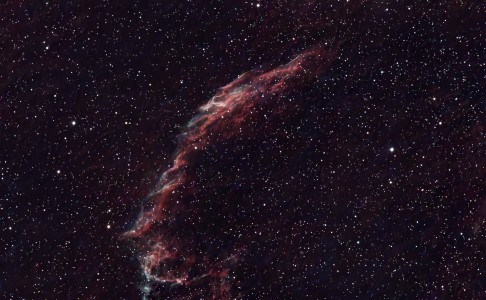
Image of the day

Captured by
GERALD KREITZBURG

Eastern Veil Nebula

My Account

New to Astromart?

Register an account...

Need Help?

Posts Made By: Curt Renz

June 30, 2008 03:03 PM Forum: LUNATICS

July New Moon Spotting

Posted By Curt Renz

Who will be the first to spot the July New Moon with naked eyes after sunset? The Dark Moon will be in geocentric longitudinal conjunction with the Sun on 2008 JUL 03 at 02:19 UT (JUL 02 at 21:19 CDT). North Americans will have a fine opportunity to sight a Moon aged about 24 hours. Venus might serve as an aid. In the coming months early New Moon spotting will become more difficult as the twilight ecliptic tilts toward a less favorable position.

I’ve created a graphic previewing the west-northwestern sky as viewed from Chicagoland 25 minutes after sunset on July 3, although it should well serve most North Americans. The Moon will be visible about 6° to the upper left of Venus. The graphic can be seen by clicking: http://www.curtrenz.com/astronomical.html

Photos or descriptions of the July New Moon would be welcome additions to this thread. Please include the date, time, time zone and location. Good Luck!

Below is a photo I took on 2007 JUL 15 of the Moon aged 38:05 hrs.


June 30, 2008 03:56 PM Forum: Solar System Observing

Jupiter at Opposition - 2008 JUL 09

Posted By Curt Renz

Magnificent Jupiter will be in longitudinal opposition to the Sun on 2008 JUL 09 at 07:39 UT. Near that date it will be rising around sunset, transiting the meridian around local midnight and setting around sunrise. Those events occur about four minutes earlier each evening. Jupiter’s declination at opposition will be S 22.5°, meaning it still will be riding relatively low above the southern horizon for northern hemisphere observers. Its meridian transit altitude will be 67.5° minus your northern latitude.

Jupiter’s closest approach to Earth for this apparition will occur on 2008 JUL 10 at 4.1610 AU. Its apparent equatorial diameter will be 47.3 arcseconds with polar diameter at 44.2 arcseconds. Its stellar magnitude will be -2.7.

The apparent tilt of Jupiter’s equatorial plane will be -1.5° at opposition. That will reach 0° on 2009 APR 16. The apparent tilt oscillates with a major component equal to Jupiter’s approximately 12-year orbital period and a minor component contributed by Earth’s annual motion. It’s not an actual wobbling, but a change in our viewing perspective. The Galilean satellites all lie in planes close to Jupiter’s equatorial plane.

With the decreasing apparent tilt of the orbital plane of the Galilean satellites, #4 Callisto can once again be involved in transits, occultations, eclipses and shadow transits. The other three participate in all of these events each time they orbit Jupiter. But Callisto only does so during periods that last about three years in alternation with approximately three-year periods in which it appears to pass north or south of Jupiter at each conjunction.

The decreasing tilt means more of the satellite events will be occurring during this year’s apparition of Jupiter compared to recent years. Quadruple shadow transits are impossible due to a commensurability among the orbital periods of the inner three Galilean satellites. Triple shadow transits are only possible when #4 Callisto participates. However, this will never happen during the current series of Callisto shadow transits. The next triple shadow transit will occur in 2013. But numerous dual shadow transits will continue happening during the current apparition. The next such event will occur on 2008 AUG 05 during the pre-dawn hours for North Americans and will involve #1 Io and #4 Callisto.

Mutual passages among the Galilean satellites now appear closer than they have for several years. My calculations indicate that mutual occultations, transits and shadow transits/eclipses among the Galilean satellites will commence next year on 2009 MAR 27 and end on 2010 JAN 08. Immediately prior to and during that time period I will provide detailed predictions of the events.

On my website is a graphic illustrating the apparent retrograde loop of Jupiter as it zigzags against the background stars between now and November. To see it, click: http://www.curtrenz.com/astronomical.html

Photos and descriptions of Jupiter and its satellites during the current apparition would be welcome additions to this thread.


July 4, 2008 09:01 PM Forum: Solar System Observing

Saturn, Mars, Regulus & Moon in a Line - July 5

Posted By Curt Renz

For North American observers during the evening of July 5, Saturn, Mars, Regulus and the 3-day-old Moon (Diana’s Bow) will appear to lie on nearly a straight line, with the first three evenly spaced. The next evening the Moon will appear beneath the rest of the grouping. Tonight (July 4) should present a fine opportunity to see the Old Moon in the New Moon’s Arms behind the fireworks.

I’ve created three graphics previewing the west-northwestern sky from Chicagoland 45 minutes after sunset on July 4, 5 & 6. Although they should well serve most North American observers. They can be seen by clicking: http://www.curtrenz.com/astronomical.html

Last evening I captured the 1.3% illuminated crescent Moon aged 23:49 hrs (2008 JUL 03 at 21:08 CDT). That was 37 minutes after sunset and 18 minutes before moonset at Arlington Heights, Illinois. Below is the photo with the Moon toward the right and just above the clouds. Your photos and descriptions of the crescent Moon and its alignment partners during the coming evenings would be welcome additions to this thread.


July 5, 2008 03:28 AM Forum: LUNATICS

Moon & Fireworks

Posted By Curt Renz

Here’s a shot I took this evening of the 2-day-old Moon amid 4th of July fireworks from Arlington Heights, Illinois on 2008 JUL 04 at 21:21 CDT.


July 6, 2008 05:33 PM Forum: Solar System Observing

Venus as Evening Star - 2008-2009

Posted By Curt Renz

Expect plenty of UFO sightings during the next few months. After a long hiatus, brilliant Venus has begun entering the western sky after sunset as the Evening Star. It is far and away the brightest celestial object after the Sun and Moon.

Venus was in superior conjunction behind the Sun on 2008 JUN 09. As it appears to separate from the Sun, it will climb higher in the sky each evening. But the process will be rather slow at first as the evening ecliptic tilts over during the coming months.

Venus will be waning in phase but increasing in angular diameter throughout this apparition. Dichotomy (like a Half Moon) will occur near 2009 JAN 16. Before that date it will appear gibbous and afterward as a crescent.

Venus will achieve its greatest eastern elongation of 47.1° on 2009 JAN 14. From Chicagoland at 30 minutes after sunset it will reach its highest altitude of 35.5° on FEB 03. Its greatest brilliance at magnitude -4.6 is expected around FEB 20. Apparent retrograde motion will commence on MAR 06. Inferior conjunction between Earth and Sun by right ascension will occur on MAR 25 and by celestial longitude on MAR 27.

The Moon and Venus will appear in conjunction (UT dates) on 2008 AUG 02, SEP 01, OCT 01, NOV 01, DEC 01, DEC 31 and 2009 JAN 30 & FEB 28. The Moon will occult Venus for Europeans on 2008 DEC 01 and for observers in the South Pacific on 2009 FEB 28.

Venus will conjunct with Mercury on 2008 AUG 20 and SEP 12, also with Mars on SEP 12 to form a planetary trio. Venus will conjunct with Jupiter on 2008 DEC 01 (joined by Moon). Venus will conjunct with Saturn on 2008 AUG 13.

Venus will conjunct with Regulus on 2008 AUG 06, with Spica on SEP 19 and with Antares on OCT 27.

I’ve created a panoramic graphic to illustrate Venus’s position (Moon’s too) in the western sky as viewed from Chicagoland at 30 minutes after sunset throughout the current evening apparition. It should well serve most northern hemisphere observers. I also made a diagram to demonstrate the relative positions of Sun, Earth and Venus throughout the 1.6-year synodic cycle. To see them, click: http://www.curtrenz.com/astronomical.html

Photos and descriptions of Venus would be welcome additions to this thread.

July 30, 2008 06:42 PM Forum: Solar System Observing

Dual Transits Across Jupiter - August 4/5

Posted By Curt Renz

I calculate that during a period of 21 hours on 2008 AUG 04/05 all four Galilean satellites and their shadows will transit Jupiter. #3 Ganymede and #4 Callisto will be in transit simultaneously. The shadows of #1 Io and #4 Callisto will be in transit simultaneously.

I’ve created three graphics related to these events. The first is a timetable. The second is a view from above Jupiter’s north pole. The third is a view from Earth. To see them, click: http://www.curtrenz.com/astronomical.html

Photos or descriptions of the events would be welcome additions to this thread.

August 7, 2008 10:58 PM Forum: Solar System Observing

Mercury as Aug/Sep Evening Star

Posted By Curt Renz

The elusive little planet Mercury is beginning another apparition as an evening star following its superior conjunction behind the Sun on 2008 JUL 29. This will be a poor one for northern hemisphere observers due to the sharp angle with which the ecliptic strikes the early evening horizon during late summer and early autumn. But it will be superb for those in the southern hemisphere.

Mercury will achieve its greatest eastern elongation of 26.9° on SEP 10. But its greatest altitude at 30 minutes after sunset from Chicagoland will be only 3.2° on AUG 29. For Sydney, Australia that will be 19.7° on SEP 11. Mercury will achieve dichotomy (50% illuminated like a Half Moon) on SEP 14. Before that date it will be gibbous and afterward a crescent. It will then fall to inferior conjunction between Earth and Sun on OCT 07.

On AUG 15 Mercury, Venus and Saturn will appear in a tight group. Mercury and Venus will be especially near each other on AUG 20 and then meet again on SEP 12. Mercury and Mars will conjunct on SEP 06 and again on SEP 22. Mercury will conjunct Regulus on AUG 09 and Spica on SEP 23. On SEP 02 Mercury, Venus and Mars will aid New Moon spotters.

I’ve created two graphics illustrating Mercury’s current evening apparition: one for northern and one for southern hemisphere observers. They can be seen at: http://www.curtrenz.com/astronomical.html

Photos and descriptions of Mercury during its current apparition would be welcome additions to this thread.

September 2, 2008 05:23 PM Forum: Solar System Observing

Dual Shadow Transits on Jupiter - Sep 7/8

Posted By Curt Renz

Two shadows of Galilean satellites will be simultaneously transiting Jupiter during the evening of September 7th in North America and the early morning of September 8th in Europe. Io (#1) itself will be in transit along with its shadow and that of Callisto (#4). I calculate that the period in which both shadows are fully on Jupiter’s disk will only last two minutes from 00:13:28 UT to 00:15:28 UT. In Chicagoland this will occur around sunset, but Jupiter will be above the horizon. Observers to the east will see the dual shadow transits at nighttime and those to the west in daylight.

I’ve created three graphics to illustrate the events. The first is a timetable. The second shows a view from above Jupiter’s north pole. The third is a close-up of the view from Earth. They can be seen by clicking: http://www.curtrenz.com/astronomical.html

Pictures and descriptions of the events would be welcome additions to this thread.

September 9, 2008 07:50 PM Forum: Solar System Observing

Moon Occults Neptune - SEP 12/13

Posted By Curt Renz

The 94% illuminated waxing gibbous Moon will occult Neptune during the night of 2008 SEP 12/13 for many observers in North America, northern South America, Iceland, the British Isles and the northern coast of France. Some in western North America may have to deal with daylight. Most Britains will only catch the immersion before the Moon sets. Some South Americans and French have a shot at seeing a graze.

Immersion will occur on the Moon’s dark limb and emersion on the bright limb. There will be no northern graze path since it would be in space above the North Pole. The southern graze path traverses northern South America, the Atlantic Ocean and the northern coast of France. Observers on the path may witness a graze as lunar hills and valleys appear to pass across the disk of Neptune. Those north of the path could see a full occultation.

If you would like occultation or graze data for your location, please reply to this post with a latitude, longitude, time zone and altitude above sea level.

Below is my graze map.


September 30, 2008 03:43 PM Forum: LUNATICS

Early Autumn New Moon Spotting

Posted By Curt Renz

Who will be the first to spot the early autumn New Moon with naked eyes after sunset? The Dark Moon was in geocentric longitudinal conjunction with the Sun on 2008 SEP 29 at 08:12 UT (03:12 CDT). The first opportunity for North Americans will come on October 1. Venus will serve as a guide. Here in the months surrounding the autumnal equinox, young Moon spotting can be difficult for northern observers as the twilight ecliptic has tilted toward an unfavorable position.

I’ve created a graphic previewing the western sky as viewed from Chicagoland 25 minutes after sunset on October 1, although it should well serve most North Americans. The Moon will be visible about 5° to the lower left of Venus. The graphic can be seen by clicking: http://www.curtrenz.com/astronomical.html

Photos or descriptions of the early autumn New Moon would be welcome additions to this thread. Please include the date, time, time zone and location. Good Luck!

Below is a photo I took 30 minutes after sunset on 2007 SEP 13 of the Moon aged 2.5 days, circumstances similar to what we might expect this year on October 1.
