Image of the day

Captured by
Michael Scherman

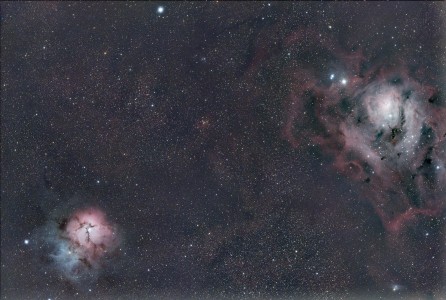
Lagoon and Triffid Celestron C6 Hyperstar4

My Account

New to Astromart?

Register an account...

Need Help?

Posts Made By: Alan French

February 27, 2003 11:01 PM Forum: Birding Optics and Photos

Birding/Astronomy Dual Use Telescope

Posted By Alan French

If you want a scope that can handle frequent trips into the field, you are probably better off getting a spotting scope designed for birding. If, like me, you enjoy setting a scope up on the shore of a lake or back deck and are not carrying it around, then the Taks and TVs are worth considering.

February 27, 2003 11:04 PM Forum: Telescope Making

newtonian focal plane

Posted By Alan French

When an eyepiece is in focus, the field stop of the eyepiece is at the focal plane of the mirror (at least in the center of the field).

March 2, 2003 08:38 PM Forum: Telescope Making

Mirror Cell - # of points

Posted By Alan French

A 17.5" x 2" mirror will sag a maximum of about 1/29th wave with a 9 point support system. (See "Mirror Support: 3 or 9 Points?", Sky & Telescope, Sep 94, pp. 84-87.) There should no need to go to an 18 point system.

March 7, 2003 10:36 PM Forum: Birding Optics and Photos

Best Spotting Scope Under $300?

Posted By Alan French

Actually, if you restrict them to the lower powers, even many inexpensive spotting scopes can provide very nice views. I bought a used Spacemaster with tripod and two eyepieces for $100 in 1980 or so. With the 22x wide field eyepiece it works very well, providing sharp, color free images. With the 60x eyepiece, things are different. The secondary color is obvious and the image is pretty horrid. We later bought one for my Mom, and the newer Spacemaster seems right on par with the older one, although they added a nice sight hole.

This afternoon I compared my trusty 22x Spacemaster with a Swarovski ATS-65 HD. At 22x the Spacemaster compared very well. Only when carefully looking at a dollar bill about 35 feet away could I see a slight advantage in resolution with the Swarovski. At 60x the Swarovski remained sharp and color free. Unfortunately, I no longer have the 60x eyepiece for the Spacemaster, so I could not do a direct comparison, but the views in the Swarovski were far superior to what I recall seeing with the Spacemaster at 60x. (I no longer own the 60x eyepiece because I was always disappointed in it and simply saw no advantage over the 22x.)

I think someone could do a lot of birding with a relatively inexpensive spotter at 20 to 30x.

March 9, 2003 03:37 AM Forum: Equipment Talk

Need help on a focus problem

Posted By Alan French

It sounds like your scope has astigmatism. One one side of focus a star image will be a line, on the other side of focus the line will be at 90 degrees to the first side of focus. Less severe cases will show slightly oblong out of focus images, again at 90 degrees to each other on opposite sides of focus.

Chances are that it is due to improper mounting of either the primary or secondary mirror. An 8" Coulter owned by a friend had the secondary held distorted by the adhesive holding it and his scope showed astigmatism. We had first remounted the primary in a conventional cell (no adhesive) and found the astigmatism was still there. We rotated the primary mirror 45 degrees and the astigmatism did not rotate with it. We remounted the secondary properly and the astigmatism vanished.

March 11, 2003 11:21 PM Forum: Equipment Talk

Green Lasers: Thumbs up or down?

Posted By Alan French

They work very well. A big advantage is that you can see exactly where the scope is pointed without having to look through some type of finder. Finders often seem inconventiently placed in at least some tube orientations, especially with scopes requiring a ladder. It is also nice that other folks can see exactly where the scope is pointed.

As others have mentioned, you should always be considerate when using a green laser pointer. They don't fit in at all venues. As to their eating batteries - why are folks using one use batteries? If you don't want to use rechargeables, get lithium batteries. Otherwise, invest in rechargeable alkalines or NiMH batteries.

You can use a clothespin to hold the pointer "on" while you are swinging the scope around.

March 13, 2003 12:42 AM Forum: Telescope Making

Help with Mirrors

Posted By Alan French

Mirror ratings can be very confusing, for sure. Generally, mirror makers have given what are called peak-to-valley (PTV) readings, which are supposed to be the worst error on the mirror. To add to the confusion, they may give the error on the mirror surface, or at the wavefront after the light has been reflected off the mirror. The wavefront error is twice the surface error, so a 1/8 wave on the surface translates to 1/4 wave at focus.

The problem with PTV is that it may not accurately represent the mirror as a whole. A mirror could be extremely accurate over most of its surface, and have a small region that has a 1/2 wave defect, and still work exceptionally well. A 1/4 wave mirror may be quite rough - have lots of 1/4 wave defects, and perform poorly. Generally a proper test of a mirror considers the entire surface. The RMS (root-mean-square) measurements are one way to do this.

Fortunately, and experienced mirror maker can make a nice, smooth mirror where the PTV readings provide a reasonable quarantee of the mirror's performance. A smooth, 1/4 wave mirror works very well. (Claims of mirrors better than about 1/10 wave from Foucault testing should be treated with skepticism.) If someone generates RMS values from Foucault readings, they are assuming the mirror is smooth and that the zones read are truely representative of the mirror (the same goes for other measurements relating to the entire mirror).

The best guarantee of a good mirror is to buy one from a maker with a good reputation.

March 13, 2003 12:44 AM Forum: Telescope Making

Help with Mirrors

Posted By Alan French

Diffraction limited means the mirror's performance is only limited by the "wave nature" of light. Generally, this is taken as a mirror that is 1/4 wave at the wavefront (1/8th wave surface).

March 16, 2003 01:35 PM Forum: Equipment Talk

C11 vs Starmaster 11

Posted By Alan French

Quite a few people have commented that the optics in the Starmaster are going to be better, so that it will be the better planetary scope. Please note that better optics also mean better deep sky performance. Deep sky objects also benefit from quality optics, which will show subtle details in DSOs not revealed by poorer instruments.

March 16, 2003 06:13 PM Forum: Equipment Talk

Refractor Collimation

Posted By Alan French

Alignment is quite easy with a Cheshire eyepiece, especially on a bright, sunny day. Put a cover over the lens. Put the Cheshire in the focuser without a diagonal. Aim the 45 degree reflective surface of the Cheshire at the bright, blue sky (away from the Sun, please!). If you look through the Chesire you will see some reflections. They shold all be nice and concentric. If not, adjust the lens until they are. Most achromats are corrected for coma, so careful alignment with the Cheshire should be all you need.