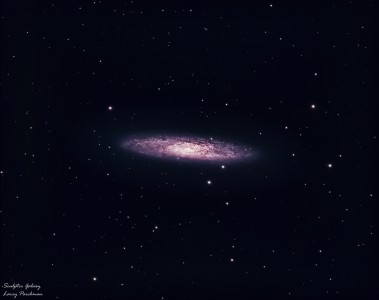
Image of the day

Captured by
Lawrence Parchman

Sculptor Galaxy (NGC 253)

My Account

New to Astromart?

Register an account...

Need Help?

Posts Made By: Keith Lawson

September 29, 2018 03:36 AM Forum: Telescope Making

Black Brant

Posted By Keith Lawson

Well... More retirement tinkering. Finished restoring a old Cave Astrola 1-1/2" shaft mount. Smoothed out the RA friction of the clock drive by installing teflon interfaces and clutch springs. What a difference! The rest of the restoration was basically mount cleanup, sanding & paint and the restoration of an old pier that I had used for previous projects. If you have an old Cave mount and would like to make this mod, let me know. I can send pics.

The tinkering continues...

Keith (Scopejunkie)

October 1, 2018 04:57 AM Forum: Telescope Making

Questions for the optics perfectionists

Posted By Keith Lawson

Originally Posted by Tony Aguire

I have access to a hackerspace with any of the machining tools I could ever want to create a zero image shift mechanism for the primary mirror.

My question is, is it worth going through that trouble to create a zero image shift focusing mechanism for image quality? 
Hi Tony,

Sorry for your loss. Forgive me if this old guy is misunderstanding, but wouldn't an accessory Crayford focuser accomplish zero image shift? 

Rebuilding the existing focuser mechanism is a serious design challenge. The original Celestron 8" Blue/White's came with a belt driven zero image shift focusing mechanism. It's quite a bit more complicated and requires precision machining that could be beyond the skill set of a hobby machinist. You might want to check out Robert Piekiel's "Celestron The Early Years" CD for pics of this focusing mechanism.

Forgive my ignorance but I'm confused about the "image quality" associated with a focusing mechanism.

Keith (Scopejunkie)

October 1, 2018 05:29 AM Forum: Telescope Making

Questions for the optics perfectionists

Posted By Keith Lawson

A Crayford focusing mechanism for the primary mirror would be something to see! Let us know if you go this direction and please post your progress. 

Keith (Scopejunkie)

October 19, 2018 12:47 PM Forum: Telescope Making

C14 Primary Retaing Ring Mod

Posted By Keith Lawson

The temps have dropped quite a bit here at 4000ft. Ater a month of observing during this temp change there has been no change in collimation at all. We shall see how this mod holds up once deep into winter.

Keith (Scopejunkie)

October 19, 2018 12:55 PM Forum: Telescope Making

Fork mount

Posted By Keith Lawson

Here is something a bit out-of-the box you might like to try grin

Scopejunkie

Pic 1: Alt Az mode.

October 19, 2018 12:56 PM Forum: Telescope Making

Fork mount

Posted By Keith Lawson

Pic 2: EQ mode.

October 23, 2018 03:49 AM Forum: Refractors

Celestron C6R Lens Upgrade

Posted By Keith Lawson

Hi All,

Yes, I have been tinkering again. Love retirement! Anyway, working with Ales over at Istar Optical, I came up with an adapter that will allow the owners of the Celestron C6R (w/adjustable cell) the option of upgrading to an Istar 150mm F/8 R35 lens or standard Istar 150mm F/8 achromat. Got a lens not performing well? This may be an option for you. This CNC machined adapter is a composite of ABS plastic and MDF so as to not add more weight to the front heavy C6R. The use of this mod only requires a change of in focus position of about 3/8" and installs in about minute. The lens cell adjustability is maintained. Send me a PM if interested in the adapter.

Hope to get some photos and do a lens comparison soon.

Keith (Scopejunkie)

October 24, 2018 03:14 AM Forum: Refractors

October 26, 2018 07:56 AM Forum: Refractors

Celestron C6R Lens Upgrade

Posted By Keith Lawson

Walking a tightrope? Nah! Made some extension arms for the lens adapter so I could test an F/10 objective with an F/8 telescope.

Keith (Scopejunkie)

October 28, 2018 03:18 AM Forum: Refractors

Celestron C6R Lens Upgrade

Posted By Keith Lawson

All,

Here is the full story: I own a Celestron C6-R refractor and I had wondered what it would be like to have an Istar R35 F/8 lens in place of the standard C6-R F/8 achromat. Without the proper information on Istar's cell design this just remained an "idea." To scratch an itch, I finally contacted Ales at Istar and he kindly sent me the Istar 150 mm lens cell information. With this information I started my design of an adapter plate so I could swap out the C6-R lens for a Istar R35 lens.

After designing the adapter plate I asked Ales if he could send me a lens cell from one of their 150mm lenses so that after I had produced the adapter I could do a full fit check to see if what I had made worked. Ales graciously sent me an older 150mm standard F/10 achromat so I could perform my fit check since the original Istar cell design had not changed.

Everything worked.  I was a happy camper. Being the curious ATM that I am I decided to clean and check this lens for Ales and test it (yes, Ales knew what I was doing). I rigged up some extensions to extend my newly designed cell adapter from the C6-R and took a look at the night sky with the Istar F/10 lens. Using a 250 LPI etched glass ronchi grating, at only two bands, revealed that the lens had a spherical correction better than 1/8th wave looking at both sides of focus. The lens also has a good clean edge. The star test was quite good. The star test agreed well with the ronchi test. Much better than 1/6th wave overall correction (according to Suiter's book) with smooth surfaces (more like 1/7th). The lens passes the "two ring" star test.
 
Even though the seeing was "average" I could easily see the small polar cap of Mars (12.4 arc sec) with full surface markings at 150x. Though this was not a "high power" night, I ran the magnification up to 375x (4mm Ortho). I was quite surprised with the results. The planet remained detailed and crisp despite the seeing effects. I did get a good view of Saturn at 150x revealing all the usual details before it sank too low. I am wondering what this lens will do on a good night! Clean split Pi Aql at 150x. Reconfirmed at 215x revealing perfectly round airy disks. Also clean split 10 Aries at 150x. You can only do this with very tight star images.

This is without a doubt an optic that seems to "look past" the seeing allowing a lot of detail to be seen. The testing continues... After over 40 years of owning and making telescopes, I have owned only a few optics with this ability. Instead of sending this lens back, after confirming my adapter fit-up, I asked if I could buy it. It looks like Istar quality is consistent. My previous Istar 8" F/8.8 (2010) was a good lens also.

The pic is a simulation of what I was seeing at the eyepiece.

Time to purchase some new  "stuff" for a fall/winter refractor build...

Keith (Scopejunkie)
