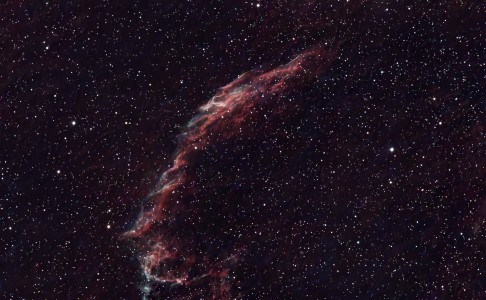
Image of the day

Captured by
GERALD KREITZBURG

Eastern Veil Nebula

My Account

New to Astromart?

Register an account...

Need Help?

Posts Made By: Anthony Wesley

June 9, 2008 02:15 AM Forum: CCD Imaging and Processing/Solar System

Jupiter and Callisto

Posted By Anthony Wesley

Certainly a very good image for your location!

Anthony

July 2, 2008 09:54 AM Forum: CCD Imaging and Processing/Solar System

Best planetary camera

Posted By Anthony Wesley

James Witt said:

Just curious what your opinion is regarding the best Planetary cameras that are available on the market today? Also why and what makes them so.

Regards,
-JW:

Hi James. I've spent a few years on and off looking for the ideal planetary camera. There's a wide range of ccd's available, with different pixel sizes and sensitivities, so that's the first place to start. You need to match the pixel size to your scope and focal length (with barlows etc).

Then there's the sensitivity... that's harder to work out cause you have to adjust for the pixel size. The best ccd's seem to be the sony ICX424AL, ICX098L and ICX285 or Kodak KAI0340DM. The 285 might be the best but its also by far the most expensive. The Kodak is a close second and has the advantage of high readout speed.

Then there's the camera itself and the features you need - adjustable exposure and framerate, overlapping exposing the next frame with transferring the last, region of interest windowing, gain/contrast/gamma adjustments etc.

And it doesn't stop there - then there's the choice of USB or firewire. The basic difference is that there's a single standard for firewire cameras that they all support, but no standard for USB so every camera is different and only works with the vendors software.

After trying a few of the cameras on the market my personal favourites are the firewire cameras from Point Grey Research in Canada, specifically the Dragonfly express and Dragonfly2 monochrome cameras.

There is a new camera coming from them - the Grasshopper, which promises to be the best camera yet. As soon as it s available I'll be getting one for eval.

cheers, Anthony
September 18, 2008 10:43 AM Forum: CCD Imaging and Processing/Solar System

Jupiter Time Limit

Posted By Anthony Wesley

Kevin,

Personally I use 3 minutes total on Jupiter - 1 minute per channel in r,g,b. There is some colour dispersion visible at the edges, but you can trade this off to get the features aligned properly where it counts, ie in the centre of the disk.

eg, here's an image from last night taken with these settings: 1 minute per channel in R,G,B @ 40fps. ie 2400 frames per channel or 7200 frames total. I normally stack the best 1000 frames in each channel, or about 40% of the total frames.

ps, registax has no specific features to correct for rotation, but if you use the multipoint alignment then this has much the same end result, not really correcting for rotations but translations, however for small movements that ok.

regards, Anthony

March 2, 2009 05:19 AM Forum: CCD Imaging and Processing/Solar System

Is this a good planetary camera?

Posted By Anthony Wesley

Greg Bradley said:

I have been looking at the specs of several cameras.

This would appear to have one of the highest but I may be overlooking something here.

My setup will be TEC180mm fluorite or Tak BRC250 using either with a Baader fluorite flatfield converter
giving say 5 or 6X =F35 or more. (Baader FFC will do up to 8X).

This is the camera. A Point Grey Research Grasshopper ICX274 chipped 1624 x 1224 (2mb)30 frames per second, with firewire 800mb/sec and 14 bit analogue to digital converter with 8,12,16 or 24 bit data output, 32mb buffer, binning and regions of interest ability. This means a smaller ROI would give a higher frame rate if needed but if not needed 30fps at 2mb could produce a lot of resolution. This is a mono camera although colour is an alternative.

Hard disk memory is cheap now, I bought a 1 terrabyte external hard disk for AUD$250 so memory is not really a concern.

http://www.ptgrey.com/products/grasshopper/Point_Grey_Grasshopper_datasheet.pdf

The chip is the same as the Lumenera 2-2 but the electronics would on paper appear to be considerably superior.

Am I evaluating this right?

Or would I be better off going for a KAI0340 chip with 200 frames per second capability and 640 x 480 or an ICX424 with 9.9um pixels with its resultant lower noise and higher sensitivity and also 74 frames per second but "only" 648 x 488?

The consideration being image scale, sensitivity and speed of fps.

Any suggestions about this?

Greg.

greg, I was about to get one of these, and then found the Grasshopper2 specs, that looks like a much nicer camera and so I'd recommend waiting and getting the Grasshopper2 instead if you like the look of these cameras.

Link:
http://www.ptgrey.com/products/grasshopper2/Grasshopper2_datasheet.pdf

There are 3 versions, I'm looking at the 1600x1200 version. 5.5u pixels (very similar to the DMK and others) but extremely fast data rates courtesy of the quad-port readouts on the ccd, and also the ccd specs look very good, very low noise.

There are issues with finding good software, but PGR are releasing a software dev kit that supports both Linux and Windows, so it should allow an cross-platform capture app to be written.

In the meantime you should be able to use any firewire video capture app under Windows. If you were using Linux then I'd suggest using Coriander.

regards, Anthony

March 2, 2009 05:23 AM Forum: CCD Imaging and Processing/Solar System

Saturn, March 1

Posted By Anthony Wesley

...and here's a short animation of 2 red-channel images showing quite a bit of cloud detail in the 8 minutes between the frames.

Link:
http://www.acquerra.com.au/astro/gallery/saturn/20090228-1440-1448-R/s20090228-1440-1448-R.gif

regards, Anthony

March 6, 2009 11:01 PM Forum: CCD Imaging and Processing/Solar System

Saturn 3/5/09 RRGB Good Seeing

Posted By Anthony Wesley

Well done Steve, a lovely image!

cheers, Anthony

March 7, 2009 09:33 AM Forum: CCD Imaging and Processing/Solar System

Saturn, March 6

Posted By Anthony Wesley

And here is a colour image from about 15 mins earlier. It looks to me like the bright storm is actually 2 close storms.

cheers, Anthony

March 7, 2009 11:49 AM Forum: CCD Imaging and Processing/Solar System

Afocal Saturn a day before opposition, Registax 5

Posted By Anthony Wesley

Jason, very impressive for an afocal image.

cheers, Anthony

March 8, 2009 10:43 AM Forum: CCD Imaging and Processing/Solar System

Saturn: Seeliger Effect and Double Transit

Posted By Anthony Wesley

Thanks Chris, lovely images!

cheers, Anthony

May 7, 2009 05:34 AM Forum: CCD Imaging and Processing/Solar System

Hipparchus & Albategnius

Posted By Anthony Wesley

Stefan, lovely image. Blue will give you more resolution in theory, but also suffers the most from atmospheric dispersion, so you might want to compare blue and green filters to see which is better in practice. Depends heavily on the seeing and the elevation of your target.

regards, Anthony
