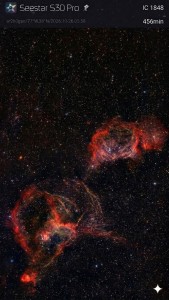
Image of the day

Captured by
Arthur Hogan

Heart and Soul Nebulas

My Account

New to Astromart?

Register an account...

Need Help?

Posts Made By: Brian Maynard

August 23, 2003 01:14 AM Forum: CCD Imaging and Processing/Solar System

NGC-6992 Redux Version

Posted By Brian Maynard

Very nice image. Great color and looks smooth.

December 24, 2003 01:30 AM Forum: CCD Imaging and Processing/Solar System

Saturn 12/21/03

Posted By Brian Maynard

Joe, great work! The northern tip of the planet showing through the cassine(forgive the spelling) division is awsome. I've only seen that in Hubble images. I can also see the elusive c ring. Fantastic!

December 26, 2003 02:48 PM Forum: CCD Imaging and Processing/Solar System

M97 and its companion

Posted By Brian Maynard

Nice shot Stefano. I think thats a whole cluster of galaxies near the nebula. I'm counting around 11 galaxies in the image. nice work

March 5, 2004 01:49 AM Forum: CCD Imaging and Processing/Solar System

SAC 7,focal reducer,questions on CCD

Posted By Brian Maynard

Just like everything else in the world, you get what you pay for. The reducer from Meade is 130 dollars because its 2 inches. Sac is 1 1/4 thus only 95 bucks. You should get the same results with whatever you choose. If you start imaging the planets and moon you dont need a reducer. You would use a good barlow lense, increacing the image scale. If imaging the moon you wouldn't even need a barlow to get nice crater images. What you will find out when trying to image dso is you MUST guide somehow. I know your scope tracks nicely visually, but the camera is hundreds of times more sensitive to the slightest movement. In a ALT/AZ mount, which you have, 10 seconds is about all you can do for exposure times before stars will start to be elongated or arches in your images. A lot of dso images need at least a 30 second exposure before you can even see it in your image. My advice, if you care to hear it, would be like you said, image the moon. Image it over and over. Get good at it. Get great at it. You'll only be able to image small sections, so you will have to learn to do mosaics to image to whole moon. Then move on to the planets. Your 12 inch should give you great planet images with lots of practice. Then you can decide if you are ready for DSO. That's when it gets more complicated and more expensive. Remember,baby steps. Good luck!

March 8, 2004 12:44 PM Forum: CCD Imaging and Processing/Solar System

Autoguiding: off-axis guider vs. finder

Posted By Brian Maynard

People have success useing both methods. If you go with an off axis guider, stay away from Meade's OAG. The pick off mirror is very small and it has a small Feild Of View. Plus, if your useing a focal reducer, you'll never get it focused. Get one of the giant easy guiders. I like the piggy backed refractor. You get a wider FOV and you can find stars well past 8th mag. for guiding. Be sure your mount can hold the extra weight and that everything is balanced or it just wont work.

May 9, 2004 03:44 PM Forum: CCD Imaging and Processing/Solar System

OT: Need friendly advice

Posted By Brian Maynard

Jose
I had the same problem with my neighbor. This guy is totaly affraid of the dark. He installed this light that would illuminate a ball park. Communication is the key. Let him know what your doing. Show him some images. Most people will cooperate. My neighbor was nice enough to leave the light off on the weekends, when I do my imaging. If your neighbor isnt so sympathetic, youll have to try a more aggressive approach. Hang a canapy, plant some landscaping that will block the light and of coarse, if all else fails, find a nice rock and accidently break the light.
Good luck.

May 13, 2004 12:22 AM Forum: CCD Imaging and Processing/Solar System

Omega Centuri

Posted By Brian Maynard

Thats a lot of stars! Good job

May 16, 2004 11:24 AM Forum: CCD Imaging and Processing/Solar System

Help w/ technique

Posted By Brian Maynard

As Joe said, align your finder scope as closely as possible. If you can, find something very distant on the horizon, a telephone pole, a chimney on a house or anything that will help put your finder right on target. Also, make sure that when everything is attached that it is balanced. If your able, hook everything up and move the scope around by hand. You should be able to let go of the scope and it will stay in any position. If it dosent, your not balanced.
That will affect the pointing accuracy of your drive system.
Hope this helps.

May 16, 2004 11:36 AM Forum: CCD Imaging and Processing/Solar System

May 17, 2004 11:33 AM Forum: CCD Imaging and Processing/Solar System
