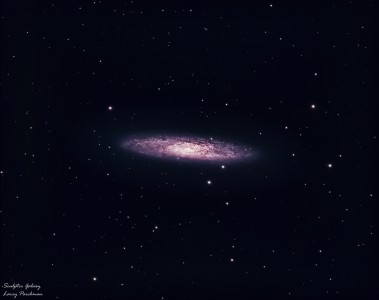
Image of the day

Captured by
Lawrence Parchman

Sculptor Galaxy (NGC 253)

My Account

New to Astromart?

Register an account...

Need Help?

Posts Made By: Dave Mitsky

November 8, 2004 11:14 AM Forum: Solar System Observing

The Sunday Night Aurora, 2004/11/8 UT

Posted By Dave Mitsky

I first beheld Sunday night's spectacular display of the aurora borealis shortly after 8:00 pm EST (01:00 UT, 2004/11/8) from northern Harrisburg, Pennsylvania. Rays, sheets, and curtains were visible in the north and northwest but local light pollution diminished their impact somewhat.

A second and more intense wave of auroral activity commenced around 11:15 pm EST (04:15 UT) and continued for more than an hour. By that time I had traveled to the ASH Naylor Observatory, which is near Lewisberry. When the celestial fireworks subsided I began observing with the ASH 17" f/15 classical Cassegrain, spending time on binary stars, open clusters, emission and planetary nebulae, and Saturn.

At about 2:45 am EST (07:45 UT) on Monday morning a third auroral display began. This was the most spectacular of the three periods that I witnessed. At least six rays stretched from the horizon to near the zenith from the north through the northwest. The most prominent ray was in the northwest and extended upwards to Perseus. These may have been the brightest auroral rays that I've ever seen. As far as color was concerned, I saw white and muted green and red hues.

Dave Mitsky

November 10, 2004 01:04 PM Forum: Solar System Observing

The Moon Occults Jupiter, 2004/11/9

Posted By Dave Mitsky

Early Tuesday morning the old crescent Moon, Jupiter, and Venus formed a striking celestial dogleg. As the morning progressed, the Moon closed the gap with Jupiter on the way to crossing paths with the King of Planets.

Two fellow ASH members and I were fortunate enough to witness the occultation of Jupiter from the ASH Naylor Observatory. To do so we had to dodge the fair weather clouds that littered the sky and nearly occluded the occultation.

Instruments used were a 5" f/5 achromatic refractor, an 8" f/6 Hardin Dob, a 12.5" f/6.5 Cave Newtonian, and a 17" f/15 classical Cassegrain.

I saw the Moon grow close to the planet through the 17" and 5" and watched the actual event through the 12.5" and the 8", using primarily a 26mm Tele Vue Ploessl (79x) and a 20mm Meade Wide Angle (66x) respectively. Seeing Jupiter being consumed gradually by the lunar surface beginning at 11:05 a.m. EST (16:05 UT) was a blast. The Galilean satellites were not visible, of course.

While we waited for Jupiter to reappear, we observed the Sun through an 8" Celestron Orange Tube SCT, a 2" generic 32mm Erfle, and a full aperture Orion glass solar filter. The large active region AR 10696 was quite impressive and was large enough to be seen without optical aid but otherwise the sun seemed to be devoid of sunspots.

The clouds were not so kind for the reemergence of Jupiter at 12:09 p.m. EST (17:09 UT) but I did catch it about 6 minutes later through the 5" achromat and a 16mm Brandon.

When it comes to daytime planetary occultations I suppose seeing half of one isn't too bad.

Before I left the observatory I viewed the Moon, which was by then far to the southwest, and Venus through the 5" and the 17" and a 55mm University Optics Ploessl (118x) but I couldn't locate Jupiter.

Dave Mitsky


November 24, 2004 05:07 AM Forum: Equipment Talk

Re: GREEN LASER BASHING:

Posted By Dave Mitsky

Tell that to a friend of mine who was lased in one eye at the Black Forest Star Party by a responsible individual who sells GLPs. (Their use is banned there by the way.) He's still suffering from some after effects.

http://www.adpc.purdue.edu/PhysFac/rem/rs/laserpt.htm

http://www.laserinstitute.org/publications/safety_bulletin/laser_pointer/

http://www.straightdope.com/mailbag/mlaserpoint.html

http://hps.org/hpspublications/articles/laser.html

http://www.labour.gov.sk.ca/safety/bulletins/laser-pointers.htm

Dave Mitsky

November 25, 2004 05:51 AM Forum: Deep Sky Observing

Saturday Night in a Home Dome, 2003/11/14 UT

Posted By Dave Mitsky

This report falls into the better late than never category I suppose.

On Saturday, November 13/14, I spent some time observing at the eyepiece of a 20" f/10 classical Cassegrain located at a friend's observatory. It was a fairly good night in terms of seeing and transparency. The first object we viewed was Comet Tucker Q1 . It appeared as a small, rather unimpressive fuzzball at 203x (25mm University Optics MK-70).

We then had a look at the bright spiral galaxy NGC 7331 in Pegasus. Using 203x and 302x (16.8mm Orion MegaVista) we studied the field and eventually positively identified four of its faint companion galaxies, namely NGC 7335, NGC 7336, NGC 7337, and NGC 7340. These galaxies range in brightness from mid-thirteenth magnitude to mid-fourteenth magnitude. NGC 7336 was the most difficult of the bunch to detect.

After slewing the big scope slightly southward, I noticed that NGC 7320, the brightest member of Stephan's Quintet, was fairly easy to discern. We didn't spend much time on the remaining members.

The next celestial target was another comet, Comet Maccholz Q2, at 127 (40mm Orion UltraScan), 159 (32mm Edmund Scientific Erfle), and 203x. I noted a wedge-shaped coma and a short tail that pointed to the northwest.

The planetary nebula NGC 1535 in Eridanus was a fine target using the 25mm with Orion UltraBlock and Lumicon O-III filters. At 127x an unfiltered NGC 1535 displayed a pleasing blue hue and a prominent central star.

The face-on spiral galaxy NGC 1232 (203x), also located in Eridanus, was fairly large and rather faint.

I showed my friend the fine binary star 32 Eridani, which is somewhat reminiscent of Albireo (Beta Cygni) as far as the colors of its components are concerned.

My friend had to get going so after taking a peek at the supernova remnant M1 we closed the Home Dome and went home.

Dave Mitsky

November 28, 2004 04:08 PM Forum: Deep Sky Observing

December 2004 DSO List

Posted By Dave Mitsky

This list should keep people busy throughout next month. Ho ho ho!

Dave Mitsky

One hundred deep-sky objects for December: NGC 891 (Andromeda); IC 342, K6, St23, Tom 5 (Camelopardalis); Be65, IC 1848, K4, Mel15, NGC 896, NGC 1027, St2, Tr3 (Cassiopeia); M77, NGC 788, NGC 835, NGC 864, NGC 908, NGC 936, NGC 955, NGC 958, NGC 1015, NGC 1016, NGC 1022, NGC 1023, NGC 1052, NGC 1055, NGC 1087, NGC 1094 (Cetus); IC 2006, NGC 1084, NGC 1140, NGC 1187, NGC 1199, NGC 1209, NGC 1232, NGC 1291, NGC 1300, NGC 1309, NGC 1332, NGC 1337, NGC 1353, NGC 1357, NGC 1395, NGC 1400, NGC 1407, NGC 1421, NGC 1426, NGC 1440, NGC 1452, NGC 1453, NGC 1461 (Eridanus); NGC 1079, NGC 1097, NGC 1201, NGC 1292, NGC 1316, NGC 1317, NGC 1326, NGC 1344, NGC 1350, NGC 1360, NGC 1365, NGC 1371, NGC 1374, NGC 1379, NGC 1380, NGC 1381, NGC 1387, NGC 1398, NGC 1404, NGC 1406, NGC 1425 (Fornax); Bas10, Cz8, IC 351, IC 2003, K5, Mel 20, M34, NGC 869, NGC 884, NGC 957, NGC 1023, NGC 1058, NGC 1161, NGC 1245, NGC 1275, NGC 1333, NGC 1342, NGC 1444, Tr2 (Perseus); M45 (Taurus); NGC 777, NGC 784, NGC 890, NGC 925, NGC 949, NGC 959, NGC 978A/B (Triangulum)

Challenge deep-sky object for December: vdB14 (Perseus)

December 3, 2004 08:28 PM Forum: Solar System Observing

Photos of the Venus-Jupiter Appulse

Posted By Dave Mitsky

I finally got my film shots from November 6 developed and scanned. Here's one of them.

Dave Mitsky

December 4, 2004 07:22 AM Forum: Pictures of Me and My Telescope and........

The Morning After

Posted By Dave Mitsky

Here's a shot of me and one of my telescopes, a 101mm f/5.4 Tele Vue Genesis sdf, after observing all night at a dark site in central Pennsylvania's Tuscarora State Forest.

Dave Mitsky

December 4, 2004 06:09 PM Forum: After Dark

Aurora Alert

Posted By Dave Mitsky

From S & T's AstroAlert for Sun-Earth Interactions:

An earthward directed coronal mass ejection is expected to increase levels of auroral activity early in the UTC day of 05 December (very late evening hours of Saturday night or very early morning hours of Sunday morning over North America). Activity has the potential to become sporadically strong over isolated regions. Observations from locations equatorward of the lines noted above are also possible in isolated regions. Observers are encouraged to watch the skies over the next few nights for possible northern lights activity.

This watch will remain valid through 23:00 UTC (6 pm EST) on 06 December. It will then be allowed to expire. For updated information, visit: http://www.spacew.com/aurora/forum.html . For real-time plots of current activity, visit: http://www.spacew.com/plots.html or http://www.sec.noaa.gov .

PLEASE REPORT OBSERVATIONS OF AURORAL ACTIVITY TO:
http://www.spacew.com/submitsighting.html

Dave Mitsky

December 17, 2004 10:04 AM Forum: Solar System Observing

C/2004 Q2 (Machholz) - Naked-Eye Sighting

Posted By Dave Mitsky

Comet Machholz Q2 was visible to the unaided eye with direct vision on Wednesday night, 2004/12/15, from a sixth magnitude dark site. It was a fine sight through 7x50 and 15x70 binoculars, my 101mm f/5.4 Tele Vue refractor, and a friend's 14.5" Starmaster Dob. The coma was distinctly blue in color through the telescopes. We could see the short dust tail but the ion tale eluded us. See these images - http://encke.jpl.nasa.gov/images/04Q2/04Q2_041203_mfh1.jpg and http://encke.jpl.nasa.gov/images/04Q2/04Q2_041204_mj1.jpg - from the Comet Observation Home Page.

The comet is currently located in Eridanus, to the lower right (west) of Rigel.

A finder chart is available at http://www.skyhound.com/sh/2004_Q2.gif (click on the image and then the icon to enlarge).

Dave Mitsky

December 17, 2004 10:45 AM Forum: Solar System Observing

Large Prominence

Posted By Dave Mitsky

There's been some major prominence activity the past two days. On Wednesday afternoon I noted a spectacular prominence on the trailing limb that was apparently still present on Thursday afternoon. It had morphed by that time into a large, looping structure.

There was also an extensive prominence on the leading limb. Several long filaments were present as well.

Observations were made with a Coronado PST, a 8-24mm Vixen zoom lens and, on Thursday, a 2x Ultima Barlow lens.

Dave Mitsky