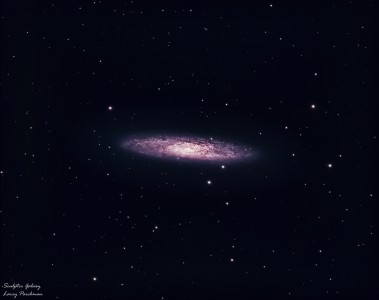
Image of the day

Captured by
Lawrence Parchman

Sculptor Galaxy (NGC 253)

My Account

New to Astromart?

Register an account...

Need Help?

Posts Made By: Alex McConahay

September 21, 2007 09:33 PM Forum: CCD Imaging and Processing/Deep Sky

Exposure Calculator

Posted By Alex McConahay

I see a number of Java Applets out in various places that allow one to enter the background values for a test exposure, and the time, etc. and have suggested subexposure values returned.....

But I don't see anything anywhere to do the same thing that one can operate without being on-line. It seems like a relatively simple calculation if they can javascript it.

Anybody know where I can get an application that does this and works off line, or where I can get the formulae so I can put it into a spreadsheet?

Oh, and hopefully is free or shareware! And not a $149 program.....

Alex

September 24, 2007 03:48 AM Forum: Equipment Talk

My favorite Astro flashlight

Posted By Alex McConahay

My favorite astro flashlight does not exist, as far as I know. If it did, it would have the following features:

...It would run on AA's or AAA's
...It would have a red led and a "white" (whether that be bluish white, yellowish white, I don't really care)
...To get from red to white or back, you would have to flip some kind of switch. (Not just rotate the wheel a little further past a click stop--with those wheels, you have to be careful which way you are turning the wheel so you don't get white when you meant red.)
...Obviously it would have a wheel, or better yet slider to dim/brighten the light. Slider is better because you can tell where it is set before you turn it on.
...It would have a master power switch so that it could not be left on in a dim position, or an auto-off so that it shuts itself off after five minutes. (If I'm using it, I would just turn it back on, if it is just sitting in its case and I had accidentally left it on, it would save its battery.)
...Small enough, and nicely rubberized, so that you can stick it in your mouth.
....And a nice lanyard to hold it around your neck, while pointing down. (But the lanyard should not clip on the back end such that it gets in the way when the light is in my mouth.)
...IT should be small, but not so small that I couldn't find it when I needed it!

Anybody make suggestions?

Alex

October 1, 2007 01:26 AM Forum: Equipment Talk

Gemini v. Losmandy DSC and Digital Drive

Posted By Alex McConahay

Anybody who upgraded from a G-11 digital drive system to a Gemini care to share some experiences?

I am dissatisfied with my Losmandy DSC and Digital Drive system for astroimaging. I am somewhat close, but at least half the time not within field of view with the DSC. How much better, if at all, is the Gemini system. I don't mind upgrading, but would hate to upgrade and find the only real difference is the goto v. pushto. If the Gemini is not a whole lot better at finding things, it is not really worth it to me.

Alex

October 4, 2007 01:49 PM Forum: Equipment Talk

Orthogonality and Polar alignment

Posted By Alex McConahay

In various threads, I have read discussion that if the mount's axes are not at right angles, you cannot get a good polar alignment. I have also read that you can overcome this by shimming. Well. Here is my question.

Is the requirement that the mount (where the dec meets the right ascension) be orthogonal, or that the scope be orthogonal to ??? (that the optical axis of the scope be at right angles to ????)? (and then, of course, just what does the optical axis of the scope have to be orthogonal to?)

I ask this because I have seen setups where an astrophoto guide scope rides on top of an imaging tube. It has it's own rings and can be set at a different angle than the main scope (pointed slightly elsewhere to find a good guide star). By definition, unless the imaging scope and guidescope are exactly collimated, one or the other would be non-orthogonal.

I understood that even if two scopes were pointed to different places, on a given mount, that neither would experience drift (as long as the mount itself were properly polar aligned).

Just wondering.

Alex

October 9, 2007 02:34 AM Forum: Star Parties

RTMC announces Pacific Astronomy and Telescope Sho

Posted By Alex McConahay

The folks at RTMC will be producing a new event starting September 13 and 14, 2008.

The Pacific Astronomy and Telescope Show (PATS) will feature vendors, lectures, and presentations for amateur astronomers from all over. It will be held in the Pasadena Convention and Conference Center on a full moon weekend each fall.

It is hoped that other amateur astronomy organizations will take the opportunity to organize their own annual meetings and events around this gathering of vendors, presenters, and enthusiasts.

There is a lot of planning yet to do, but for what information there is, go to:

www.rtmcastronomyexpo.org/PATS.htm

Alex

October 31, 2007 10:19 PM Forum: CCD Imaging and Processing/Deep Sky

Ideal exposure

Posted By Alex McConahay

I've looked at the manuals and the books, but I cannot find a good answer--or it has gotten lost in the tons of stuff I have seen.

What exposure should I shoot for with my CCD camera?

My experience with DSLR says shoot for as long as mount, skyglow, and saturation allow. That is, keep the shutter open until the stars record at the maximum sensor reading, unless that means you get too much skyglow or the mount inaccuracies are showing up.

Just what does that mean with a CCD. With CCDSoft 5, I saw that my exposures were reading 54000 or so max--which is close to saturation, but when I actually pulled them up to start processing, they were very dim.--only about 4000. Am I getting fooled by the viewing software auto-correcting or something in the display? Does the Max value in CCD soft show the saturation of the of the brightest pixels, or something else?

In short--how do I decide how long to keep the shutter open?

Alex

November 20, 2007 07:03 PM Forum: CCD Imaging and Processing/Deep Sky

Exposure relationships

Posted By Alex McConahay

I'm new to CCD work, and am trying to figure out some good guesses for where to start exposures. I know I can look at what others have done, but I need to know some "exposure relationships." To that end, I would like to know:

If I make a perfect exposure of X time, with 1x1 binning, and then increase the binning to 2x2, would my perfect exposure become X/4, and at 3X3 would it be X/9?

I've got another related question about filters, but I believe it is more complicated. So, I'll start another thread for them.

Alex


November 20, 2007 07:10 PM Forum: CCD Imaging and Processing/Deep Sky

Filter relationships

Posted By Alex McConahay

A second question (after binning in another thread).

I am assuming that any given filter except clear cuts out a certain amount of light. If the clear lets it all in, the red lets in about half, the green about half, and the blue, say, about two fifths or something. This will vary from manufacturer to manufacturer, but it could be measured and calibrated for any given set of filters/camera. And the measurements would change according to the color of the target.

With that in mind, if I could figure out the "efficiency" of my filters, and knew the perfect exposure time for "clear," could I multiply the inverse of the efficiency of a given filter by the perfect clear exposure time to get a good starting point for a color filter exposure?

Thanks for the advice.

Alex

December 9, 2007 02:56 PM Forum: Equipment Talk

Re: equipment pricing

Posted By Alex McConahay

Don,

Go to the classifieds here, and see what others are trying to sell their equipment for.

Alex

December 22, 2007 03:42 AM Forum: CCD Imaging and Processing/Deep Sky

Corrector/Focal Reducer position

Posted By Alex McConahay

Does it matter where the F6.3 Focal Reducer/Field Flattener goes in the imaging train? I have it screwed on the back of the SCT (C9.25), followed by a Robofocuser. Will that work, or should it be just before the camera? (after the focuser?)

Alex