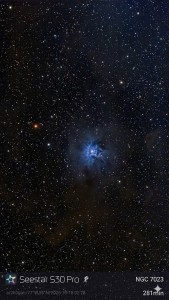
Image of the day

Captured by
Arthur Hogan

Iris Nebula

My Account

New to Astromart?

Register an account...

Need Help?

Posts Made By: Curt Renz

December 31, 2007 06:27 PM Forum: Solar System Observing

Mercury as January Evening Star

Posted By Curt Renz

Mercury is popping into the western sky as an evening star following its superior conjunction on the far side of the Sun on 2007 DEC 17. It will achieve its greatest eastern elongation for this apparition of 18.6° on 2008 JAN 21. From Chicagoland its greatest altitude at 30 minutes after sunset will be 10.3° on JAN 23, the same evening that it will appear 50% illuminated like a Half Moon. Before that date it will appear gibbous and afterward as a crescent. It will then swoop down for its inferior conjunction between Earth and Sun on FEB 06.

I’ve created a panoramic graphic demonstrating the position of Mercury in the western sky 30 minutes after sunset as observed from Chicagoland between JAN 01 and FEB 03. It should well serve most northern hemisphere observers. That and my January astronomical wallpaper calendar can be seen by clicking: http://www.curtrenz.com/astronomical.html

The young crescent Moon will appear near Mercury on 2008 JAN 09. Below is a picture I took of the Moon and Mercury on 2007 MAY 17. Photos and descriptions of the upcoming apparition of Mercury would be welcome additions to this thread.


January 6, 2008 06:15 PM Forum: Solar System Observing

Spot the New Moon near Mercury on JAN 09

Posted By Curt Renz

The Dark Moon will be in geocentric longitudinal conjunction with the Sun on 2008 JAN 08 at 11:37 UT. Since we've passed the winter solstice, New Moon spotting is becoming easier for northern hemisphere observers. That will be especially true during February through May. The timing of the conjunction this month makes it impossible for northern hemisphere observers to spot the Moon aged less than 24 hours, despite otherwise improved conditions. But the Moon on the 9th aged 1.5 days and near Mercury should be a pretty sight.

I’ve created a graphic previewing the southwestern sky as viewed from Chicagoland 30 minutes after sunset on the 9th. Mercury will be about 3° to the lower right of the Moon. The graphic should well serve most North American observers. It and another graphic demonstrating the current apparition of Mercury as an evening star can be seen by clicking: http://www.curtrenz.com/astronomical.html

Photos or descriptions of the January New Moon would be welcome additions to this thread. Below is a picture I took on 2007 MAY 17 of the Moon aged 30:42 hrs and near Mercury.



January 10, 2008 02:51 AM Forum: Solar System Observing

Moon Occults Pleiades - JAN 17/18

Posted By Curt Renz

For North Americans the 76% illuminated waxing gibbous Moon will occult stars of the Pleiades (M45) cluster during the night of 2008 JAN 17/18. Immersions will occur on the Moon’s dark limb and emersions on the bright limb. Some of the graze paths will pass through populated areas.

I’ve created a graze map that can be downloaded. Those who are north of a star’s southern graze path and south of its northern path can witness both the immersion and emersion of that star. In some cases no northern path is drawn because it is in outer space above the North Pole. Observers on a graze path will be able to see a star winking on and off as lunar hills and valleys pass by. To see the map, click: http://www.curtrenz.com/astronomical.html

Also on that web page is a graphic I made to illustrate the event at a time when the Moon is covering three Pleiades stars for Chicagoland observers. Photos and descriptions of the event would be welcome additions to this thread.

For folks in Alaska and northwestern Canada, the 91% illuminated waxing gibbous Moon will occult Mars during the late afternoon of 2008 JAN 19. It may be possible to witness the daytime event without optical aid, but binoculars or a telescope would be helpful. A graze map is available on the same webpage with the other graphics.

January 18, 2008 06:16 PM Forum: Solar System Observing

Total Lunar Eclipse - 2008 FEB 20/21

Posted By Curt Renz

A total lunar eclipse will occur during the night of 2008 FEB 20/21. As with any Full Moon, it will be visible from the entire nighttime side of the Earth. Most or all of it will be seen in the Americas, Europe and Africa.

The maximum magnitude in the umbra will be 1.105. That means during totality the greatest separation between the edge of the umbra (dark portion of Earth’s shadow) and the nearest point on the limb of the Moon will be 10.5% of a lunar diameter. The greatest possible magnitude is 1.881.

This will be the last total lunar eclipse until 2010 DEC 21, although there will be three partial lunar eclipses between now and then.

Below are my predictions for the various stages of the event in Universal (Greenwich) Time. I use the French Rule for shadow sizes and know of no other source that takes into account the oblate shape of the Earth.

00:37 UT – Moon enters penumbra (gray fringe shadow)
01:43 UT – Moon enters umbra (dark inner shadow)
02:18 UT – 50% of Moon’s diameter covered by umbra (magnitude 0.500)
03:01 UT – Totality begins (magnitude 1.000)
03:26 UT – Maximum eclipse (magnitude 1.105)
03:51 UT – Totality ends (magnitude 1.000)
04:34 UT – 50% of Moon’s diameter covered by umbra (magnitude 0.500)
05:09 UT – Moon exits umbra (dark inner shadow)
06:16 UT – Moon exits penumbra (gray fringe shadow)

I’ve created graphics that illustrate the stages of the eclipse as seen from Arlington Heights, Illinois and London, England. They should well serve most observers in North America or Europe. They can be seen by clicking: http://www.curtrenz.com/astronomical.html

Photos and descriptions of the eclipse would be welcome additions to this thread.

January 26, 2008 09:33 PM Forum: N.A.S.A.

Large Uncontrollable Satellite Falling Down Soon

Posted By Curt Renz

From AP:

WASHINGTON - A large U.S. spy satellite has lost power and propulsion and could hit the Earth in late February or March, government officials said Saturday.

Link: http://news.yahoo.com/s/ap/20080126/ap_on_go_ot/dead_satellite_4

February 15, 2008 09:26 PM Forum: Solar System Observing

Mercury as Morning Star during early 2008

Posted By Curt Renz

Mercury has begun an apparition as a morning star following its inferior conjunction between Earth and Sun on 2008 FEB 06. It will achieve its greatest western elongation of 27.1° on MAR 03 before descending to superior conjunction beyond the Sun on APR 16. The waning crescent Moon will appear near Mercury during the morning of MAR 05 (MAR 06 in the eastern hemisphere).

This will be a fine apparition for southern hemisphere observers but somewhat of a challenge for those of us in the north. I’ve created panoramic graphics for folks in both hemispheres. They can be seen by clicking: http://www.curtrenz.com/astronomical.html

Photos and descriptions of Mercury will be welcome additions to this thread.

February 18, 2008 07:32 PM Forum: Star Parties

Lunar Eclipse - Chicago's Adler Planetarium - 2/20

Posted By Curt Renz

Joe Guzmán who operates the Chicago Astronomer website will be hosting a public gathering outside Chicago's Adler Planetarium on Wednesday evening February 20 to view the total lunar eclipse. Bring your telescope or look through those brought by others.

Here’s a link to my thread on this message board with information and graphics related to the eclipse: http://www.astromart.com/forums/viewpost.asp?forum_post_id=571492&poll_id=&news_id=&page=

February 23, 2008 11:54 PM Forum: Solar System Observing

Moon Occults Venus - 2008 MAR 05

Posted By Curt Renz

The 5% illuminated waning crescent Moon will occult magnitude -3.9 Venus for many North Americans during the afternoon of Wednesday 2008 MAR 05. Since it will be a daytime event, a telescope or binoculars may be required. Venus will be elongated 24.4° west of the Sun. Immersion will occur on the Moon’s bright limb and emersion on the dark limb.

Extreme care must be taken not to look at the Sun!

Observers between the northern and southern graze paths will witness a full occultation. Those on a graze path will see lunar hills and valleys passing across the disk of Venus.

I’ve created a North American graze map, also preview graphics and data for the location of Chicago’s Adler Planetarium. They can be seen at: http://www.CurtRenz.com/astronomical.html

Photos and descriptions of the event would be welcome additions to this thread.

February 29, 2008 10:29 PM Forum: N.A.S.A.

Study Casts Doubt on Water on Mars' Surface

Posted By Curt Renz

WASHINGTON (Reuters) - It made a big splash when scientists announced in 2006 that images from a NASA spacecraft indicated water apparently had flowed on the surface of Mars in the past decade but new research casts doubt on that finding.

Link: http://news.yahoo.com/s/nm/20080229/sc_nm/mars_water_dc

March 2, 2008 06:16 PM Forum: Solar System Observing

March New Moon Spotting

Posted By Curt Renz

Who will be the first to spot the March New Moon with naked eyes after sunset?

The Dark Moon will be in geocentric longitudinal conjunction with the Sun on 2008 MAR 07 at 17:14 UT. We’re in the months of the year surrounding the vernal equinox during which New Moon spotting is ideal for northern hemisphere observers. The current point in the Moon’s 18.6-year nodal cycle is also helpful. And being near perigee helps the Moon to separate from the Sun more quickly. However, this month the timing of the conjunction will make it virtually impossible for North Americans to spot the Moon aged less than 24 hours. But the New Moon in the Old Moon’s Arms should be a pretty sight on Saturday evening.

I’ve created a graphic previewing the western sky as viewed from Chicagoland 30 minutes after sunset on Saturday March 8, although it should well serve most North Americans. There will be no other planets or bright stars to serve as guides. Therefore the azimuth and altitude markings on the diagram will be particularly helpful. The graphic can be seen by clicking: http://www.curtrenz.com/astronomical.html

Photos or descriptions of the March New Moon would be welcome additions to this thread. Please include the date, time, time zone and location. Good Luck!

Below is a photo I took on 2007 MAY 17 of the Moon aged 30:42 hours, which is similar to the age it will be for North Americans during the evening of 2008 MAR 08. Mercury also appears in the picture.