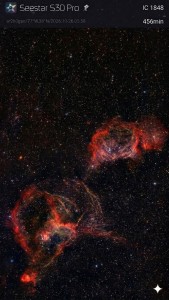
Image of the day

Captured by
Arthur Hogan

Heart and Soul Nebulas

My Account

New to Astromart?

Register an account...

Need Help?

Posts Made By: Mike Hosea

October 9, 2003 03:46 PM Forum: Equipment Talk

How do YOU say APO?

Posted By Mike Hosea

I say it "AY poh" and care not one wit whether anybody thinks that is correct or not. If you want to be "correct", simply refrain from such a heinous abbreviation, an abbreviated adjectival noun. Yuk!
--
Mike

October 13, 2003 08:12 PM Forum: Equipment Talk

October 18, 2003 07:50 PM Forum: Eyepieces

What causes eyepieces to blackout?

Posted By Mike Hosea

Bill,

Suppose you're standing at home plate and at first second and third base there is a person shining a laser pointer at the strike zone. Now suppose you want all three beams to strike one target, e.g. a catcher's mit. Now if all three beams come close enough to intersecting the same point, you can get all three to hit the mit, but I didn't say they all had to intersect--they're just all passing through the strike zone. Some eyepieces have "spherical aberration of the exit pupil", which is like when the beams don't all intersect the same point and so it is difficult to make them strike one target. In the analogy it's laser pointers and and catcher's mit, and with the eyepiece it is the exiting columns of light from the eyepiece and the human eye is the target.

If the catcher moves halfway towards the pitcher's mound, he has no chance of catching the beams from first and third. What happens with the eyepiece is you see the view in the center and you lose the edges. Note that the same thing happens if the catcher backs up by the same amount.

So some eyepieces are prone to blacking out because the exit pupil is not formed precisely (like the beams all passing through the strike zone but one is high right, another down the middle, and the other low left, for example). Obviously this can happen to varying degrees, and when you can catch all the light from the eyepiece it may be necessary to hold a very particular position to do it.

Another reason eyepieces black out is because the eye is too close or too far from where the exit pupil is being formed. If the exit pupil is formed precisely, as in all beams intersecting, then there is some leeway in positioning that will still catch all the light and allow it into the eye, but it is always possible to move back far enough to lose the light from the edges, and if there is enough eye relief it is possible to lose the light from the edges by moving too close as well.
--
Mike

October 21, 2003 05:39 AM Forum: Equipment Talk

Eyepiece Extension??

Posted By Mike Hosea

SCTs usually have a lot of back focus available, so an eyepiece extension should work in this particular case as long as the extension is not excessively long. Another way to go for medium and high power is to use a Barlowed eyepiece combination to achieve the magnification you want.
--
Mike

October 25, 2003 05:10 PM Forum: Telescope Making

Mounting a secondary?

Posted By Mike Hosea

Bob,

Look at page 4 of the Protostar manual.

http://www.fpi-protostar.com/ftp/instman13.pdf

--
Mike

October 29, 2003 07:38 PM Forum: Equipment Talk

24mm Pan + 5x powermate anyone?

Posted By Mike Hosea

Jason,

I haven't said much on this question because I haven't tried it. But I guess I can share with you the thought process I would go through in your shoes. You may find it interesting as I am similarly bound to try most things only at my expense and so I have to cull the possibilities somewhat by reason rather than by experimentation.

I'm sure it will work well, but at 10 elements and 12 air-to-glass surfaces I suspect the comparison of this combination to a 5mm Nagler Type 6 with 7 elements and 8 air-to-glass surfaces is not likely to defy expectations. For my money the 5x Powermate is not useful enough with a wide variety of focal lengths for my scopes to justify the expense, and in my Dob-Newts I didn't like the height of the 2.5x PowerMate which is similarly sized--just seemed unnecessarily unwieldy with moderate sized and larger eyepieces.

I think the difference between a 5x PowerMate and a 5mm Nagler Type 6 is about $75 at MAP. This is 37% more for the type 6 Nagler, nothing to sneeze at, but maybe it is a bargain when you consider the second-guessing that you will avoid versus going with the PowerMate compromise.

Anyway, that's the way it goes in my head. YMMV.
--
Mike

October 31, 2003 05:26 AM Forum: Equipment Talk

help with finder

Posted By Mike Hosea

That's what I would do. Just cut down the tube. Should be fine.
--
Mike

October 31, 2003 10:00 PM Forum: Equipment Talk

Aperture, Refractor vs. Reflector

Posted By Mike Hosea

Reflective surfaces tend to scatter more light than refractive ones, and baffling a refractor is easier. Other than that, and thermal issues with larger optics, the views are very similar at medium and high magnification. Usually modern APOs have faster f-ratios than a stopped down reflector and so are capable of wider views. If you stop down your Newt and then use a 31mm Nagler, you'll probably see that illumination for wide true fields leaves something to be desired. But for higher magnifications on planetary targets, for example, the only difference you're likely to see if your mirrors are of the same quality as the APO you're comparing against is more diffuse glow around bright objects in the reflector. This diffuse glow is always present due to atmospheric scattering, but scattering from telescope and eyepiece optics add on top of that, and the reflector is most likely going to add noticeably more of it than a refractor. It may require averted vision to notice this, though.

Since my largest reflector is only 10", I just get a 4" off-axis aperture. I've always found that that planetary detail was much inferior in the 4" mode despite the very pleasant contrast and brightness balance of the 4" view at moderate planetary magnifications. Taking off the mask, the brightness often would seem to increase more than I wanted, but I could always see more, not less. I expect ones mileage may vary as one tries this experiment with larger and larger reflectors that permit larger unobstructed off-axis apertures that get closer and closer to offering the resolution that the atmosphere permits.
--
Mike

November 5, 2003 05:30 PM Forum: Equipment Talk

Monocentric eyepeices

Posted By Mike Hosea

Yes. We've discussed it some here in the Astromart forums. Try [Search Forums] between, say, June and present on TMB or Supermonos or monocentrics in the Eyepieces forum. That should bring up some threads.

Without a doubt, the Supermonos have less scatter, and they're surprisingly well-corrected even in faster scopes, with the most bothersome off-axis aberration being field curvature in fast scopes, particularly fast scopes with a little curvature of their own, like fast Newts. You may hear talk about them being "sharper" than this or that high-quality eyepiece, but note that this usually comes when the target has low-contrast detail, so I personally think that in accord with optical expectations, they are "just as sharp" as the better competition and that their design and implementation as one super-high-quality optical group with just two air-to-glass surfaces gives them a significant contrast edge.

Eye relief is a little better than Abbe orthos at the same focal length, and it is possible to get used to the 30 degree apparent field. However, I think this will be easiest for people who consistently stick to narrow-field eyepieces. Eventually I found the shock of going back and forth between a SuperMono and type 6 Naglers to be too much, and for me using Dob-Newts, the reduction in scatter and contrast benefits weren't enough to overcome a desire to reduce my investment in equipment somewhat. I suspect that in fine APOs the reduction in scatter is more pronounced and a much stronger plus, which is to say, I think I may have chosen differently if I had an APO f/6 or slower instead of premium Dob-Newts.
--
Mike

November 5, 2003 07:43 PM Forum: Equipment Talk

This is probably a stupid question, but.....

Posted By Mike Hosea

As you may or may not have gleaned from the other responses, putting the cap on and then unplugging the hole will eliminate most of the false color at the expense of EVERYTHING else. I can't figure out when you'd ever want to do this, except to further your optical education by the experiment, but it must have seen like a good idea to the marketing division of the Sirius Cybernetics Corporation, you know, that bunch of mindless jerks who'll be the first up against the wall when the revolution comes. (c.f. Hitchhiker's Guide to the Galaxy)
--
Mike
