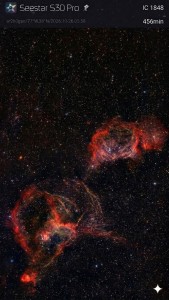
Image of the day

Captured by
Arthur Hogan

Heart and Soul Nebulas

My Account

New to Astromart?

Register an account...

Need Help?

Posts Made By: Jeff Hapeman

April 27, 2002 01:27 AM Forum: CCD Imaging and Processing/Solar System

BRC for CCD image?

Posted By Jeff Hapeman

I know a few who have tried...I understand it is a bit of pain getting the whole thing put together. The BRC is really designed primarily for film photography. I believe there was a long thread on this on the UnCensoredTakGroup on Yahoo. You may want to join and hunt that thread down.

Jeff

May 13, 2002 03:26 PM Forum: Off Topic Discussions

Virus Warning!!

Posted By Jeff Hapeman

Glenn:

Try here: http://www.sarc.com/avcenter/venc/data/w32.klez.removal.tool.html

BTW, if you kept your Outlook up to date and patched, and the same with your anti-virus software, this virus should not be a problem.

Jeff

June 18, 2002 12:36 AM Forum: CCD Imaging and Processing/Solar System

Hey "jhapeman"

Posted By Jeff Hapeman

hhehe. I have been clouded out and then I was in the hospital for the last 10 days with meningitis (tip: don't ever get it). Here is a pic from one clear night before the trip to the hospital, a four-hour hydrogen-alpha exposure of IC1396 and some other goodies. Details are here: http://www.ntsllc.com/ccdastro/IC/IC1396.html, where you can also get to the full-sized image.

Jeff

July 5, 2002 03:15 AM Forum: Equipment Talk

RC Optical quality

Posted By Jeff Hapeman

Mike:

I just got a 10" RCOS and it is superbly manufactured. The machining and fit and finish are remarkable and IMHO, comparable to Takahashi--which is to say, the best. The scope looks and feels like a Porsche. The mirror is mounted with a mirror cell with standard three-point adjustment.

Brad has some innovative designs for a collimation setup that make it very easy to collimate the RC, and it holds the collimation extremely well. The electronic secondary focuser is wonderful and precise, and the use of a special carbon-fiber composite allows it to keep precise focus throughout the night as temperature shifts (there is a balance between the carbon and a special epoxy that have coefficients of expansion and contraction that cancel out for a net result of essentially zero shift).

There is also a new Telescope Command Center setup that is just being wrapped up that interfaces with Maxim. It allows for active control of the primary and secondary temperatures as well as automated focusing.

Very slick. I am terribly impressed.

Jeff Hapeman

September 13, 2002 02:25 AM Forum: CCD Imaging and Processing/Solar System

Got Broadband? You'll need it....:-)

Posted By Jeff Hapeman

Thanks everyone! The effort was well worth it if you all could enjoy it. I still might get around to "squaring it off," but I spent a lot of my summer on this one already.

Jeff

September 18, 2002 07:03 PM Forum: CCD Imaging and Processing/Solar System

Best entry level scope for CCD Imaging??

Posted By Jeff Hapeman

Here's my advice, take it for what it's worth.

Start with short focal length imaging. This means you are a bit better off staying away from the standard SCT's. It is far easier to acquire good images, center objects on the chip, etc. with a shorter focal length than with a longer focal length.

When starting out in CCD imaging, you need to focus on learning the basics or you will never get anywhere. With a short FL, you can easily master guiding, focusing, etc. and then spend the most time where it is needed--image processing. Learning image processing is one of the most difficult parts of CCD imaging. Plan to spend a lot of time learning good processing technique.

A second major thing to make sure you get right is your mount. A good quality mount, properly rated for your load, is critical. I would stay away from the CI-700 or GP. They are of lower quality, and you will spend a lot of time just trying to make them work well. The Losmandy mounts now have an improved worm, and the quality is much better. If you have the money, spend as much as you can on the mount. The AP600 is a great choice, but if you want to get a mount that can carry heavier loads in the future, try the 900. The Takahashi mounts are excellent, but a bit clunkier to use--no nice keypads, etc--although they do work very well with The Sky. I would recommend an EM-200 or NJP-160.

As for the CCD, the Starlight cameras are OK, but stay away from the single-shot color. The colors are never very good from these cameras; you are far better off with color filters and a monohrome CCD. The HX-916 would fit here. Frankly, I would steer you towards the new SBIG ST-2000XM. The main reason people have bought the Starlight Express cameras in the past was that they were less expensive. The new SBIG ST-2000 uses the same inexpensive Sony CCD as many of the SX cameras, and also has the built-in guider chip. Anyone who does not like this feature has never used it...it is incredible to have a built-in off-axis guiding chip. It is also very easy to use for a beginner and solves a ton of problems caused by off-axis guiding.

The concepts are simple--keep it simple but high quality and the initial learning curve will be smaller and the results more gratifying. You can move up to more difficult types of imaging later--like the long FL hi-res work. Your TV-102 is a great place to start. In fact, my first telescope that I learned to image with was a TV-102 several years ago...

Hope this helps a little,

Jeff Hapeman

September 20, 2002 04:32 AM Forum: CCD Imaging and Processing/Solar System

st-2000xm first light.

Posted By Jeff Hapeman

Very nice, what filter did you use to cut down the brightness?

Jeff Hapeman

September 24, 2002 01:27 AM Forum: CCD Imaging and Processing/Solar System

LX-200 vs G-11 as an imaging mount

Posted By Jeff Hapeman

Paul,

If you want to image, it's pretty simple. Get a GEM. The LX-200 mount is not really adequate for imaging--too much PEC (WAY too much), too much backlash, etc. An AO-7 does help, but now you've spent so much money that you might was well have bought a good GEM to start with--and learning how to use an AO-7 just adds another whole level of complexity.

It sounds like you are thinking of mostly visual work, though...you need to decide what you want to use the mount for most often. The alt-az LX-200 with Meade's packaged OTAs is a pretty good package for the price and for visual work, is hard to beat.

Jeff Hapeman

September 29, 2002 01:08 AM Forum: CCD Imaging and Processing/Solar System

Veil Nebula in Ha and OIII light

Posted By Jeff Hapeman

Pretty cool, Ron. What I like about narrow-band filters is not only their ability to kill light pollution--from the moon and otherwise--but the nice improvement one sees in FWHM.

Jeff Hapeman

October 6, 2002 08:22 PM Forum: CCD Imaging and Processing/Solar System

Deep image of the Cocoon Nebula

Posted By Jeff Hapeman

Ron,

Very nice image. I took a long exposure with my FSQ of that area last year, and the dust lane is really quite long. It sort of reminds me of a snake or caterpillar, with the Cocoon as the head.

Jeff
