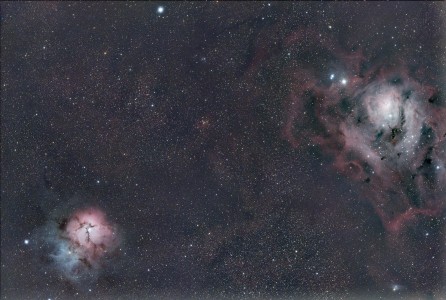
Image of the day

Captured by
Michael Scherman

Lagoon and Triffid Celestron C6 Hyperstar4

My Account

New to Astromart?

Register an account...

Need Help?

Posts Made By: Nils Schoultz

March 8, 2004 04:27 PM Forum: Telescope Making

dimwitted secondary question, with picture

Posted By Nils Schoultz

I recently bought a replacement secondary mirror for my Orion xt10, and attached it using the GE silicone adhesive folks recommend here. Now that it is on the holder, however, it looks wrong - the face of the mirror will clearly not be in the center of the tube. As seen in the picture, it is pretty far to the right of center. This new Antares quartz secondary is a good deal thicker than the original - is this the problem, if it is a problem? I had assumed that the thing to do was to glue the center of the secondary to the secondary holder. Was this wrong? What should I have done?
I'm replacing the focuser, too, so now I worry that I'm changing the position of two components of the telescope. I was worried enough about changing just one. Any advice on how to proceed would be appreciated, apologies for lowering the level of discussion.

March 10, 2004 07:02 PM Forum: Astro Binoculars

false color in big Fujinons

Posted By Nils Schoultz

Until now I've only used handheld binos for astronomy, but health problems are forcing me to consider a mounted pair. I've narrowed the choice down to the two big Fujinons - 10x70 and 16x70. I have a handle on the differences and my preferences except for the one thing that the specifications can't tell - false color. I'm sensitive to it - not that I hate it, but I notice it more and more and spend time looking at and for it, rather than at the stars. Can someone with experience comment on the difference? The 16x70 is more appealing, but if there is a lot more false color, I'd prefer the 10x70. Anyone have experience with both - maybe guru Barry?

March 30, 2004 07:35 PM Forum: Astro Binoculars

Fujinon 10x50 FMT-SX

Posted By Nils Schoultz

This binocular exists, it has been on sale in Europe for some time. Like the 7x50 I like so much, but (obviously) higher power and 65 degrees apparent field of view. German reviewers claim it is sharp and flat to the edge. It would be possible to buy from Europe, but at euro 650-700 plus shipping and customs this is not a bargain, especially since the 7x50 and 70mm models sell for so much less in the US.
I wrote to Adorama, Anacortes, Astronomics, and B&H, but so far no one knows anything about it. A rude lady at Fujinon in NJ transferred me to someone's voicemail; he hasn't returned my call. Anyone here have any more info than I have? Why would Fujinon build a binocular but not want anyone to buy it?

April 16, 2004 03:38 AM Forum: Coronado-Lunt-DayStar Solar Filters

coronado cemax eyepieces and baader?

Posted By Nils Schoultz

Has anyone used the coronado cemax eyepieces with a baader white light filter? If they are optimized for H-a, does that mean they are not a good choice for white light? They look nice, but maybe I should stick with ultimas/ultrascopics/les. I thought one of the folks on this forum might have tried this and have an opinion. The telescope is an 80mm refractor (binoviewed) if that matters.
thanks,
Nils

April 20, 2004 05:41 PM Forum: Binoviewers

Denkmeier website update

Posted By Nils Schoultz

I was just looking for their phone number and saw that they updated their website with pictures of the new power switch. Looks like they are packaging a one arm version with the standard binoviewer and the two arm version with the Denk II.

May 14, 2004 04:20 PM Forum: Binoviewers

Re: Weird things with BlackNight binoviewers?

Posted By Nils Schoultz

Levente,
I will probably get jumped on for contributing here because I have had issues with Siebert, but your post interests me as a binocular repairer (not as a Siebert critic).
Even if you can merge the images, your binocular or binoviewer can still be miscollimated. Especially at night, and with low magnifications, your eye/brain can compensate for a bit of miscollimation and merge images. The miscollimation still exists, however, and will manifest itself as a headache or tired feeling from the effort you are unconsciously making. To see if you do have a collimation problem, focus on an object in the middle distance (not at infinity) during the day. Concentrate on something right in the center of the field of view and then take turns closing each eye and looking through just one side in turn. The object should be stay centered in both sides, if not there is miscollimation.
This will be (in my experience) slightly more visible in daytime than at night - especially if the miscollimation is up/down, which the eye-brain resists compensating for more than left/right. It will also be more obvious at higher magnification, something you may have already noticed with your 15mm eyepieces. It is unlikely that the eyepieces are causing the problem.
Nils
I should note that this is binocular knowledge. I've never built a binoviewer or even taken one apart. Binoviewers are different of course in that you have one image that is being split in two, rather than two images. Still, it seems to me that the same test for collimation should work.

July 27, 2004 04:04 PM Forum: Binoviewers

tricks for achieving high magnifications?

Posted By Nils Schoultz

With the various correctors available now, getting low power in the binoviewer has become much easier. Sometimes, however, I find myself wanting higher powers than my setup allows. If you could achieve 4x or 5x easily with the binoviewer, this would allow planetary viewing with cheap and comfortable 20-30mm plossls. Has anyone found a way to do this using a barlow or powermate, before or after the diagonal, or some other interesting solution? My particular interest is getting more than the 2.5x my newtonian ocs + powerswitch allows when used in my refractor, so if anyone has any ideas, I'd be grateful.
thanks,
Nils

September 30, 2004 08:14 PM Forum: APM

Re: SuperMono respect

Posted By Nils Schoultz

Thanks Mike, I've found it wierd that it hasn't sold, too. The supermonos are great - I'm keeping my pair of 8mms and one 10mm. The 6mm just doesn't have enough field of view for me to keep up in my nudge-nudge dob, so I don't use it much. It only gives 100x in my refractor, and this isn't really a planetary magnification I use much. I hope you're wrong about the S&T article. Maybe when the planets are back up at a reasonable hour, things will change. I consider the ones I bought a bargain, they give the sharpest planetary images I've ever seen, and I second what you say about their comfort in use. I am particularly sensitive to low eye-relief and have turned away from the 19mm Panoptic and the Nagler t6s because of it. The TMBs have been no problem and are a joy to use. I don't so much mind about not selling my 6mm - it looks nice with the other two - I just think it is a shame if what you think is happening is true.
Nils

October 21, 2004 09:05 PM Forum: Binoviewers

binoviewed scope = what size bino?

Posted By Nils Schoultz

I imagine this issue has been hashed out already, but I can't find an answer searching the archive here. My question is: when you binoview a telescope, what is the equivalent in binoculars? The first thought is that a 10 inch telescope binoviewed is like a 5 inch binocular. This is wrong (I think) because instead of dividing the diameter in two, we should divide the surface area. Some quick figuring using area = pi*r^2 shows that putting a binoviewer in an 80mm scope is equivalent to 57mm binoculars, a 102mm telescope can become 72mm binoculars, and a 130mm telescope is like 92mm binoculars. This would confirm my subjective feeling that an 80mm telescope binoviewed is nothing like a 40mm binocular. Of course there are differences between how binoculars and binoviewers pass light, but am I right in thinkinng that this is the right way to give a rough estimate of what I'm seeing?

November 28, 2004 06:32 PM Forum: APM

102/800 first light

Posted By Nils Schoultz

My new 102/800 arrived last week and I have had two very moonlit nights with it. It is a replacement for a much loved and already missed 80/600 from the same LOMO (St. Petersburg) factory. First impressions were that a 4 inch scope is much more massive than a 3 inch. I had never had a refractor this size so was unprepared. I'll never want for anything bigger as a quick look scope, that's for sure. The lens cell and lw tube assembly are excellently designed and made. There were few pictures on the web of this telescope so I will include a few here. They show what is for me a invaluable feature - an extendable drawtube that allows use of a binoviewer with no corrector (when collapsed as shown in first picture) and as normal in mono mode with the extension pulled out. It secures with a simple thumbscrew on the bottom of the tube and is very smooth in operation, with just the right feeling of resistance.
I'll post more on the performance of the telescope after I have had a few more dark nights. I did have a view of Saturn that was as good as any I have ever had except perhaps for a couple of nights a few years ago with my old Intes Micro m603. The view was more dramatic in the TMB, however, due to the beautifully sharp dropoff between the gold of the planet and the blackness of space around it and between the planet and its rings. This blackness was always smeared with a bit of light scatter in the m603 and in my 10" dob, but with the TMB it is a black so black as to almost look liquid. There was also rich detail on the cloud tops and clear definition to the Cassini division. Fantastic. It is only recently that Saturn, Auriga and Orion have risen above the treetops from my backyard, so I'm sure I will have some weeks of lazy observing just staring at the old standbys.
Attached will be a few pictures of the scope, its owner, and a few of the features I mentioned. Thanks to Thomas Back, Markus Ludes, and the people at LOMO for making this fine instrument for me.
Nils
(edit) As in the movies, dog was not mistreated in taking the picture. She assumes that whenever the camera is out, she needs to be in the picture, so trotted over and sat next to the telescope.