Image of the day

Captured by
GERALD KREITZBURG

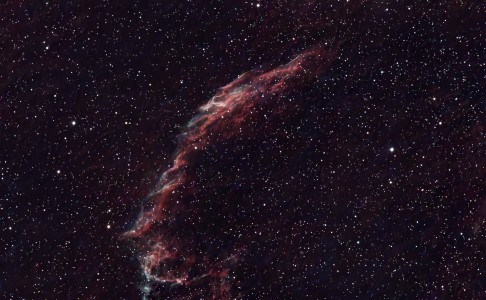
Eastern Veil Nebula

My Account

New to Astromart?

Register an account...

Need Help?

Posts Made By: Jared Willson

October 16, 2009 08:08 PM Forum: Refractors

Question on Field Flatness

Posted By Jared Willson

Is flatness of field in a doublet or triplet determined solely by the focal length? I had the impression that was so, but keep seeing owners referring to how much flatter the field is in one refractor vs. another. Obviously, my statement wouldn't apply to more complex designs with integrated field flatteners, and I understand that longer focal length scopes have flatter fields. Just curious. Is there much variation in field curvature for refractors of a given focal length?

- Jared Willson

October 22, 2009 12:10 AM Forum: CCD Imaging and Processing/Deep Sky

M33--My Best Capture to Date

Posted By Jared Willson

I don't past very many images on this forum because most of my efforts would suffer so badly from comparison. smile This one, though, felt like it was appropriate.

M33 captured from Mill Valley, CA on the night of 9/27-9/28

Astro-Physics Mach1 mount; SBIG STL-11000 camera; APM/TMB-152 @ f/8
Captured in Equinox Image; Calibrated in Maxim DL (flats, bias, and hot pixel map); Deconvolution in Maxim DL layered in Photoshop CS3; Color combine, curves, levels, and noise reduction in Photoshop CS3

70 minutes luminosity; 60 minutes H-alpha (merged into the red channel); 30 minutes each RG&B

I took the H-alpha while the moon was still up, and the rest of the data once it became dark. Strangely, I realized this is the longest exposure I have ever done (even though it's only a little over three and a half hours). Got to find a way to get out more and capture data over multiple observing sessions!

- Jared Willson


April 5, 2011 02:49 PM Forum: CCD Imaging and Processing/Deep Sky

NGC 3718

Posted By Jared Willson

It's hard for me to believe, but this past weekend was the first time I have ever taken a scope to a dark site. In this case, it was an observing trip with my astronomy club to the Mojave National Preserve about ninety miles west of Las Vegas. The skies were dark--about magnitude 6.5--but the seeing conditions were relatively poor. Apparently, winds are common this time of year in the Mojave, and this past weekend was no exception with 50 mph gusts on Saturday night.

Despite the mediocre seeing conditions, I did manage to capture an image on Friday night. NGC 3718 and its surroundings.

AT10RCF with A-P field flattener (from my 130mm refractor); A-P Mach1 GTO mount; FLI ML-8300 camera with AstroDon Gen II filters; MMOAG off axis guider with Lodestar guide camera.

120:40:40:40 LRGB with the luminance data binned 1x1 (probably a bad choice given the seeing) and the RGB data binned 2x2. While the resolution was definitely on the mediocre side, it's amazing how deep you can go even with relatively short integration time when you are imaging under transparent skies. I managed to catalog items down a bit past 20th magnitude including bunches of faint galaxies and even a few quasars.

The image was captured in Maxim DL v4 and post processed in Photoshop CS3. Darks and bias subtracted flats were used for calibration. The camera was running at -30C.

Other fun "firsts" for this trip... I saw the Zodiacal light for the first time (or at least the first time since I knew what it was). I also managed to observe Omega Centauri and Centaurs A visually for the first time, though they were awfully low on the Southern horizon.

I would love any constructive criticism.

- Jared Willson

November 21, 2005 09:00 PM Forum: Refractors

Sell Meade 102ed for WO 105ed?

Posted By Jared Willson

I owned one of the 80mm ED triplets for about a month. It was very good visually (not perfect but very good for its price point), but was not at all well corrected for the increased sensitivities that many CCD cameras have into the violet end of the spectrum. Purple halos abounded.

I don't know whether the 105 is the same optical design as the 80mm ED triplet--it may well not be. If it IS just a scaled up version of the same design, though, I'd probably lean away from it for imaging, or at least wait for some initial test reports that include imaging specifically.

My experiences are not a knock on W.O. scopes in general. In fact, I liked the 80mm enough to replace it with the Fluorite triplet version (which so far as performed flawlessly). I simply found that the 80mm ED triplet was not suitable for astroimaging. If you want to see what I ran into, just look at any of the deep sky images on the William Optics website for the 80mm ED...

- Jared

November 22, 2006 01:07 AM Forum: Refractors

It's official!

Posted By Jared Willson

It's a lovely scope, Floyd! I have one of last year's models--identical to this year's aside from the 10:1 focuser and the index marks on the draw tube--and have been extremely happy with it. I have never been able to detect any false color with it inside or outside of focus, and star tests are near perfect with mine!

FYI, it's actually FPL-53 not true Fluorite. I think WO started calling it a "Super APO" rather than a "Fluorite" scope a few months back. Not that it matters... the performance speaks for itself.

If you are going to use it for imaging you need to be aware that the field is not at all flat. Even on a relatively small CCD chip you will need a field flattener/focal reducer. The TeleVue model is a pretty good match for this scope, based on my experience. Not required, of course, for visual use.

I use mine for airline travel, as a guide scope for my FLT-110 (TEC), and for wide field astrophotography and I couldn't be happier with it.

Good luck - Jared

February 3, 2007 03:11 PM Forum: Refractors

Evaluating the New William Optics FLT 132mm

Posted By Jared Willson

This is an air spaced lens, yes? When you look through the front of the lens can you see three little spacers at 120 degrees? That could easily cause what you saw. If so, nothing at all to worry about.

- Jared

April 11, 2007 11:13 PM Forum: Refractors

the best Apo 80mm for visual.

Posted By Jared Willson

Best optics in an 80mm: LOMO 80mm 480 (I understand the 80/600 is also exceptional, but less portable)
Best optical tube for the above optics: A&M carbon tube w/ a Feathertouch focuser--just beautiful

- Jared

April 12, 2007 06:34 PM Forum: Beginning Astronomy?

Green newbie needs help with photography

Posted By Jared Willson

1) It is possible to get some amazing results with an 80mm ED and a DSLR, but there are a few things you need to know:
a) This combo is particularly well suited to wide field deep sky photography because of the short focal length and large CCD chip
b) Deep sky astrophotography requires a really good quality mount for accurate tracking over a long period of time. I would say something like an Celestron CG5 or an Orion Sirius mount is the bare minimum--even with your relatively short focal length. That will let you take 30s+ unguided subexposures and combine them in Photoshop (or equivalent)
c) For most narrow field DSO's, you don't have enough aperture or focal length, so concentrate on the wide field stuff like diffuse nebulae, some brighter, nearby galaxies, open and globular clusters, and a few of the nearby planetaries
2) For planetary imaging, I would still recommend doing prime focus photography rather than eypiece projection. Mounting a camera the size of a digital rebel w/ its lens on the back of your scope along with a star diagonal and an eypiece is going to be a bit "touchy." I'd try out a couple of barlows stacked together and see whether that works. See if you can borrow the barlows. Strictly speaking, you don't need an equitorial mount for lunar and planetary imaging since the exposures are so short, but it is still helpful since you can avoid the image drifting across the field of view of your camera.
3) Some of the best planetary cameras are actually NOT created with traditional cameras. Instead, a lot of astrophotographers have found that webcams work really well. They let you take an AVI movie, throw out the worst frames, and enhance the detail by combining the information from multiple images. It's not very expensive, either, and the cameras are so light that they don't pose much of a challenge to your mount. I would think about getting a Celestron NexImage camera--about $100 US--and trying out Registax software
4) Even though your scope and camera are suited for wide field DSO's, I would think about starting with planetary imaging. That way you can avoid the expense of a new mount. Also, planetary imaging (at least in my opinion) is a little easier than deep sky imaging, though it still has a pretty steep learning curve.
5) Can't recommend any books in particular as I have mostly learned through trial-and-error and by finding online resources.

Best of Luck!

June 3, 2007 10:34 PM Forum: Refractors

Orion ED100 star test

Posted By Jared Willson

Try running the same test through some colored filters to get a better idea what is going on. If you have a fairly narrow band green filter, that is the best choice. You may find that the rings are more similar inside and outside of focus when only one frequency at a time is examined. That that is the case, then what you are seeing is most likely spherochromatism--a sort of a cross between spherical aberration and chromatic aberration.

Spherochromatism is a shift in the level of spherical correction with wavelength. A scope that is well corrected for spherical aberration in the green portion of the spectrum, for example, may not be in the red portion or the blue portion.

- Jared

October 17, 2007 03:42 AM Forum: CCD Imaging and Processing/Deep Sky

vdB27 area in Taurus

Posted By Jared Willson

Absolutely superb work, Tom!