Image of the day

Captured by
Arthur Hogan

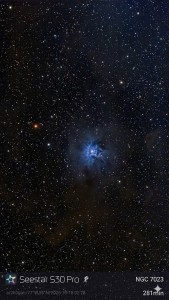
Iris Nebula

My Account

New to Astromart?

Register an account...

Need Help?

Posts Made By: Bill Meyers

April 23, 2005 01:12 AM Forum: Equipment Talk

Nagler 7 or Nagler 5?

Posted By Bill Meyers

In my scope my Nagler 9 gives 161x. (The scope is an 11 f4.55 SM Dob with Paracorr yeilding an effective focal e length of 62.5 inches). I need something higher for the moon and planets. Seeing is not so good here in Ohio. A Nagler 7 would give 208x, which sounds a bit low -- 250 would be perfect I think -- and a 5 Nagler would give 280. Which should I choose?
Thanks for any advice.
Bill Meyers

April 23, 2005 02:24 AM Forum: Eyepieces

Nagler 7 or Nagler 5?

Posted By Bill Meyers

n my scope my Nagler 9 gives 161x. (The scope is an 11 f4.55 SM Dob with Paracorr yeilding an effective focal e length of 62.5 inches). I need something higher for the moon and planets. Seeing is not so good here in Ohio. A Nagler 7 would give 208x, which sounds a bit low -- 250 would be perfect I think -- and a 5 Nagler would give 280. Which should I choose?
Thanks for any advice.
Bill Meyers

Thread:

May 15, 2005 01:26 AM Forum: Equipment Talk

A Pfund of nformation?

Posted By Bill Meyers

Is anyone familiar with these scopes or with the Pfund design? One type is being sold at
http://www.customopticalsystems.com/
Sounds interesting. Any info will be appreciated.
Thanks
Bill Meyers

May 19, 2005 03:57 PM Forum: Deep Sky Observing

Startesting star charts for the traveler

Posted By Bill Meyers

When I compare star charts to see which to purchase, or to use
on a given cccasion, I use the following criteria:

1. Faintest stars shown. On this basis, the Peterson Guide, Pasachoff,
Stars and Planets, bests all other compact books since it goes to
magnitude 7.5. Scale is small, but a plastic loup that sits on the
charts will make it more readable, at least at a desk.

SA 2000 original edition goes to mag 8, and SA3000 revised goes to mag
8.5, about doubling the number of stars shown, a big help.

The limiting mag for the Night Sky Observers' Guide finder charts,is
said to be mag 9, more than doubling the number of stars, I estimate,
of SA2000 Revised. To see this visually, I always examine the region
near Eta and Zeta Scopii.

The new versions fo the Astro Cards, are computer drawn rather than
by hand unlike the earlier edtion. The mag limit is stated to be 9,
but I find it shows many more stars than the NSOG finder charts.

2. Number of objects shown. Pasachoff greatly exceeds othr books
here too, but the charts in SA2000 has still more.

3. Contrast when viewed at night. Here the yellow stars on blue
backgroud Moore and Tirion book, the Cambridge Guide to the Stars and
Planets, excels. Paschoff is not very readable by me under red light
For reasons of low contrast, the earlier Ridpath and Tirion Collins
Guide to the Stars and Planets,is bested by the other books.
Deep Map 600 is even more readable under red light than any of the
above books.

4. Commentary. John Sanford, Observing the Constellations, uses the
same maps as Ridpath and Tirion but accompanies the charts with much
more extsive commmentary and descriptions, so it easily bests the
Moore and Tirion book. Pasachoff has good commentary as well but not
as good as Sanford.

5.Contiguity. If a chart shows a constellation but doesn't show
objects in adjoining constellations even though the objects are only a
very small distance away, it is harder to use. Paschoff doesn't make
this error but Ridpath and Tirion, Moore and Tirion, and Sanford do.

6. Scale. Deep Map 600 has a larger scale than any of the books
mentioned and I prefer it to them for that reason. It has some
commentary as well.

7. Included objects. I apply a Scorpius test, a Sagittarius test, and
a Canis Major test, to evaluate selection of objects. I look to see if
NGC6231 is included, and if 6302 (The Bug Nebula) are included in
Scorpius, and if 6822 and 6828, two globulars in Sag thar are very
close the the center of our galaxy, are included. I look to see if
h3945, one of the great double stars, is shown and labelled, in Canis
Major. Deep Map 600, the new AStrocards, and SA2000 Revised score well
here.

8. Naming. I look to see if 6302 the Bug Nebula is named on the chart,
and if NGC 6822 is named on the chart.

9. Scale. The new Astrocards have the same ;arge scale as SA2000 , a
big plus for both. it is slightly smaller scale than the SA2000
Revised, Deluxe Edition.

10. Portability. It looks like the New AStrocards, plus the reader for
them, will go to the Shingletown Star Party with me. Also, as a
backup, some sheets from SA2000 first edition, removed from the
binding and folded in the way one folds a road map, accordian style,
an idea I got from an article by Tony Flanders.

11. Aesthetics. Erich Karkoschka's fine little book, The Observer's
Sky Atlas, is very compact and goes to mag 9 in its finder charts. It
is a good alternative to the new Astrocard plus charts from SA2000
combination described above though I am not enthusiatic about it from
an aesthetic viewpoint. I might take the second Edition to
Shingletoown with me.

Ciao,
Bill Meyers


June 18, 2005 04:56 AM Forum: Equipment Talk

Starblast vs. ST 80, 100, 120?

Posted By Bill Meyers

I have never owned any of these but am considering gettng a grab and go scope and am leaning tgoward the Starblast but would like to consider the others also. Can anyone compare them optically, mechaniclly and especially ergonomically? Convenience is really important to me.
Thanks,
Bill Meyers

June 21, 2005 03:39 AM Forum: Equipment Talk

Quo Vadis Johnsonian pop-up scopesS

Posted By Bill Meyers

this scope has been on the market for at least two years, but I have seen no posts or reviews of it, which is surprising considering its highy original design. Does anyone know anything about it? Surely some must have been sold by now. Thanks for any information,
Bill Meyers

July 15, 2005 05:23 PM Forum: Equipment Talk

Two new books

Posted By Bill Meyers

Astronomy Hacks: Tips and Tools for Observing the Night Sky, by Robert
Bruce Thompson and Barbara Fricthman Thompson, paperback, O'Reilly
Press, New York, 2005, 388 pages, $24.95, contains 65 very detailed
and well-presented tips, called hacks by the authors, on equipment and
observing procedures, useful to beginners and to fairly advanced
observers. The authors' judgement strikes me as exceptionally sound. I
think it is a fine book to recommned to beginning and intermediate
observers. I got a lot out of it.

The Next Step: Finding and Viewing Messier's Objects, by Ken Graun,
published by Ken Press, Tucson Arizona, 2005, hardcover, 352 pages,
$29.95. This covers all the M objects with photos of constant scale,
and descriptions. It invites comparison to Mallas and Kreimer, and to
O'Meara's book, also based on observations with 4 inch Tele Vue
refractors. Okay, I'll compare them: Mallas and Kreimer paved the way
and is very solid and well-organized. They are good observers. O'Meara
is a world class observer, he includes sketches, he is a good writer,
and he gives much more information about the objects than do the
others. Ken Graun is an accomplihed observer, but an outstanding
writer, a winner of prizes for astronomical writing. His long
discussions of Messier himself are highly original, well-researched
and totally charming. The layout of the book is superb. A delightful
book.
Ciao,
Bill Meyers


April 26, 2006 03:10 AM Forum: Equipment Talk

Finding Y Canum Venatacorum with SkyCommander

Posted By Bill Meyers

Hi, everyone,
I have SC the 2003 edition, which I like. I use it on an SM Dob in the Dob mode, without tracking, and I can find DSO's in the catalog easily. And I can find any of the 41 or so stars that are listed in order to initialize the SC. Similarly I can find double and multiple stars since SC gives a separate catalog for them.
However, I cannot easily find a non-double star, let's say Y Canum Venatacorum, since there is no catalog for individual stars. Y Canum is a carbon star and there are about 30 or so of these I want to find. I have to use SC since I am observing from my driveway in the city and can't see enough stars to starhop.
Any advice would be appreciated.
Thanks,
Bill Meyers

May 22, 2006 01:53 AM Forum: Equipment Talk

Wanted: altitude brake?

Posted By Bill Meyers

Hi,
I have a premium 11 inch dob, well balanced for eyepiece weight but when I change from a heavy widefield eyepiece, such as a 31 Nagler or 20 Nagler Type 2, to another eyepiece of the same or different weight, the scope moves during the change and I lose the object. Extremely frustrating and time-wasting.
Thanks for any suggestions about what to do to remedy this.
Clear skies,
Bill Meyers

May 27, 2006 09:07 PM Forum: Equipment Talk

Where is M13 - a brief review

Posted By Bill Meyers


This is a nifty new software program by Bill Tschumy of ThinkAstronomy.com, cost $19, that shows the location of 784 deep sky objects in our galaxy and outside it, by means of a top and side view, so together they approximate a three dimension view. The Messiers, Caldwells, and a variety of NGCs and Ics and Crs are among those shown.
I have tried hard for a long time to find good representation of where DSOs are in our galaxy, including resort to Henbest and Cooper’s The Guide to the Galaxy, and consulting a lovely map of the galaxy published a few years ago by National Geographic, in which they had the help of some very good people in specifying object locations.
But I like Where is M13 very much better than those. I think it would be a wonderful tool for teaching people about the sky, combined with looking through a scope at public gatherings. This indeed is Bill Tschumy’s interest.
To get an idea of what the program can do to help visualization, enter for example M2 and M3 and M75, or M1 and M20, or NGC 659.
Clear skies,
Bill Meyers
