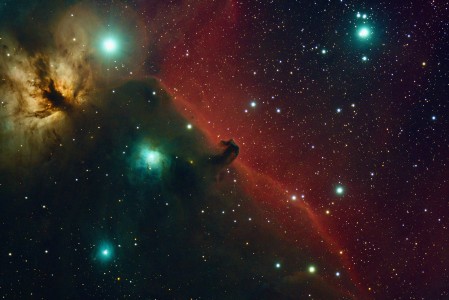
Image of the day

Captured by
Erwin Forbragd

Horsehead Nebula

My Account

New to Astromart?

Register an account...

Need Help?

Posts Made By: Timm Bottoni

March 1, 2006 07:59 PM Forum: Refractors

Foam vs Knife-Edge Baffles

Posted By Timm Bottoni

Hi Phil,

I found a picture in this review of knife edge baffles for you.
http://www.cloudynights.com/item.php?item_id=1274&pr=2x6x17

It sort of shows it.

I would bet that foam is cheaper, and my Megrez II 80 used to make the "vwoop" sound when it was really cold out, but I fixed it with a couple of self sticking black felt circles for next to nothing. I had a sheet of them from the store that we use to put on the bottom of things to keep them from scratching the surface of a shelf or table. I unscrewed the tube and lens from the focuser, and slid the foam baffles to the right spot and stuck two on the inside the tube so that it doesn't slide backwards anymore.

The foam contracts a LOT more than the metal, of course, when its below freezing out. I guess only those of us crazy enough to observe in cold temps found that out. The foam is surprisingly tight and hard to slide at room temps.

Take it easy bud!

Timm

Philip Good said:

I've seen various references on other sites to advantages of foam ridged baffles versus knife-edge baffling. Statements such as the foam "absorbs" the light and a conical foam baffle is placed along the light path to provide extra baffling. Is this just marketing hype and can some of the gurus here spell out advantages/disadvantages between foam and kife edge baffling and maybe even explain what exactly knife-edge baffling is?

Obviously, one disadvantage of the faom baffle, as some of us have found out, is that it can come loose inside the scope and slide around, making a rather amuzing "vwoop" sound. grin

Thanks

March 5, 2006 08:55 PM Forum: Beginning Astronomy?

What happened - 1st attempt

Posted By Timm Bottoni

Hi,

Did you cover the viewfinder? If not, light can enter the viewfinder from the back, and bounce back into the camera while the shutter is open on a long exposure.

Timm

Todd Lindley said:

Help! This was my 1st night out to attempt widefield astrophotograpy with my Digital Rebel on a barndoor mount. I was unpleasantly surprised to see that with exposures of about a minute or more...the image began saturating white. Can anyone explain what is happening here?

Sky was good and dark with a street light a few houses behind me (at my back). Little to no light pollution in the direction of the photo. Settings were:

Canon Digital Rebel (300D)
18mm f3.5 2 min

Todd

March 14, 2006 09:32 PM Forum: Refractors

WO APOGRADE comparison shots

Posted By Timm Bottoni

Shot prime focus with a Canon 20D, cropped to 100% view. The shot is in focus, and the Semi-Apo lens is collimated perfectly by me.

Timm

March 14, 2006 09:34 PM Forum: Refractors

WO APOGRADE comparison shots

Posted By Timm Bottoni

Same picture but with the FD lens, collimation has not been touched, this is how it came from WO, I had to move the tripod back about 10 feet, so that the magnification would be roughly the same. Again cropped to 100%.

Timm

March 16, 2006 03:12 PM Forum: Birding Optics and Photos

Cardinal

Posted By Timm Bottoni

Ivan Ong said:

A red cardinal on an unseasonably warm winter's day. I shot this with my Tv-60mm with a Canon 20D, hand held. At ISO 1600, no issues with handholding!
Ivan

Nice shot!

I shot this using my WO Megrez FD and a Canon 20D - on a tripod 1/800 at ISO 800 from inside my house but with the door open.

Timm

April 11, 2006 05:12 PM Forum: Digital SLR AstroPhotography

Eclipse from Egypt

Posted By Timm Bottoni

Excellent work!

Timm

April 14, 2006 03:29 AM Forum: Equipment Talk

Apo refractors comparison

Posted By Timm Bottoni

Hi,

The only one I can comment on is my Megrez 80 that is now an APO with the APOGRADE.

See my review if you are interested...
http://www.astromart.com/articles/article.asp?article_id=398

Timm

July 22, 2006 02:04 PM Forum: Equipment Talk

WO 8x42 APO vs Celestron Outland LX 8x42

Posted By Timm Bottoni

Hi,

I have the WO 8x42 APO binocs, so I can only speak about them, having never seen the others. I bought mine from WO last Fall during their floor model clearance, and they were obviously making room for the new Phase coated ones, since mine are before that.

Overall these are excellent binocs, very sharp (to near the edge - blurs slightly right at the edge of the field of view) with excellent contrast, good fully multi-coated optics, virtually no false color on axis. They are well made, have a very close min focus of about 6 feet, have nice twist up eyecups with good eyerelief, and I would guess that the new models are even better.

Highly recommened by me, at least. WO stands behind their products but you can contact them directly and ask them about the warranty. Send them an email which you can find on their website on any page - they are very responsive.

Also, I have my comments on the mini review on Bird Forum.net along with the others...
http://www.birdforum.net/reviews/showproduct.php?product=117

Timm

July 26, 2006 02:17 PM Forum: Beginning Astronomy?

How to calculate Powermate/Barlow magnification wh

Posted By Timm Bottoni

Use a tape measure and measure it in the daylight.

Setup a tape measure on something like a fence, far enough away to reach focus. Measure the field of view with something like a medium focal length eyepiece, a plossl should work. See how many inches you see - lets say you are at 100 inches.

Then using the same eyepiece, see how many inches you see of the tape measure, then use the double barlow and see how many inches you see.

There is a chance that you will cut off or vignette some of the field of view, but assuming you aren't vingetting, the ratio of the field of view should equal the magnification ratio.

You can do the math knowing your first magnification of the unbarlowed eyepiece since magnification = telescope focal length / eyepiece focal length.

Lets say you have a 1000mm focal length scope, and your eyepiece is a 10mm eyepiece, which equals 100X. Your first measurement is 100 inches of tape measure.

Then you barlow and see 50 inches, so take 100/50 = 2X, and you are at 200X. With two barlows, lets say you see 20 inches which would then give you 100/20 = 5X, so you are at 500X.

Does that help?

Timm

P.S. I got this from the book "Astronomy Hacks" - a very worthwhile read, especially if you own a reflector, in particular a Dobsonian.

August 4, 2006 10:35 PM Forum: Eyepieces

Burgess Optics TMB PLanetary Review

Posted By Timm Bottoni

Excellent review! Very objective and qualitative!

I am seriously thinking of moving to wider field eyepieces than my Televue Plossls, and knowing what experienced observers think of the various options is a huge benefit when trying to decide how to part with one's hard earned cash.

Timm
