Image of the day

Captured by
Michael Scherman

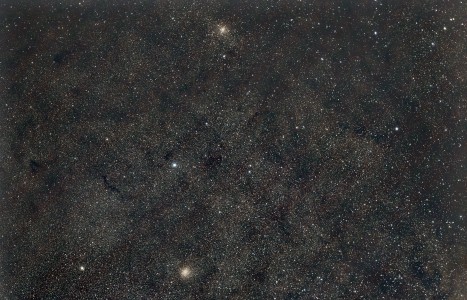
Dual Clusters near Antares

My Account

New to Astromart?

Register an account...

Need Help?

Posts Made By: Bob Woish

January 2, 2008 08:06 PM Forum: Equipment Talk

Help with Star Testing My SVP120

Posted By Bob Woish

I recently got an Orion Sky View Pro 120 achromat and it does a good job on planets, the primary reason I got it. But the star test shows zone errors. Is it reasonable to think that another one would perform better? I am attaching the star test (inside focus on left, outside focus on right). This was shot through a green filter.

I am trying to learn to evaluate star tests. I am getting the Suiter book.

Any comments apprecitated!
Bob

January 17, 2004 10:56 PM Forum: Equipment Talk

Orion SteadyPix Universal Camera Mount opinions??

Posted By Bob Woish

I hate mine. It also slips around, not to mention being a real pain to set up in the first place. Be careful not to scratch your camera lens with the eyepiece.

Also only my Orthos will fit it. Plossls have a broader lens mount so you have to grap the EP lower on the barrel, limiting the length of barrel that can fit in the focuser, adding to the stability problem that's already there.

I took the plunge and bought a webcam and 1-1/4 inch telescope adapter. Much better! Now I can shoot .avi files and combine frames. (see registax.com)

I never got my $$$'s worth out of the (un)Steadypix.

January 17, 2004 11:08 PM Forum: Solar System Observing

Jupiter and Saturn

Posted By Bob Woish

Yikes! Paul that's awesome for an 8" SCT. What camera do you use? (I looked at your site.)

Bob

January 17, 2004 11:22 PM Forum: Solar System Observing

Visual observation of Encke division?

Posted By Bob Woish

re: "Is it possible to see the Encke with an 8" aperture scope, assuming good seeing and good optics?"

This was taken with a Celestron G8.

January 22, 2004 01:56 PM Forum: Equipment Talk

Do I really need to clean my mirror, please help

Posted By Bob Woish

Hi Ricardo,

Well opinions are like, uhmm, noses, everybody's got one. Here's mine...

I'd clean it but definitly take heed of Floyd's advice about distilled water, and yes, begin by allowing running water to rinse off any looses particles. And I would add that while cleaning the mirror, forget the gloves. If treated, they'll introduce chemicals onto the mirror. If not, they can still introduce lint.

Just wash your hands throroughly first. Use cotton balls and VERY mild dish soap to do the cleaning. Apply the dilluted soap to the mirror and swirl it around GENTLY under running water with a few cotton balls in hand. Don't "turn" the cotton balls, as any finger oils will be on the side you hold. IN other words, let nothing touch the mirror that has touched your hands. Grab new cotton balls instead. Repeat this so that the residue from the film on your mirror gets washed off as well.

When done, rinse and dry as Floyd suggested, but don't use Kleenex! It will deposit tiny flakes of lint back onto the mirror. Use an old, clean, well-used towel that has had all the lint washed out over many washings. And BARELY dab the surface. I can usually dab up the water droplets without actually contacting the mirror surface.

I would not want an unknown substance on my mirrors. If you're not sure what it is, it could be something that could attack the coatings over time if left there.

Once you're happy with your cleaning job, remember the old saying, "A dirty mirror is better than a poorly cleaned one." The little dust specks that take up residence on optical surfaces don't affect performance very much at all, certainly it would have to be really dirty to degrade your images noticeably.

Good luck,
Bob

January 25, 2004 05:07 PM Forum: Equipment Talk

Recommended First Scope???

Posted By Bob Woish

6" Dob. Enough aperture for deep-sky, enough f-ratio (usually f/8) for excellent planetary and lunar views, and portable enough. My 6 incher is one of my favorite scopes.

If you want something driven, look at the Orion AstroView 90. I just got one and I love it. $342 with drive. But for my only scope I'd go with the Dob.

January 26, 2004 04:05 PM Forum: Equipment Talk

Web Cams?

Posted By Bob Woish

Yes, they're a good solution. But stay with CCD sensors and stay away from CMOS, they're way too grainy.

These were taken with a Celestron G8 and Philips ToUCam Pro.

January 27, 2004 11:28 PM Forum: Equipment Talk

Recommended First Scope???

Posted By Bob Woish

Mark, there's an Orion Skyview 90 in the classifieds, only $200. It's the same as the AstroView.

Click here http://astromart.com/viewad.asp?cid=244986

Bob

January 30, 2004 06:12 PM Forum: Equipment Talk

Orion Astroview 90 vs. 6” f/8 Newtonian

Posted By Bob Woish

...continued

Both scopes also showed a faint shroud of light around the planet. Neither was objectionable to me. The refractor, of course, had its due share of violet, and the Newt, even though recently cleaned, showed glare from the inside of the tube and diffracted light from the secondary obstruction. For me, that settles that debate… both types have extra light floating around if you look for it.

OK, on to Jupiter. I still had the 130x – 135x EP’s in the scopes. Jupiter was awesome in the Newt during steady moments. Red Spot, bright pink (anyone notice nice coloring in GRS this year?) A paler section to the east. Nice contrast! Festoon city! Detailed voids in the SEB and NEB. Knots, spots, a feast! Too bad there were no transits last night.

In the refractor, almost the same, but not quite. The dimmer image cost a very small amount of detail, but with patience I could see everything I could see in the 6. I think this is amazing performance for a scope just over half the size! And, as mentioned above, I’m comparing a Chinese objective to a Parks mirror. Another round of Kudos for Chinese refractors. I’d have to say if this was my first scope, and I eventually learned to see well as would be necessary with ANY scope, I’d be absolutely thrilled with the views.

Unfortunately, clouds set in before I could push the power. But the views were so excellent I have no regrets.

I like the refractor. Again, as I have said before in the forum, I like to sit down. I adjusted the refractor tube a little forward from balance to make the height of the EP just right for sitting with my elbows comfortably on my knees, supporting my chin. Very relaxing. The Newt, yes, brighter, but I had to stand in a crooked position to look into the EP and I’d call it a night earlier than I would with a refractor, especially considering the sometimes wavier image in the larger aperture. The larger reflector didn’t reveal any more detail than the 90, but the detail was a little sharper.

If you prefer to be comfortable while viewing, or have small kids around, and enjoy steadier seeing, and have a primary interest in lunar/planetary, the refractor would be the way to go. You will certainly see more planetary detail in a refractor than in a less-than-perfectly collimated reflector. And I remind you, this comparison was done with a Parks mirror with probably a 1/10 wave surface error or less with a two-vane spider and reduced secondary obstruction (1-inch). You won’t get this performance in the average Dob. To mention a 90mm in the same breath as this scope is a credit to the AstroView.

However, I will not claim equality in any way on DSO’s between a 90mm aperture and a six-inch aperture. You makes your choices and you lays your money down. If you want deep-sky performance, and don’t mind learning to collimate WELL, and you don’t mind sometimes awkward viewing positions, then a 6-inch Dob with excellent optics would be a better choice.

January 31, 2004 01:01 AM Forum: Equipment Talk

Polarizing filters - Uses besides the moon?

Posted By Bob Woish

Using a polarizer is preferred to stopping down in good seeing, due to preserving the increased resolving power of the larger aperture. You also cut down on certain components of seeing disturbances.

If seeing is really bad, stopping down helps because your scope will not resolve larger pockets of disturbed air. You may see the image shift in apparent position as the air pockets pass through your field of view, but distort less. The tradeoff is you also lose resolving power on what you're observing.

Polarizers are a great brighness control on brighter planets too. You often see more detail in scopes of larger apertures.