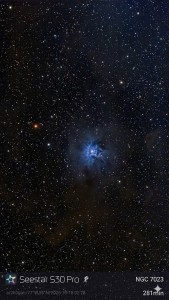
Image of the day

Captured by
Arthur Hogan

Iris Nebula

My Account

New to Astromart?

Register an account...

Need Help?

Posts Made By: bruce welte

September 13, 2003 09:00 PM Forum: Equipment Talk

Time for Another Dumb Question.....

Posted By bruce welte

I'm a newbie at this and am gradually learning bit by bit about eyepieces, my EQ mount on the Orion Skyview Pro 120, not to mention sky charts, etc. Thanks to everyone in the past for their help and suggestions. Once again, I'm posting another baffling question I'm facing.

From my backyard location, I have no problem spotting Polaris and Cassiopia (the big "W") without my telescope. A couple other major bright stars are easily seen, but things like the "teapot" are "Lost in Space." Once I get my scope set up (I have a 9 x 50 finderscope on it), using a 25 or 32 eyepiece, I'm then completely lost. I see tons of stars and twinkling lights through the finderscope and the telescope itself, but haven't a clue exactly what I'm looking at or exactly where my telescope is pointed. For example, looking at Polaris, I see it and a couple stars around it when viewing naked eye. But once I use my scope, I see at least a dozen stars or more around it. Everything starts to look alike. I know the general direction my scope is pointed, but I still don't know exactly where in the sky it's aimed. This is making it a bit difficult and frustrating to find other stars and deep space objects.

Is there a special trick you all use to figure out what you're looking at? I'm in the city of Pittsburgh and do have light pollution to a certain point. However, there's a park behind my house and I have more "dark sky" in that direction. I've heard about the green laser pointers but wasn't sure exactly how effective they are. Any comments on them or other laser pointers? Are they helpful in finding where you are pointing to? Any tricks, methods, techniques, etc. you all use to sort these stars out would be very much appreciated. Thanks in advance to everyone for their help!


October 3, 2003 12:01 PM Forum: Equipment Talk

Air Moisture, Dew, Frost, - Care & Storage

Posted By bruce welte

Being new to astronomy, this morning was my first experience with huge amounts of moisture on my equipment once I brought everything inside from the outdoors (temperature around 30 degrees with loads of frost outside).

It's easy enough to wipe off the optical tube case, mount, tripod, etc. with a paper towel, but what does everyone do about lenses and eyepieces? Although they didn't frost up outside when viewing this morning, when I brought all my equipment inside my house, the opticals all fogged up. I know just leaving the moisture on them can't be good for the opticals, but I don't want to scratch or damage the EPs, etc. either. Any suggestions would be appreciated.

Also, on another storage issue, at the present time, I leave my Skyview Pro 120 EQ refractor set up inside my house and when I want to view from my backyard, I first take the tripod and mount outside, then take out the optical tube and assemble the scope. I was giving some thought as to leaving the tripod and EQ mount outside permanently and keeping the tube only in my home when not viewing. I was thinking about keeping it stored in one of those large Rubbermaid sheds that you see at Wal-Mart and Home Depot. I though perhaps placing a large black "Hefty" bag over it, while stored inside the plastic shed would protect it from moisture and dirt. This would certainly make setup a lot easier for me. Does anyone have any thoughts as to this idea for storage? Being outside in Pennsylvania during the winter, it would be exposed to cold temperatures, but I would think moisture wouldn't be much of a problem is covered up (maybe with a blanket, then a plastic bag) while stored in the Rubbermaid shed. I use the scope any night we have clear here in Pennsylvania.

Thanks for all your suggestions.

October 20, 2003 12:51 PM Forum: Equipment Talk

Eyepieces, Powermate, Sizes & Suggestions

Posted By bruce welte

I have an Orion Skyview Pro 120EQ Refractor. I also have the following eyepieces: Celestron 7.5, Sirius 10, Nagler 17, Sirius 25, Meade Super Plossel 32, Televue 55 and a Celestron 2X barlow. My scope can take 1.25 and 2 inch eyepieces.

I was thinking of getting the TV Powermate to use especially for my 2 inch EPs. Any comments on this product or performance? Or would it make more sense for the money that the Powermate costs to get a higher power Nagler, like 4mm or so? Any other suggestions on EPs would be appreciated.

Also, my Skyview Pro has an upgraded TV diagonal. Should I consider upgrading the focuser as well? Would it make any difference in viewing if I did? If I should upgrade, anyone have any suggestions that would work for this scope and compliment my eyepieces that I have?

Thanks in advance for everyone's help and suggestions.

November 5, 2003 12:33 PM Forum: Equipment Talk

This is probably a stupid question, but.....

Posted By bruce welte

Can someone explain to me about the cap at the end of my optical tube? I have an Orion Skyview Pro 120 refractor and at the end of the tube is the dew shield, then an end cap that has 2 pieces to it. There is an inside "circle" of the cap cover that measures around 1.5 inches in diameter that can be removed, while the main end cap cover can remain in place.

Since I'm new to astronomy and scopes, I haven't a clue how I would use this. In what case(s) would I leave the end cap cover on and just remove the small center portion of the cap? Is it common to view with the cap cover on and just the center portion removed?

On another issue, for backyard city viewing I've been enjoying this scope, but I'd like some advice from the experts out there. I was thinking about buying a 2nd scope (not only for my viewing, but to share with my wife so we both have scopes to view with at the same time). I don't want to spend more than $2000 total (tube assembly, mount and tripod). What would you folks recommend that would give me more than what I already have? Viewing would be from my city backyard view. I enjoy planetary viewing and deep space objects but find results with my Skyview Pro 120 (even with Nagler EPs) limiting in brightness, clarity and details compared to many photos I see on this site.

Thanks in advance to everyone for their guidance, help and suggestions.

April 21, 2006 10:44 AM Forum: Equipment Talk

Celestron SkyScout

Posted By bruce welte

I'm curious about this new product. I live in a sky polluted city, so only very bright stars and planets are visible normally. We get an occasional dark night where you can easily see Andromeda or the Orion nebula, but most of the time, they are just "fuzzy" unless viewed with binoculars or a telescope. With Celestron's new SkyScout GPS accessory, the features of it (without magnification) make me wonder how effective this product would be for me in just identifying items I'm trying to find in the night sky. For example, with my limited knowledge of the galaxies, if I wanted to find the ring nebula and couldn't see it without any magnification device, what use would this product be? How could it be used with binoculars and/or a telescope? This seems like a great product if you are out in the country in really dark skies and just kept pointing to items to identify them, but what use would it be in light polluted skies when many objects can only be seen with magnification devices? Any feedback or comments would be appreciated, as I would hate to spend $400 and have this item sit in a drawer being unused. Thanks.