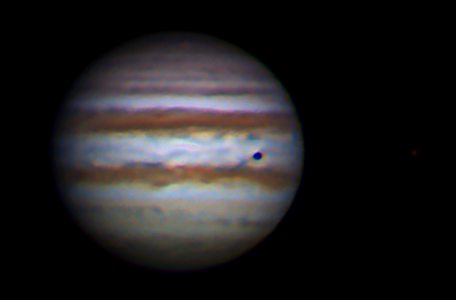
I have written on this elsewhere, the material below will get many issues out on the table. Regarding your 9.25 the first step is to get an insulated dew shield (such as the Just-Cheney dew shield) and the second step is to consider active heating. For my C14 I went to an internal dew heater for which I will try to append a picture to this post.
Here are some of my thoughts on the topic:
Tube currents are the nemesis of Newtonian owners, and other scope designs come in for their share of discussion. On SCT groups a lot of electrons are spent worrying about the effect of a heater system on the image.
Thursday night I had a 9.25 strap wrapped twice around my FS128 and the images of Mars at 250x were about as steady as one might hope. Indeed my G11 has the older stepper motors and if anything I was losing image stability to that, not to tube currents. Mars was clear and steady.
After struggling to keep my C14 frost and dew free for years I finally made the extremely radical and not widely emulated step of putting the heating strip directly in the tube. I could go on about this at great length, but to sum up, if you have it outside the tube, it's because you're trying to put heat in the tube, and if you're trying to put
heat in the tube, you might as well not waste a lot of amps trying to force it through aluminum which is doing its best to conduct it away from where you want it to be. Fact is, I haven't noticed "tube currents" on the C14 any more than I did the other night with my FS128.
Now maybe it's because I ain't picky enough.
But I have seen some pretty severe tube current situations with the same SCT, most commonly with a hot mirror; and I have watched a hot mirror stabilize over the course of an hour or two. I have seen bubbles and waves and all manner of wild and uncomfortable effects. So I feel comfortable in saying I know how the instrument performs "as a general rule."
But I note that the wisdom among Newtonian owners is that the crucial thing is to break the boundary layer over the primary. To this end they are willing to introduce "extreme tube currents" with fans that blow directly across the mirror. And the image improvement is fantastic.
A further point: When I actually studied the C14 with its internal dew heater (a 2.1 amp C11 heater that is putting out about 23 watts on the inside of the tube) I was astounded to note that the heat on the corrector was only barely detectable and the heat on the tube wasn't
detectable at all, to within the resolution of this instrument. Indeed, what I saw was, a huge delta in temperature between the sky side and the ground side of the instrument. My conclusion at the time was that the earth-sky thermal exchange mechanism basically swamps all
the other conditions going on inside the scope. I began to have an image in my head that the 23 watt heat source is really pretty feeble, that the strip still loses a lot of heat to conduction through the aluminum tube, that the air rising to the corrector is at best only a degree or two warmer than the rest of the air in the tube, and that
the cooling of the aluminum OTA rules the roost.
It has been suggested to me that the thing to do here is insulate the outside of the tube; at various times, I have done that, but I am aware of the conundrum, that one wants to *heat the corrector and cool the mirror* (in a refractor you really just want to keep the objective a bit warm). Given these contradictory objectives, these days I
basically have decided what the heck and let the system cool as it wants, and let the internal heater pump what I now perceive to be a very thin, feeble stream of heat up to the corrector.
Combined with my experiences with the FS128 and its heater, I'm of the mind, that these dew strap heaters really aren't significant impediments to performance. Of course, even if they were, they are better than having the optic frost over.
But I'm putting the point out there because I think that it is very difficult to come up with a "consistent battle plan." For example, let's say you convince me to insulate my OTA and decrease the heat going to the corrector on the SCT. We have this issue, that the outside temperature varies over the course of the night, and the primary mirror is a huge thermal mass that "tracks" thermal changes
only slowly; as we put more insulation around the tube, we slow that process down. I might be losing on the primary's ability to cool what I've gained by turning down the heater.
With a refractor, one wants the least heat possible, but even so, you've got two lenses to heat up in a doublet, and three in a triplet, so you can't cut back too far, and these optics are a lot slower to take up the heat than a thin corrector.
I'd like to end with some pithy statement, but it seems to me that you do what you gotta do, it's a practical matter; but that tube currents as such don't seem to play as much of a role in all these issues as much as the thermal boundary layers right near the surface of the
objective or primary, so that, in the end, tube currents have fallen very low on my list of worries in terms of performance.
I think it would take a hundred high quality sensors and a super computer and a Ph.D. in thermodynamics to figure this all out. I note that even with a big freezer and some smart folks at MIT one wouldn't duplicate the night sky effects. The freezer presents a nearly uniform environment from the point of view of radiative heat loss. The outside world does not.
regards
Greg N