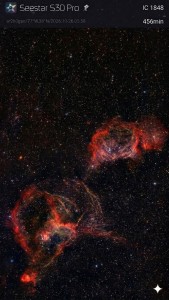
Image of the day

Captured by
Arthur Hogan

Heart and Soul Nebulas

My Account

New to Astromart?

Register an account...

Need Help?

Posts Made By: Lorne Johnson

March 14, 2007 09:48 PM Forum: Equipment Talk

Lumicon UHC filter vs. Astronomik

Posted By Lorne Johnson

Hi Paulo!

I have a Lumicon 2" inch UHC and an Astronomik 1.25 UHC. I think, but am reluctant to swear, that the Astronomik requires slightly less refocusing, and that the airy disks remain observably tighter in the Astronomik. I would describe the difference as somewhere between subtle and immaginary.

Clear Skies (non here) ,
Lorne

Paulo martin said:

Hello,

There is ani difference between the UHC Lumicon filter and Astronomik UHC?

Thanks,

Paulo

March 16, 2007 01:23 AM Forum: Beginning Astronomy?

My first telescope

Posted By Lorne Johnson

Giuseppe Quadrini said:

Hi, I'm a beginner and I'm looking for something that would be a good telescope for myself and family

Budget-Maximum 1500$

What would be recommended? I was looking at
Meade - 10" f/4 SN-10 AT LXD75 go-to, with UHTC optics
Thu I find it a bit bulky..

Any input is appreciate, thanks


The best advice is that you go to a "star pary" given by a local astronomy group, and try out some scopes.

If you can't do that, I would strongly recommend an 8" f6 dobsonian with 2 inch focuser. Cost is well below $1500 ($300 to $1000), some come with GoTo (though I don't recommend it). This leaves you money left over for some solid eyepieces, and a UHC filter, maybe a solar filter. You can see a lot with such a scope, planets, the moon, all the messier objects, the veil. It will resolve globular clusters. My favorite scope is still my 8 inch dob, and if I could only have one that would be the one.

It takes 5 minutes to set up (if you are slow). The Meade will be a beast by comparison has a narrow true field of view 1 degree maximum, and won't show much more than the 8. And because you will use it a lot more, you will actually see more through the 8" dob.

This, of course, is only my approach to spending your money, but it is also a major slice of the conventional wisdom.

Best of luck,
Lorne Johnson

March 24, 2007 09:12 PM Forum: Beginning Astronomy?

Which diagonal, 1 1/4" or 2" ??

Posted By Lorne Johnson

Bill Burghardt said:

Other than possible back focus problems with short focal length eyepieces in some telescope, the positive note is that the 2 inch diagonal gives you room for diverity in selecting new eyepeices. Cost difference is not that big an issue on your purchase, UNLESS, you buy a 1-1/4 diagonal and next week get a great chance on that 2 inch eyepiece. NOW you need to go out and double your expenditure for diagonal for the 2 inch compatable diagonal.

Simple words, get it now, and need not buy it later.

Best wishes.


I would personally do this by considering true field of view. I believe that the 703 has a focal length of 1750 mm. Limited to 1.25" eyepieces this gives you a theoretical maximum field of view of just under .9 degrees (too narrow for me). With the 2 inch eyepieces you get a theoretical field of just over 1.5 degrees, which is reasonably comfortable for me. I like deep sky and extended objects, I also star hop, so I like a wider potential field than some folks.

Best of luck!
Lorne Johnson

April 25, 2007 01:16 AM Forum: Beginning Astronomy?

Vixen GPD-2 vs. Vixen GPD

Posted By Lorne Johnson

sebrin campbell said:

I'd be very interested in user comments comparing construction quality and tracking accuracy between the newer, Chinese made (Japanese assembled) Vixen GPD-2, and the same size, slightly older, but completely Japanese made, Vixen GPD.

I believe that the GP 2 is Chinese made, to Vixen specifications. The jury appears to be out, but it certainly could go, either way.

May 19, 2007 02:46 PM Forum: Beginning Astronomy?

Which spiral?

Posted By Lorne Johnson

Hi Paul!

I've seen sprial structure in M81 (the runder one) with an 8 inch dob from a dark sight. I tried higher power more or less by chance (about 130x) and it started to show with averted vision. Skies were pretty dark.

Paul Cezanne said:

I'm a rank beginner, have only been out a few times. I have an older Celetron NexStar 8. I've been impressed by Saturn and months ago, I was impressed by the Orion Nebula.

I've been disappointed in spirals so far, but I've not seen all that many. Don't get me wrong, seeing M81 and M82 together did elict a wow, and I know I'm not going to see what the cameras see, but which spiral should I be aiming at to see some hint of arms?

I've seen arms in M51 but that was in a 14" or 16" dob.

Thanks!

Paul

June 4, 2007 12:34 PM Forum: Equipment Talk

KineOptics HC Focusers

Posted By Lorne Johnson

Evan Reed said:

I'm poking around for some good quality, low-priced, low profile focusers for a dob. I came across KineOptics and it looks like their HC-2 is just what I'm looking for. They look relatively simple (which is often a good thing), and I think they will do everything I need them to. Before I sink money into it however, I'm wondering what experiences people have had with these focusers, positive or negative. Thanks guys!


I have a friend who has one, and I am planning to put one in a dob truss (T-Scopes used to use them as standard equipment). His experience of the HC-2 is that it is a very good focuser, the length of travel did not prove to be a problem for him. It is a nice smooth focuser.

He feels that it is a harder to Sqare the HC-2 to a round tube than the more conventional crayfords. His is mounted through a wooden bevel on a sonotube, and any adjustment has to come via shims. He does not feel this would be an issue on a truss dob with a flat focuser board. You can lower the "l" length about an inch with that focuser, if you stick to typical focal-extention eyepieces.

July 17, 2007 09:34 PM Forum: Reflectors

Galaxy/Royce/Discovery/?

Posted By Lorne Johnson

Generally speaking, there are a number of very good mirror makers out there. Zambuto is the most famous, but Mike Spooner, Tom Swazey, and several others are all very much in the same league. You wouldn't go wrong with any of them. Discovery mirrors are also very good, and you wouldn't really go wrong with one of them, some people get a dicovery refugured, and often it's more a matter of finer polishing than significant refiguring. Bob Royce runs a professional optical company making this kind of thing for NASA and other places and he produces on his promises both time and performance. (He makes astronomy mirrors on the side because he is an avid amateur astronomer.) I don't have any experience with Galaxy.

Among the top levels (and that may well include Discovery) any perceived difference is as likely to be psychological as optical, and certainly the best mirrors only do their best under very good seeing conditions, rare where I live. That said, I own a Sponner 8 inch, and a Royce 12.5 inch conical (light, easy to mount, and cools down quickly). I certainly get "peace of mind" from them.


Evan Reed said:

So I am looking into building a dob around a higher-end mirror and have been doing some research on primaries. I am interested in feedback people have on the optics and customer service of these companies (or others you have worked with). I was honestly surprised to find the price differences were rather drastic. For example a 10" f/6 is $599 Discovery, $795 Royce, and $995 Galaxy. I wasn't expecting a $400 difference in price, with Galaxy leading the way (guaranteeing 0.85 or better Strehl while Royce claims 0.96). Since I have heard nothing but good things about all of these products, my biggest question is: is anything in the way of customer service being sacrificed for the lower price? Is Galaxy simply a smaller operation? Thanks for looking.

Evan

August 24, 2007 03:15 PM Forum: Equipment Talk

maximum fov of MN56?

Posted By Lorne Johnson

I've happily used my MN56 with a Siebert Observatory 36mm and (briefly) with a 35 mm TV Panoptic. The edges can't possibly be fully illuminated, but it's not something that one notices on the double cluster, the Andromeda galaxy, the Virgo cluster of galaxies, or the big Nebulae in Cygnus. I believe that it's a peripheral vision phenonenon.

Now for imaging it would be very different.

Greg Nowell said:

I got the specs off the Intes site on the MN 56 and am wondering about its maximum fov. This is a 5 inch Mak Newt and it has a two inch crayford. Now maybe that's there for eyepieces like the Nagler 17 but I'm wondering whether in fact you get a fully illuminated field of view with a 40mm 70 degree eyepiece as you would with a refractor of the same size. The secondary at 30mm would not, in a regular Newt design, be large enough to illuminate fully a two inch eyepiece.

thanks
Greg N

ps. You know, I know there's lots of different folks in the biz, but I get a little squirrely inside thinking about buying from a telescope company that spells "aperture" as "aperature." Call me old fashioned....


Tube diameter: 162 mm
Tube length: 720 mm
Clear aperature: 127 mm (5 inches)
Focal length: 762 mm
Focal ratio: f/6
Diameter of secondary mirror: 30 mm
Central obstruction (diameter basis): 23.6%
Tube construction: seamless aluminium with 7 internal tube baffles
Focuser size: 2" Low Profile Crayford Focuser with draw tube and 1.25"/2" eyepiece adaptor
Mirror coatings: 96% reflection on mirrors
optical quality: ~ 1/8 wave p.t.v. or better
Corrector substrate: Russian BK7 glass
7X35mm finder
A carry case is included

September 26, 2007 05:40 PM Forum: Reflectors

Who make the best mirror?

Posted By Lorne Johnson

Jim Mosheck has it about right. I would add Mark Harry in the 6 to 8 inch range, and Michael Spooner does great work. Bob Royce is particularly good at delivering in the time-frame he gives.


Paulo martin said:

Hello,

I like know who make the best mirror quality today., in your opinion, and why it´s the best?

Sincerely,
Paulo