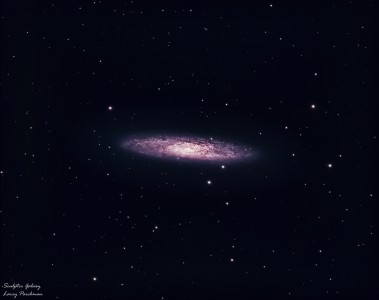
Image of the day

Captured by
Lawrence Parchman

Sculptor Galaxy (NGC 253)

My Account

New to Astromart?

Register an account...

Need Help?

Posts Made By: Ron Bee

March 11, 2005 05:42 AM Forum: Solar System Observing

Planetary Observation History

Posted By Ron Bee

In 2003, my Light Cup knocked me in the head ;-) while looking for early Mars and it suddenly dawned on me that to get a "fuller" appreciation of planetary visual observation, one should be a student of its history . Thus began my time-machine journey .

Starting with Mars (my favorite planet), the book The Planet Mars by William Sheehan is a must-read for anyone wanting to get the "timely" ;-) view of Mars, the efforts of the observers in their strive toward understanding and the mistakes/misconceptions along the way.

Moving on to Ring Planet, the book The Planet Saturn, A History of Observation, Theory and Discovery by A.F.O'D. Alexander is priceless. Much details were presented, the struggle to recognize the "ring" as ring, including the observation and discovery of the Encke Division. One can't help but develop a huge doze of respects
for the attempts of these classical observers to contribute to the sum of knowledge despite mistakes and all. Unfortunately out-of-print but can be sniffed out through used book places.

And with my recent love affairs with our lovely Moon, the Epic Moon book by Sheehan gave a deep insight into our closed neighbor which was so highly scrutinized. The unimaginable daunting accomplishment of the mappers! Some of the proposed ideas and misconceptions are well lunatic indeed . Through close-eye imagination of how it was like in previous centuries, one get a good doze of impression that the Moon was not such a simple object at all and it's no wonder that the old observers have such a tough time. A must-have for all lunartics ;-) as well as DSO observers!

Lastly, I just finished Thomas Hockey's book, Galileo's Planet, Observing Jupiter before Photography. Here, those pioneering observers before us struggle to understand what they see. The decades of observation leading to the dawning realization of the GRS was so intriguing.

In summary, myself a recent planetary/lunar newbie and tyro :-(, after having read these four books, I feel I've come to know of many new names - too many to list out here, developed a much deeper respect for the classical observers, their contribution and their ingenuity of remarkable conclusions without any space age
assistance despite some mistakes made along the way. I feel fortunate that we're benefiting from and standing astronomically microscopic on the shoulders of these "giants"! Lastly, when I look
at Mars, Saturn, the Moon and Jupiter, I feel I'm now observing on a much firmer visual foundation.

Highly recommended for your library.

Ron B[ee]

March 15, 2005 07:21 AM Forum: Eyepieces

2-4mm Nagler Zoom first light

Posted By Ron Bee

Well, as I said previously, this is my most economically shattering expensive eyepiece I've had the pleasure of forking out my dough ;-) to dear Uncle Al. I got my zoom from Skies Unlimited. Needless to say, we've had cloudy days, foggy nights since immediately after I confirmed my order online :-(.

Mechanically, the 2-4mm Nagler zoom is so well made and feel very solid, about the size of my 5mm Tak LE but heavier nevertheless much lighter than my Radian. The zoom ring twist very smoothly with no binding at all. There's a click stop at each settings of: 4mm (195x), 3.5mm (222x), 3mm (260x), 2.5mm (312x) and 2mm (390x). In used, my twisted brain ;-) seems to want to twist the zoom ring clockwise for lower power and counterclockwise for higher power which is opposite of the zoom actual operations. After I came back in, I found out the counterclockwise does mean lower power ;-).

As luck would have it, tonight was a clear night at last and I just came in shivering from the 55d F cold night after spending a frost biting ;-) 2.75 hours with the zomm, my 4mm Radian and my 4mm TMB Super Monocentric eyepieces (which all yield a nice 195x) granting a bright and contrasty 0.67mm exit pupil . The test scope is my 5.1" TMB130LW APO "Super Light Cup" ;-). Condition is Pickering 6 (7 at times) using the nearby star Beta Geminorum to gauge the seeing. Target was Saturn. I briefly took a look at the Moon to begin with but it was already getting lower and I could see the nice waves of "oceanus
air" going over the surface ;-).

First up was my trusty old 4mm TV Radian. I can't say enough how much I love the Radian, so much so my 5mm Tak LE and my 5mm Nagler T6 will soon meet with "adios" ;-). I could see the SEB, sharply defined Cassini Division with gap, grayish shading in both ansae of the B-ring and A ring that looked like it's made of a bunch of
"wires".

I dropped in the 2-4mm Nagler zoom and the view looked remarkably similar. Only after waiting a long time and looking really hard, did I see the ultra low contrast EB which I didn't see in the
Radian. Now the EB is not at all an easy feature in my opinion. Later I switched back to the Radian and after a while I saw the EB too, though not as obvious as the Nagler zoom. Everyting else had a very similar view to the Radian with the exception of the smaller FOV. Here I also discovered that while the Radian is so comfortable to use due to its eye relief, I found that the 10mm eye relief of the zoom is tight. What I mean is that to see the entire 50d AFOV,
my eye socket ;-) was touching the yucky rubber cup (please bring back the Instadjust!). If I pull back and little, the view is enormously more comfortable but I wasn't able to see the entire
FOV. No big deal really. The color rendition is also similar to the Radian: namely Saturn looks mildly yellowish. The dark green SPR is pretty obvious, though somehow not so much so in the Radian.

Last in was my planetary eyepiece: the SuperMono. After swapping several times with the zoom, I could see that Saturn had just a tad less yellowish. Let me say it's really a tad and I don't think anyone would even notice. Well, let's say the real test of the color rendition will be the bright Moon. The SuperMono is really
super sharp having only 3 elements and 2 air-glass surfaces while the Nagler zoom has remarkably only 5 elements but 6 air-glass
surfaces and the Radian having 7 elements and 16 air-glass surfaces. In moments of steadiness, I could see that Saturn was a tad sharper, evident in the EB being easier to see as well as gradations on the globe between SEB and the SPR. Let me emphasize that the difference was again very small. I'll say that most of the time were spent swapping eyepieces and waiting for steadiness.

At first, I was planning to make 3 sketches. But early during observations and swapping, it was evident that all 3 sketches would have looked nearly the same! Having spent all my time on all 3 eyepieces, I spent 0 time on sketching :-(.

While swapping eyepieces, I first notice a familiar feature with the Zoom. Back when I learned about Jupiter rim darkening last year,
this phenomena indicate existence of "phase" that is limb darkening can be attributed to the back that the outer planet is well passed opposition and that the sun angle is no longer of the same intensity at both limbs. Well the zoom showed this to me tonight and confirmed all the way slowly twisting the zoom 'till 312x. The following limb was clearly darker than the preceding rim. This was seen in the other two eyepiece later but a teeny less obvious in the Radian.

Tonight, humidity is still not non-existent evident by my eyepiece case being wet to the touch. So light scattering test will have
to wait. I did perform a lateral color test using Saturn and nearby magnitude 0.4 Alpha Canis Majoris. At about 25% from the edge of the FOV, I start to detect lateral color and get progressively more evident until the edge of the FOV in the Radian - no surprise there. There is also lateral color in the Nagler zoom perhaps slightly less maybe 20% from the edge of the FOV. There is no lateral color in the SuperMono and just a wee bit of a touch right at the edge - truly remarkable. Using Saturn however, lateral color is not noticeable in either the Radian or Zoom until the globe of Saturn is touching the edge of the FOV, not at all in the SuperMono.

I also spent some time playing with magnifications. Going up to 3.5mm (222x), this holds nicely more often than not. I'm suspecting
that this will be the sweet spot for my TMB130LW akin to 176x being a sweet spot for my 4-inch TV-102. Still a nice fairly sharp view at 3mm settings (260x). 2.5mm (312x) was acceptable at times but the 2mm settings (390x) was very revealing. Despite the exit pupil of a tortuous 0.33mm, it seems the planet was still bright enough and has good contrast. The only problem was I could actually see "waves of seeing" accross the globe of Saturn - something I haven't
seen before! The planet also vibrated noticeably Very interesting. This causes the view to be soft.

Well this is only the first light and I don't make any conclusions. But don't let me stop you if you want to make one yourself ;-). But stop right there ;-). Let me caution that the differences in sharpness and contrast are small amongst the eyepieces, none of which "wipe the floor" ;-) of the others. I plan to do more
comparison and hopely in Antoniadi II seeing or better. I also would like to test the zoom out with 8-inch Discovery PDHQ f/6 Dob (at the moment the mirror needs cleaning ;-). I do know this
however: the SuperMono and nudging just don't go together well with me ;-) - thanks goodness for driven GEM ;-).

I got the zoom of this short focal length because at these low ends of focal length, a 0.5mm change in focal length can result in an enormous gap in magnification that I speculate no single focal eye
piece will do. And as much as I love my SuperMonos as my ultimate planetary eyepieces, there just ain't anything I can use after 4mm
:-(. So, I can say that tonight the zoom has met my need and expectation with flexibility no single-focal eyepiece can even compare. And since 75X/inch on Mars did work so well with my TV-102 in 2001 and 2003 apparition when the seeing goddess gave us the kiss, I expect to be using close to the 2mm settings during this Martian apparition with my Super Light Cup ;-)!

Ron B[ee]

March 24, 2005 08:04 PM Forum: Refractors

Re: ED-80 day

Posted By Ron Bee

Michael Sutherland said:

Gad, 5 out of the first 8 ads in the refractor classified's are for Orion ED-80's.

Is there a time limit on those lenses and everyone needs to dump them quick before they start to crumble? wink

Just a FYI
Mike s

Well perhaps Mike, 'em sellers have finally recognized the errors of their ways and have come to the new dawning realization that 4-inch (100mm) is the minimum teeniest aperture to go with ;-)?

Ron the 4-inch Tall Evangelist B[ee]

May 30, 2005 04:39 AM Forum: CCD Imaging and Processing/Solar System

Which webcam?

Posted By Ron Bee

The dark side of imaging force clouds everything ... ;-). Being a pure visual observer, I've been toying with idea of experiencing the power of imaging recently.

Still knowning next to nothing about webcam but I've been learning ;-), I'd like to get my "focusers" wet soon. I've been reading up on the how-to's and the reviews and have some idea about some cameras. I'm mainly interested in planetary and lunar imaging and may dabble in DSOs some day. No black/white camera - I want color (I don't mine if I have to get a different camera for DSOs later but I rather the first camera does particularly well on the planets and the Moon).

Firstly, my environment is with APO refractors: 4" f/8.6 (FL 880mm) or 5" f/6 (FL 780mm) an Vixen SP mount with RA clock drive, being a 4-inch/5-inch Tall Evangelist you know. I also plan to get a 5X Powermate (or would my 2X Ultima or 1.8X TMB barlow that I have be sufficient to start with)? Now I understand the image scale won't be anywhere as big as 'em pictures from the mighty SCT/MCT . I have a 300 Mhz P-II laptop with 256MB running Windows 2000 with plenty of disk space (should this be sufficient to do the capture? - I can process the images later on my 2.4 GHz P4 desktop with 512MB memory).

So it appears that the Toucam Pro II which already comes with a 1.25" adapter, seems to be very popular for planetary/lunar imaging. I realize I'll need an IR filter (perhaps a Baader one).
http://www.optcorp.com/product.aspx?pid=4086&kw=Toucam&st=2

While researching, I ran across the SAC.
http://www.sac-imaging.com/main.html
SAC 10 looks intriguing but much more expensive. However, I don't see much of planetary pictures taken through the SAC and those I've seen so far don't look as good as through the Toucam.

So the question is: what should I pick? Are there any other color webcam that is "better" than the Toucam (but not too expensive)? I'm not a handyman and actually get turned off if I have to make accessories myself or have to adapter the camera a lot (don't mind learning the software however). I don't mind paying a little more if it can yield better and more painless results ;-). What about cooling? Do I really need it for planetary pictures?

Finally, I'll start out with the Moon first, try my hands at Jupiter and hopefully get enough experience by the time Mars swell hugely later this year ;-).

Thanks,
Ron B[ee]

June 9, 2005 11:57 PM Forum: Refractors

Refractor Jurassic Park?

Posted By Ron Bee

It wasn't too long ago that I read somewhere in which someone wrote wink that if it were for the efforts of Roland Christen and Al Nagler (referring to their breakthrough in APO refractors), the refractors might have gone the way of the dinosaur (i.e. extinction). I guess this was because the achromat of yesteryears were all very long in length (but prudent in focal ratio wink.

With so many new APOs these days, I wonder if the refractors have been making a come up, Jurassic Park style wink?
http://www.apogeeinc.com/

Ron B[ee]

June 13, 2005 05:37 AM Forum: Solar System Observing

Light Cup noted Alpetragius clone?

Posted By Ron Bee

Tonight, I had a great time with my old pal, my 4" TV-102 Light Cup viewing the 6-day old Moon. Upon stumbling onto Crater Capella, I immediately noted that with its central "conical peak", it looks so
close in semblance to the famous crater, Alpetragius, which also has conical central peak! Tonight best power was at 146x through my 6mm Radian, though I had a brief moment that I could play with my 2-4mm Nagler zoom @2mm (440x ;-) that felt so close to have a lick at the vanilla color and flavor ;-) cone clone.

I consulted the Modern Moon book and indeed Dr. Wood did notice the similarity between the two craters. So glad I got the impression right. Here are a couple of pictures that gave a very close picture
of what I saw tonight.
http://www.astrosurf.com/cidadao/crater_alpetragius_01.jpg
http://www.astrosurf.com/cidadao/crater_capella_01.jpg

Why not have a look and let me know if you think Capella is a clone of Alpetragius? If not, you may have to wait for the next lunar cycle to get the light angle just right.

Ron B[ee]

June 15, 2005 03:30 PM Forum: Solar System Observing

Best Mars Photos (4-inch & 5-inch)

Posted By Ron Bee

I just found these two photos from 2003, taken through a 4-inch and 5-inch APO refractor. Good heavens, I had to knock myself on the head to make sure I'm awaked. What fine photos from such small aperture!
http://alanchuhk.sev84.001at.com/P030830b.jpg
http://alanchuhk.sev84.001at.com/P030829a.jpg

Ron the 4-inch and 5-inch Tall Evangelist B[ee]

June 19, 2005 01:35 AM Forum: Equipment Talk

Can diagonal cause chromatic aberrations?

Posted By Ron Bee

Someone elsewhere stated that a diagonal could cause more chromatic aberrations than normal in achromat. Now we're talking about fairly good diagonal here (not some cheap stuff). I find this hard to fathom. If this is possible, can someone explain how this can be?

Thanks,
Ron B[ee]

June 19, 2005 03:56 PM Forum: Solar System Observing

The "Eye of Moon"?

Posted By Ron Bee

Last night, I was out rummaging on the 12-day old Moon when my 4-inch TV-102 Light Cup stumbled on crater Vitello using a 6mm Radian at 146x.

RB: What's this Light Cup?
LC: Do you remember Mars?
RB: Sure
LC: Did you remember how Solis Lacus, the Eye of Mar, look like?
RB: Who could forget.
LC: Now look closely, Do you see the "eye"?
RB: Say, what da you know!
RB: Now let's see, the central peak makes up the pupil and the surrounding ridges make up the eye with one part drooping like the painting of the Eye of Ra in an Eyptian pyramid! Right?
LC: Right on, I'd say you've got the eye ;-) for it.
LC: Now give me more OTA back rub, will ya?

I spent more time at it and made a lousy first-grader :-( sketch around 6:45UT (06/18). I was able to use my 2-4mm Nager zoom and the view that brought the eye best was at 3.5mm setting (251x) while 3mm and 2.5mm still giving a decent view at 293x and 352x! Note that blackish area to the left of the "pupil". It gave me an impression of a "red eye" ;-). In the photo from the Consolidated Lunar Atlas, I circle the eye shape with red.
http://www.cloudynights.com/observe/ronbee/Moon/Images/Vitello-EyeOfMoon.jpg

If you guys are out there lunar meandering, please check Vitello and please let me what do you see. Does our good old Moon have the "Eye of Moon" perhaps rivalling the "Eye of Mars"? Or is the Light Cup full of ???? ;-)?

Ron B[ee]

June 29, 2005 02:06 AM Forum: TeleVue

Light Cup Hot Tip - Deep Impact

Posted By Ron Bee

Here's my Light Cup Hot Tip on observing Deep Impact this July 3rd, your chance to catch this once in a life time event. My 4-inch TV-102 Light Cup is going to be at 8000 ft. elev. just to get a front-row seat to the big bang ;-).

Seeing a magnitude 10 comet is similar to seeing small magnitude 10 galaxy. So use your DSO skills and tricks if you're using small telescope. Hopefully, we'll all see the so called predicted
brightening. Driven mount ;-) will prove its worth as my Light Cup and I planned to start ahead of the 11pm event just in case there's a slight error in the predicted time of impact. Get thee to a fairly dark sky. I've already tried the comet under my orange/gray sky of NELM 3.5 and it was a *no show* in my 4-incher :-(. Make sure you have a good finder chart.

Date of impact: July 3rd 2005
Time of impact: 10:52pm Pacific time. Start watching early!
Comet magnitude: 9.3, predicted to brighten to magnitude 6!

S&T Guide:
http://skyandtelescope.com/observing/highlights/article_1522_1.asp
Charts:
http://www.griffithobs.org/comettempel.html
http://neo.jpl.nasa.gov/news/news145.html
Telescope Size:
http://deepimpact.umd.edu/amateur/beginner/sec5.shtml
Sketch of how comet look like back in May
http://deepimpact.umd.edu/amateur/view_gallery.cfm?obsnID=1322
How deep a crater:
http://www.planetary.org/deepimpact/di_crater.html
NASA FAQs:
http://deepimpact.jpl.nasa.gov/faq.html
http://deepimpact.jpl.nasa.gov/faq1.html
http://deepimpact.jpl.nasa.gov/faq2.html
http://deepimpact.jpl.nasa.gov/faq3.html
http://deepimpact.jpl.nasa.gov/faq4.html
http://deepimpact.jpl.nasa.gov/faq5.html
Who discovered the comet?
http://deepimpact.jpl.nasa.gov/science/tempel1-discoverer.html

Enjoy and best of the best luck and a Vue-ing impact ;-).

Ron B[ee]
