Image of the day

Captured by
GERALD KREITZBURG

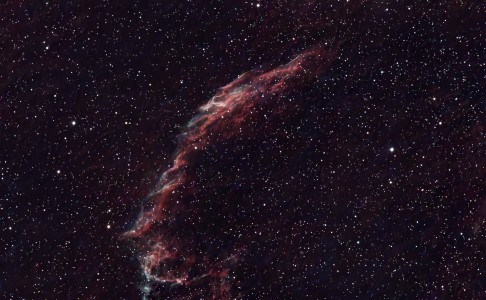
Eastern Veil Nebula

My Account

New to Astromart?

Register an account...

Need Help?

Posts Made By: Curt Renz

April 6, 2007 09:33 PM Forum: Solar System Observing

Changing Aspect of Saturn's Rings

Posted By Curt Renz

Here are couple of images that I created demonstrating Saturn and its rings in ecliptical coordinates. The first is for dates of extreme or zero tilt. The second is a set showing thirty consecutive oppositions. A larger version of the second image can be viewed at http://www.curtrenz.com/astronomical.html wink


April 10, 2007 01:26 AM Forum: Solar System Observing

Venus Passes Pleiades - April 11/12

Posted By Curt Renz

Venus will pass 2.6° to the south of Alcyone (brightest of the Pleiades, M45) during the night of April 11/12. I’ve created a graphic demonstrating Venus’s movement in ecliptical coordinates relative to the Pleiades from 2007 APR 09 through APR 15. It can be seen at http://www.curtrenz.com/astronomical.html

April 13, 2007 06:43 PM Forum: Solar System Observing

Jupiter's 2007 Apparition

Posted By Curt Renz

Jupiter was in Conjunction with the Sun on 2006 NOV 21 and is now shining in the post-midnight southeastern sky at magnitude -2.4. It is in apparent retrograde motion in the constellation of Ophiuchus, about 11° to the east of Antares, the magnitude +1.0 star in Scorpius. Jupiter is currently rising around midnight DST. It will continue to rise about four minutes earlier each evening.

The following are my predictions of oppositional extremes during Jupiter's current Synodic Cycle (the period for Earth lapping Jupiter: 1.092 years.)

JUN 05 at 23 hr UT: Opposition in Celestial Longitude
JUN 05 at 23 hr UT: Greatest Elongation of 179.3°
JUN 06 at 01 hr UT: Opposition in Right Ascension
JUN 06 at 04 hr UT: Greatest Brilliance at Mag -2.6
JUN 07 at 12 hr UT: Closest Approach at 4.30438 AU

Around the time of Opposition, Jupiter will be rising near sunset, transiting the southern meridian around local midnight, and setting near sunrise. Its ecliptical latitude at that time will be N 0.7°, and its declination will be S 21.9°. That means for northern hemisphere observers, at meridian transit Jupiter will culminate at an altitude that is equivalent to one's co-latitude (90° minus one's geographic latitude) minus 21.9°. For example, I live at N 42.1°, therefore it will culminate at 26.0° above my southern horizon.

At Opposition, Jupiter's apparent equatorial angular diameter will be 45.7 arcseconds. Its axial tilt relative to Earth will be -2.6°. Jupiter's four great satellites orbit in planes close to the planet's equatorial plane. The tilt means that this year only the inner three Gallilean satellites (not Callisto) will experience eclipses, occultations, transits and shadow transits relative to Jupiter.

After Jupiter's 2007 Opposition, it will become stationary in celestial longitude and resume its apparent direct motion on AUG 07 at 02 hr UT. Jupiter will be 5° north of Antares on AUG 21 at 10 hr UT, their closet mutual approach this year. Jupiter will reach Eastern Quadrature (90° east of Sun) on SEP 04 at 00 hr UT. Eventually it will again move in Conjunction behind the Sun on DEC 23. Jupiter will not be occulted by the Moon in 2007.

For information on the visibility of all naked-eye planets, please consult my monthly astronomical wallpaper calendar at:

http://www.curtrenz.com/astronomical.html

Also, that webpage will frequently have graphics demonstrating upcoming shadow transits across the disk of Jupiter due to its satellites.

I "discovered" Jupiter in 1958 with my new 3" reflector after realizing it was not a UFO mother ship accompanied by four scouts. Since then I have welcomed its return to the evening sky every 13 months. The planet and the dances with its four great satellites are indeed pleasures to behold. Enjoy Jupiter's 2007 apparition! smile

April 16, 2007 05:31 PM Forum: Solar System Observing

April New Moon Spotting

Posted By Curt Renz

The celestial geometry is quite favorable this month for North American New Moon spotters. The ecliptic at sunset will be nearly vertical and the Moon will be north of the ecliptic. The Moon will also be near perigee, which speeds its angular movement from the Sun.

Geocentric conjunction between the Moon and the Sun in ecliptical longitude will take place on 2007 APR 17 at 11:36 UT. With extraordinary luck and skill someone in North America may spot the Moon that same day. To do so with naked eyes would be a near miracle.

I’ve created graphics previewing the western sky as seen from northwest suburban Chicago 25 minutes after sunset on 2007 APR 17 & 18. Although they should reasonably serve most North American observers. To see them, click: http://www.curtrenz.com/astronomical.html

In my graphic for the 17th the Moon is aged 13.4 hrs, while its apparent disk is illuminated by 0.5% and is elongated from the Sun by 7.9°. That is scarcely beyond the theoretical Danjon limit for detecting the Moon of about 7°. At the time and place noted in the graphic the Moon will be at azimuth 290.0° and altitude 2.8°. The ultra-slim crescent will appear less of an arc than a semi-circle, and in a “U” position that is somewhat unusual outside of the tropics.

In my graphic for the 18th the Moon is aged 37.4 hrs, while its apparent disk is illuminated by 3.6% and is elongated from the Sun by 21.7°. It should be easily spotted by North Americans with clear skies. At the time and place noted in the graphic the Moon will be at azimuth 285.3° and altitude 15.9°.

Happy New Moon Hunting! wink

May 7, 2007 04:41 AM Forum: Solar System Observing

Mercury as May-June Evening Star

Posted By Curt Renz

Mercury was in Superior Conjunction behind the Sun on May 3 in preparation for a favorable apparition as a May-June junior Evening Star. While it will pale in comparison to its brilliant big sister Venus, which will be higher in the western sky, this will present a fine opportunity for those who have never observed the elusive little planet.

Mercury will achieve its Greatest Eastern Elongation from the Sun of 23.4° on June 2 at 10 hr UT, before diving back toward Inferior Conjunction between the Earth and Sun on June 28. As viewed from northwest suburban Chicago 30 minutes after sunset, Mercury will achieve its greatest altitude of 13.3° on May 29. On May 7 its magnitude will be -1.8, which will steadily dim to +3.0 on June 20.

The planet’s apparent disk will be 50% illuminated (like a Half Moon) on May 27. Before that date it will appear gibbous and after that a crescent. On May 17 and June 15 Mercury will serve as an aid for New Moon spotters as the young Moon passes to the north of Mercury.

I’ve created a panoramic graphic demonstrating Mercury’s position in the west-northwestern sky as seen from northwest suburban Chicago from May 7 to June 20. Although it should well serve most observers in the northern hemisphere. To see the graphic, click: http://www.curtrenz.com/astronomical.html

Photos and descriptions of this fine apparition by Mercury would be welcome additions to this thread. smile

May 10, 2007 10:11 PM Forum: Solar System Observing

Moon Conjuncts Mercury & Venus - May 17 & 19

Posted By Curt Renz

Some pretty alignments will soon occur between the waxing crescent Moon and the two inferior planets. That should present us with fine viewing and photographic opportunities.

The Moon will conjunct Mercury and Venus during the evenings of May 17th and 19th respectively. Mercury on the 17th will serve as a guidepost for New Moon spotters. That evening at 20:46 CDT the Moon aged 30:19 hrs will pass 2.5° north of Mercury as viewed from northwest suburban Chicago. On the 19th at 22:06 CDT Diana's Bow (3-day-old Moon) will pass only 58 arcminutes north of brilliant Venus for observers at that same location. The center-to-center angular separations will vary slightly across North America.

I've created one preview graphic for the Mercury event and two for Venus. They can be seen at: http://www.curtrenz.com/astronomical.html

Descriptions and photos of the conjunctions would be welcome additions to this thread. wink

June 1, 2007 06:56 PM Forum: Solar System Observing

Jupiter at Opposition - 2007 JUN 05

Posted By Curt Renz

Jupiter will soon be at Opposition from the Sun as viewed from Earth. Currently it is in apparent retrograde motion in the constellation of Ophiuchus, about 8° to the east of Antares, the magnitude +1.0 star in Scorpius. Tonight Jupiter will a little west of the Moon which will be a day past full.

The following are my predictions of Jupiter's upcoming oppositional extremes:

JUN 05 at 23 hr UT: Opposition in Celestial Longitude
JUN 05 at 23 hr UT: Greatest Elongation of 179.3°
JUN 06 at 01 hr UT: Opposition in Right Ascension
JUN 06 at 04 hr UT: Greatest Brilliance at Mag -2.6
JUN 07 at 12 hr UT: Closest Approach at 4.30438 AU

Around the time of Opposition, Jupiter will be rising near sunset, transiting the southern meridian around local midnight, and setting near sunrise. These events will occur about four minutes earlier each day. Jupiter's ecliptical latitude at opposition will be N 0.7°, and its declination will be S 21.9°. That means for northern hemisphere observers, at meridian transit Jupiter will culminate at an altitude that is equivalent to one's co-latitude (90° minus one's geographic latitude) minus 21.9°. For example, I live at N 42.1°, therefore it will culminate at 26.0° above my southern horizon.

At Opposition, Jupiter's apparent equatorial angular diameter will be 45.7 arcseconds. Its axial tilt relative to Earth will be -2.6°. Jupiter's four great satellites orbit in planes close to the planet's equatorial plane. The tilt means that this year only the inner three Gallilean satellites (not Callisto) will experience eclipses, occultations, transits and shadow transits relative to Jupiter.

After Jupiter's 2007 Opposition, it will again become stationary in celestial longitude and resume its apparent direct motion on AUG 07 at 02 hr UT. Jupiter will be 5° north of Antares on AUG 21 at 10 hr UT, their closet mutual approach this year. Jupiter will reach Eastern Quadrature (90° east of Sun) on SEP 04 at 00 hr UT. Eventually it will move in Conjunction behind the Sun on DEC 23. Jupiter will not be occulted by the Moon in 2007.

For information on the visibility of all naked-eye planets, please consult my monthly astronomical wallpaper calendar at:

http://www.curtrenz.com/astronomical.html

Also, that webpage will frequently have graphics demonstrating upcoming shadow transits across the disk of Jupiter due to its satellites. There will be a double shadow transit on June 9.

I "discovered" Jupiter in 1958 with my new 3" reflector after realizing it was not a UFO mother ship accompanied by four scouts. Since then I have welcomed its return to the evening sky every 13 months. The planet and the dances with its four great satellites are indeed pleasures to behold. Enjoy Jupiter's 2007 apparition! grin
June 8, 2007 02:32 AM Forum: Solar System Observing

Dual Shadow Transits across Jupiter - 2007 JUN 09

Posted By Curt Renz

Simultaneous transits across Jupiter by its great satellites Io (1) and Ganymede (3) and their shadows will occur early on 2007 JUN 09.

07:32 UT - Ganymede begins transit
07:48 UT - Ganymede's shadow begins transit
09:12 UT - Io begins transit
09:18 UT - Io's shadow begins transit
09:40 UT - Ganymede ends transit
10:06 UT - Ganymede's shadow ends transit
11:24 UT - Io ends transit
11:30 UT - Io's shadow ends transit

I’ve created graphics that preview the event. One shows a telescopic view from Earth, and the other looks down from above Jupiter’s north pole. Both graphics also have an inset showing a wider angle view from Earth. They can be seen by clicking: http://www.curtrenz.com/astronomical.html

Photos and descriptions of the event would be welcome additions to this thread. wink

July 6, 2007 04:04 PM Forum: Solar System Observing

Early Bird Special - Mercury as Morning Star

Posted By Curt Renz

Mercury is about to begin a favorable apparition in the pre-dawn east-northeastern sky following its Inferior Conjunction between the Earth and Sun on 2007 JUN 28. Greatest Western Elongation of 20.3° will occur on JUL 20 at magnitude +0.4. As viewed from northwest suburban Chicago at 30 minutes before sunrise, its greatest altitude of 9.4° will occur on JUL 24 at magnitude -0.2. Also on JUL 24, its apparent disk will be 50% illuminated, like a Half Moon. Before that date it will appear as a crescent and afterward gibbous.

The waning crescent Moon will appear about 9° to the left of Mercury on JUL 13. After peaking in the early morning sky, Mercury will then move toward Superior Conjunction behind the Sun on AUG 15. During the apparition it will increase in brightness from magnitude +2.5 on JUL 07 to -1.7 on August 10. Toward the end of that period it will actually be slightly brighter than Sirius, the brightest fixed star.

I’ve created a graphic demonstrating the movement of Mercury through the east-northeastern sky as viewed from Arlington Heights, Illinois 30 minutes before sunrise from JUL 07 through AUG 10. Although it should well serve most northern hemisphere observers. It can be seen by clicking: http://www.curtrenz.com/astronomical.html

Photos and descriptions of this Mercury apparition would be welcome additions to this thread. wink

July 16, 2007 03:21 AM Forum: Solar System Observing

New Crescent Moon - 2007 JUL 15

Posted By Curt Renz

Here is a shot I took of the crescent Moon aged 38:05 hrs on 2007 JUL 15 at 21:09 CDT from Arlington Heights, Illinois.
