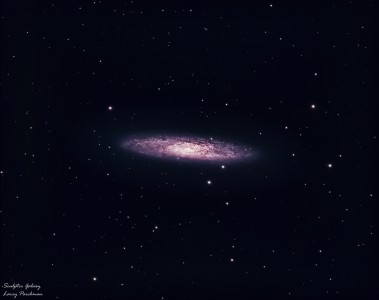
Image of the day

Captured by
Lawrence Parchman

Sculptor Galaxy (NGC 253)

My Account

New to Astromart?

Register an account...

Need Help?

Posts Made By: Dave Mitsky

May 18, 2004 07:44 PM Forum: Solar System Observing

C/2001 Q4 (NEAT) from the Tuscarora Forest

Posted By Dave Mitsky

My friend Tony Donnangelo and I traveled to a dark site in central Pennsylvania's Tuscarora State Forest on Sunday night, 2004/5/17 UT, to observe Comet NEAT Q4. Although the weather conditions were not perfect, the comet was easily visible to the unaided eye.

Through Tony's 14.5" Starmaster Sky Tracker Dob Q4's coma sported an aquamarine hue. I couldn't detect any color with my 101mm Tele Vue refractor but the view was glorious using my 35mm Panoptic and Tony's 22 and 17mm Type 4 Naglers.

My Burgess 15x70 binocular gave the best portrayal of the comet's tail, which extended for more than 2 degrees. I also observed Comet NEAT Q4 through my Celestron Noble 8x42 and Tony's Celestron Ultima 7x50 binoculars. The comet was located about five degrees northwest of M44, the Beehive Cluster, as judged by the 6.25 degree field of view of the Nobles.

We also observed a thin crescent Venus, Saturn, Callisto's shadow transit, two ISS passes, an Iridium flare, seven asteroids, Comet LINEAR K4 (which was still a dim, little fuzzball), and a host of deep-sky objects.

Dave Mitsky

May 23, 2004 04:28 PM Forum: Solar System Observing

Comet NEAT Q4: Recent Observations

Posted By Dave Mitsky

I saw a pale blue hue in Comet NEAT Q4's coma at magnifications of 52x and 83x on Wednesday (2004/5/20 UT) night through the 12.5" Cave Astrola at the Astronomical Society of Harrisburg's Naylor Observatory. I also observed the comet at low power through a 4.3" TAL Newtonian and at high power through the ASH 17" classical Cassegrain. At 259x the coma was rather large and asymmetric with a "jagged" periphery. The stellar pseudonucleus was quite bright.

Last night at the Mason-Dixon Star Party (see http://masondixonstarparty.org/ ) under mediocre conditions I viewed Q4 through a 10x50 binocular, a 10" Meade LX200 SCT, a 155mm Astro-Physics Starfire apochromat, a 152mm Takahashi apochromat and twin 24mm Takahashi LE eyepieces, Kent Blackwell's 25" ATM Dob and 31mm Nagler type 5, Roy Diffrient's 18" ATM Dob and 35mm Panoptic, and Ted Forte's 18" Obsession Dob. Color was most apparent in Roy's scope. The comet's dust tail was visible with difficulty through the 25". The BW-Optik Binocular Viewer equipped Tak was the best in revealing the ion tail.

Dave Mitsky

May 25, 2004 08:30 PM Forum: Solar System Observing

The Sun in Taurus, 2004/5/25

Posted By Dave Mitsky

Have a look at Tuesday afternoon's SOHO LASCO C3 image on the SOHO site (browse http://sohowww.nascom.nasa.gov/ and click on The Sun Now and then the LASCO C3 image). The Sun is midway between M45 (the Pleiades) and Melotte 25 (the Hyades). It looks like there may be a couple of sun-grazing comets too.

Dave Mitsky

May 25, 2004 09:52 PM Forum: Solar System Observing

Five Views of the Sun, 2004/5/25

Posted By Dave Mitsky

On Tuesday afternoon I joined 2 other Astronomical Society of Harrisburg members in observing the Sun. Ted Nichols II and Bill Leitzell already had the ASH heliostat (see http://www.astrohbg.org/gallery2/Tour-of-Naylor/2d_projector for a photo) in operation when I arrived at the ASH Naylor Observatory. The projected image of the Sun displayed the large sunspot group 618 in fine fashion. AR 10618 has the potential to produce X-class solar flares so there is a possibility of auroral activity later in the week. AR 10615 was near the leading limb.

I then prepared the ASH Astroscan using a 13mm Tele Vue Ploessl and an aluminized glass solar filter to view the Sun's disk. The 35x power image was not as pleasing as the heliostat's projected image.

I believe I saw 618 without magnification by holding the Astroscan's solar filter up to the Sun.

Before Bill left I beheld the Sun through his solar-fiter equipped 7x35 binocular. AR 10618 was easily visible.

Finally, I set up the ASH Celestron C8 SCT for a final peek at the daystar. At 78x (26mm Tele Vue Ploessl) I saw quite a bit of detail in the sprawling 618 group. The umbra of the largest spot was quite complex, with what looked to be four separate parts.

Dave Mitsky

June 1, 2004 03:21 PM Forum: Deep Sky Observing

June DSO List

Posted By Dave Mitsky

Here's my June DSO list, which covers a swath of right ascension from 14 to 16 hours.

Dave Mitsky

Twenty deep-sky objects for June: NGC 5466, NGC 5676 (Bootes); M102, NGC 5907, NGC 6015 (Draco); NGC 5694 (Hydra); NGC 5728, NGC 5878 (Libra); M5, NGC 5921 (Serpens Caput); M101, NGC 5474 (Ursa Major); NGC 5566, NGC 5634, NGC 5701, NGC 5713, NGC 5746, NGC 5813, NGC 5838, NGC 5846 (Virgo)

Challenge deep-sky object for June: Abell 2065


June 1, 2004 03:55 PM Forum: Deep Sky Observing

New Supernova in Capricornus

Posted By Dave Mitsky

A relatively bright (~14th magnitude) supernova, SN 2004bv, is now visible in NGC 6907, an 11.9 magnitude spiral galaxy in Capricornus. See http://www.rochesterastronomy.org/snimages/ for further information.

Dave Mitsky

June 4, 2004 06:45 AM Forum: Solar System Observing

The Two "Great" Comets

Posted By Dave Mitsky

Well, I finally saw Comet LINEAR T7 again on Thursday evening. I was at the ASH Naylor Observatory and observed it with the 17" f/15 classical Cassegrain at 118, 144, 162, and 259x. The sky was mostly clear but conditions were not ideal. The comet was located just to the southwest of Alphard and was barely visible through the 5" f/5 finder scope. I could not see it with my Meade 8x42 binocular.

At third to fourth magnitude C/2001 T7 (LINEAR) certainly is brighter and also has a larger coma than it did some months ago, before it dove out of view for northern observers. The coma was noticeably asymmetrical at 259x but there was otherwise no hint of a tail.

After viewing a number of other objects including the Moon, Jupiter, Alpha Herculis, M104, M51, M57, and M3 through the ASH 12.5" f/6.5 Cave Newtonian, the ASH 127mm f/12.1 Orion MCT, and a fellow member's 10" Meade f/10 LX200 SCT I finally remembered to track down the other "great" comet, C/2002 Q4 (NEAT) with the 12.5". Fifth to sixth magnitude Comet NEAT Q4 was postioned just to the west of a fifth magnitude star that is northwest of Lambda Ursae Majoris. The coma was smaller and perhaps more condensed than it had been and there was still a bright pseudonucleus. Magnifications of 52, 79, 121, and 159x were used.

Dave Mitsky

June 4, 2004 09:17 PM Forum: Solar System Observing

A Sunrise Lunar Light Ray in Montes Riphaeus

Posted By Dave Mitsky

On the night of Friday, May 28th, I observed a previously unreported lunar light ray in Montes Riphaeus, a 150 kilometer long mountain range south of the crater Lansberg. I viewed the ray initially sometime around 9:30 EDT (01:30 UT 2004/5/29) at 159x using the 12.5" f/6.5 Cave Newtonian at the Astronomical Society of Harrisburg's Naylor Observatory near Lewisberry, Pennsylvania. A bit later I verified my sighting with the 17" f/15 classical Cassegrain, employing magnifications of 162, 202, and 259x. What I saw was a thin shaft of light running in the direction of the terminator, just south of an arc-like region in the Riphaeus Mountains. The ray was positioned roughly at 6.25 degrees south, 27.5 degrees west.

Before leaving the observatory I noted that the ray had widened somewhat at 10:45 EDT (02:45 UT).

Dave Mitsky

June 10, 2004 06:46 AM Forum: Solar System Observing

The Transit of Venus from the Jersey Shore

Posted By Dave Mitsky

Over the years I've observed from more than a few strange places but watching the transit of Venus from the roof of a 23 story tall casino in Atlantic City may possibly have been both the oddest and the "coolest".

Two fellow ASH members and I left Harrisburg, Pennsylvania at 1:30 a.m. EDT and arrived in the eastern gambling Mecca around 4:15 a.m. We drove to the shore since the Tuesday morning weather forecast seemed most promising there. The forecasts were a bit off since low level clouds obscured the Sun at sunrise but otherwise my friends and I were able to view the remainder of the event in its entirety.

Venus was easily visible to the naked-eye using a variety of solar filters including Baader AstroSolar material, Mylar, black polymer, and #14 welder's glass. Although it spanned only 1/32nd of the Sun's disk, Venus was larger than I expected. Through filtered 7x50 and 10x50 Celestron Ultima binoculars the apparent size of the planet was rather impressive.

I used my 80mm f/5 Orion ShortTube 80 achromatic refractor with a Baader filter and my 114mm f/7.9 Celestron C4.5 Newtonian with a Mylar filter. My friend Tony Donnangelo brought his 102mm f/8 Takahashi FS-102 apochromat, which provided the best views. We used a Baader white light filter and Lumicon Solar Prominence filter with his scope.

We were fortunate enough to observe the black drop effect just prior to third contact and the aureole of Venus a bit later.

I photographed the transit with a Pentax K1000 SLR film camera and a Sony DSC-707 digital camera.

When the transit was over we loaded our equipment in Tony's vehicle and drove to the Trump Plaza for breakfast. Aferwards there was no time or inclination to gamble.

Dave Mitsky

June 21, 2004 04:28 AM Forum: Solar System Observing

Saturday Night - A Brief Report, 2004/6/20 UT

Posted By Dave Mitsky

Tony Donnangelo, his 14.5" Starmaster Sky Tracker Dob, and I journeyed to a dark site in the Tuscarora Forest in central Pennsylvania last night. The weathermen lied, as usual, in that the sky never completely cleared until about 2:00 a.m. EDT but we were able to get quite a bit of observing in nonetheless. We saw the end of a shadow transit, the GRS, the shifting compact arrangement of three of the Galilean satellites, two comets, five asteroids, and dozens of DSOs including quite a few galaxies that I hadn't seen before. I witnessed four bright meteors and many more through the eyepiece and over a dozen satellites (including three Iridium flares), most of which I tracked with my 15x70 binocular or my 101mm Tele Vue refractor.

Considering that it was the night before the beginning of summer it was rather chilly - 44 degree Fahrenheit! It was cold enough to wear gloves! The brisk wind blowing from time to time didn't help matters any.

Dave Mitsky