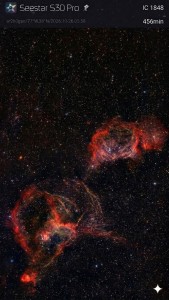
Image of the day

Captured by
Arthur Hogan

Heart and Soul Nebulas

My Account

New to Astromart?

Register an account...

Need Help?

Posts Made By: Michael Connelley

November 16, 2006 05:41 AM Forum: Deep Sky Observing

Can you see these galactic details?

Posted By Michael Connelley

Hello:
I have observed many of these with a 12.5" cassegrain at a dark site.

1: Dust bands in M82 A
2: Spiral arms of M61 E
3: Equatorial dust band of NGC891 A
4: Spiral arms of M33 A
5: The obscuring cloud of M64 ("Black eye") A
6: Spiral arms of M51 A
7: Emission nebula, NGC604 in M33 A
8: Dust bands in NGC3556 E
9: Spiral arms of M99 E
10: One dust band in the Andromeda galaxy A
11: Spiral arms of M101 A
12: Equatorial dust band of NGC3628 A
13: Two dust bands in the Andromeda galaxy A
14: Emission nebulae in the spiral arms of M101 B
15: Spiral arms of M100 E
16: Equatorial dust band of NGC4565 (Coma Berenices) A
17: "Bend" of galaxy NGC4656 (Canes Venatici) E
18: Spiral arms of NGC2403 E
19: Spiral arms of NGC2903 E
20: Bridge between M51 and companion galaxy B

Cheers
Mike Connelley

November 20, 2006 03:04 AM Forum: Telescope Making

Making Aluminum Altitude Rings

Posted By Michael Connelley

Hello:
To bend aluminum bars, you can hire the Incredible Hulk, or use the method on this web page:

http://home.wanadoo.nl/jhm.vangastel/Astronomy/50cmscope/bending.htm

I plan on using this technique to make a light weight top end ring for a future ATM project.

Cheers
Mike Connelley

December 3, 2006 08:50 AM Forum: Deep Sky Observing

The Cone Nebula

Posted By Michael Connelley

Hello:
I have only seen the Cone Nebula once, with a 12.5" dobsonian on Mauna Kea (9,300 ft). It appeared as a slightly darker triangular patch in the background sky. Even with a narrow band filter, it was VERY hard to see. I recently tried it with a different 12.5" scope, and didn't get it (which isn't surprising since I couldn't see the Horsehead Nebula either, which is quite a bit easier to see). When going for faint nebulae, I look for them in this order:
1) M42
2) Flame Nebula
3) Horsehead Nebula
4) Cone Nebula

If I have a hard time seeing one of these, then I know the next one will be invisible.

Cheers
Mike Connelley

December 11, 2006 11:29 AM Forum: Equipment Talk

Thinking about a mount....

Posted By Michael Connelley

Hello:
I would think that a G-8 or G-11 would work well. I was out last night with a friend showing me how to use the ST-4 with my G-11, and the autoguiding worked well but windshake was an issue. The G-11 was holding a pair of 4" refractors at the time. My friend was using a G-8 with a 4" refractor and a ST2000 CCD. If you want rock-like stability, another friend of mine shoots with a 4" refractor and a 60mm guide scope on an NJP mount! No stability problems there! I agree with the notion that when it comes to astrophotography, no mount is too big.

Cheers
Mike

December 29, 2006 10:23 AM Forum: Refractors

Do classic achromats outperform modern APOs?

Posted By Michael Connelley

Hello:
I've use an achromat that beat any APO I've looked through. It just so happens that it was a 16" f/15 achromat and the largest APO I've looked through is 5"! So, if an achromat has 10 times the light gathering power of an APO, it can beat it. All else being equal, a N" APO should beat the pants off of a N" achromat, even if the achromat has a much longer focal length. But, not all APOs are equal. I'm sure that a well built and maintained 4" Unitron can beat a poorly built "APO" (I'll leave the debate of what's a true APO versus semi-APO to others).

Cheers
Mike Connelley

December 30, 2006 08:08 AM Forum: Deep Sky Observing

Object database preferences

Posted By Michael Connelley

Hello:
Three major databases that professionals use are SIMBAD, Vizier, and NED. With SIMBAD, you can give the name of the target, and it retieves data like position, brightness, and what kind of object it is, with links to images and references. Vizier is a clearing house for astronomical catalogs, and allows online browsing of these catalogs. You can search for objects within a catalog, such as for a star brighter than 15th magnitude within 10' of a certain position. NED is an extragalactic oriented database, which I don't use much since my field is star formation. But the extragalactic guys use it all the time.

Cheers
Mike Connelley

January 19, 2007 01:50 AM Forum: Equipment Talk

Considering purchasing a cassegrain/mak, any sugge

Posted By Michael Connelley

Hello:
I agree that wanting a larger scope, goto, and photographic capabilities for $1000 is pushing it. I've been doing visual observing for a long time and just started getting my feet wet with astrophotography (with a lot of help from a friend), and it's tough. If you want to do long exposure photography, a DSLR will eat up a big part of your $1000 budget. An equatorial mount will easily eat up the rest. I would recommend you first go in one of three directions: 1) a larger scope for visual use or 2) a small refractor for photography or 3) Get a larger scope for visual use and get add on the photography stuff later. For example, a C8 on a german mount with goto is about $1500. The increase in light gathering power is significant, but won't knock your socks off like a 12" will. But it does track, which I find very useful especially when observing the planets. A way to get your feet wet in photography is webcam imaging of the planets. In this case, the long f/ratio of a maksutov is an advantage, and good sized maks are in your budget.

Cheers
Mike Connelley

January 28, 2007 12:15 AM Forum: Equipment Talk

Is GOTO worth it?

Posted By Michael Connelley

Hello:
I don't think goto is worth it. Given how popular goto is, others clearly disagree. I know how to use a telrad, finderscope, star charts, etc. to find what I want. When I have used a mount with goto, I've often found myself fighting the computer more than I was observing. So, I find goto systems are frustrating to me, and I don't need them. I also enjoy hunting down small, faint targets as much as I like looking at them.
The non-goto Losmandy mounts still track the sky, and you can use the hand paddle to guide your telescope or adjust the telescope pointing. All goto does is find things for you. Most german equatorial mounts can be used without any of the goto electronics. I agree, it's quite expensive. If you want to connect your scope to a laptop, so that you can click on a target and the scope goes there, then you would need goto.
There is a wide selection of german equatorial mounts that can hold a 10" SCT. There is the GM8 and it's larger brother, the G-11, both from Losmandy. There's the Atlas mount from Orion (and related clones), and the super-polaris mount and it's related clones (the Celestron CG-5, Meade LXD-75, etc.). Mounts like the CG-5 may be too light to support a 10" scope for long exposure photography. I personally use a G-11 mount for a 12.5" cassegrain, and it works quite well.

Cheers
Mike Connelley

February 1, 2007 07:31 PM Forum: Telescope Making

Sub-$2000 16-inch mirror

Posted By Michael Connelley

Hello:
You could probably find mirrors from the old 16" Newtonians Meade made a while ago fairly cheaply. Meade used the 16" f/4.5 mirror on their DS-16 equatorially mounted Newtonian and later their solid tube dobsonian, and I assume are using the same mirror for the lightbridge. A friend here bought on of these mirrors cheap a while back (because it had horrendous spherical aberration), and got it refigured for a few hundred bucks, and now he has a nice scope.

Cheers
Mike Connelley

February 6, 2007 10:10 AM Forum: Refractors

Achro/Apo question

Posted By Michael Connelley

Hello:
To me, it sounds like you're pretty happy with your scope, so I wouldn't sweat it. I'm in a similar boat. I have a scope that I like to use for planetary observations with a 33% central obstruction. A smaller secondary might help a bit, but I like the views I get so I don't worry about it.

I once asked a friend why reviews of expensive astronomy gear always seem positive, and his response is that very few people will admit that they really bought a piece of junk, or that they just wasted a lot of money. I strongly suspect that a bit of this psychology is involved. I don't doubt that expensive apochromatic refractors give very nice images (owning one myself). But I also think that the folks who have bought these need to believe that they got something extra by paying more that a less expensive scope could not provide. While this is likely the case, the differences between a fast apo and long focus refractor aren't that dramatic. In a comparison between a 3" f/16 Unitron and a 4" Takahashi on Ed Ting's page, the Tak had brighter images (bigger lens, better coatings), better contrast and more "snap" to the images. I think this is in part to the larger lens gathering 78% more light, and some is due to the achromat being an achromat. I'll finish by saying that the best I've ever seen Saturn was through an achromatic refractor. Even though it had a simple crown-flint doublet, a 16" Clark lens can provide a spectacular image!

Cheers
Mike Connelley