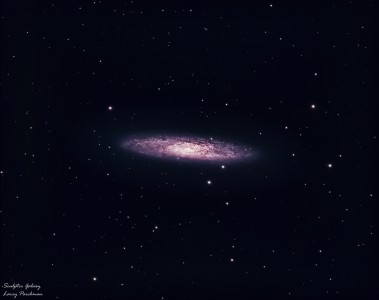
Image of the day

Captured by
Lawrence Parchman

Sculptor Galaxy (NGC 253)

My Account

New to Astromart?

Register an account...

Need Help?

Posts Made By: Dave Mitsky

March 23, 2004 04:23 PM Forum: Solar System Observing

Planets, Earthshine, and an Occultation

Posted By Dave Mitsky

I took my Celestron 20x80's to the top of a nearby hill to view the two-day-old crescent Moon and the five naked-eye planets on a very chilly Monday evening. The arc of the ecliptic was plain to see with speedy Mercury (-0.85 magnitude) near the western horizon and the Moon (-9.23 magnitude) to the left and above followed by brilliant Venus (-4.31 magnitude), Mars (1.33 magnitude) just to the east of M45, Saturn (0.02 magnitude) residing in the feet of Gemini, and lordly Jupiter (-2.45 magnitude) rising with Leo.

As I admired the ghostly looking Earthshine I noticed that a star in Pisces was soon going to be occulted. As it turned out 6.3 magnitude ZC 247 was covered by the Moon about 25 minutes later at 00:40 UT, 2004/3/23. Another star (or two) was also due to be occulted according to Starry Night Pro but I left before that happened.

Before driving home I spent a few moments looking at M45, M42, NGC 1981, M44, M41, the Double Cluster, and the Alpha Persei Association with my big binocular.

Dave Mitsky

March 29, 2004 07:17 AM Forum: Solar System Observing

The Almost Triple Transit, 2004/3/28 UT

Posted By Dave Mitsky

Early Saturday night I had good views of Jupiter's Great Red Spot transit through the Astronomical Society of Harrisburg's 12.5" f/6.5 Cave Newtonian and the 17" f/15 classical Cassegrain. What might have been a dark barge was visible as well.

By the time that Callisto's shadow ingressed on the disk of Juiter the seeing had taken a definite turn for the worst. When Io joined the party two shadows were visible but by the time of the triple transit the seeing was so bad (the worst that I've experienced in many months) that it was not possible to discern Callisto's shadow in the north polar region despite stopping down both scopes to as little as 6 inches. We could make out the shadows of Io and Ganymede with some effort.

So it was 2 out of 3 (the shadows of Callisto and Io and Io and Ganymede) two times.

Efforts to image the event through the 17" with a Meade LPI device were not very successful.

Other objects observed with the 12.5 and 17" included Mercury, Venus, the Moon, Saturn, Titan, M65, M66, M104, and the famous variable star R Leonis. Several eighth and ninth magnitude stars in Taurus were occulted by the Moon during the early part of the night. I also viewed the Moon and Jupiter with the new ASH 127mm f/12.1 Orion StarMax Maksutov-Cassegrain.

Dave Mitsky

March 30, 2004 08:43 AM Forum: Deep Sky Observing

A First Quarter Moon Messier Marathon!

Posted By Dave Mitsky

On Sunday night I learned that Bernie Sanden and Tom Polakis conducted a complete Messier Marathon of 110 objects on Saturday, March 27th, under the light of a first Quarter Moon. They observed from Vekol Ranch, 50 miles south of Phoenix, Arizona using Sanden's 12.5" and a 20" belonging to Polakis. They also observed all nine planets.

I had heard of only one successful 110 object marathon for this year prior to this (from 6000 feet in the Canary Islands during New Moon) and was amazed that these Arizonans were able to pull off this observing tour de force.

Dave Mitsky

April 5, 2004 08:45 AM Forum: Solar System Observing

Sunspots, Venus and the Pleiades, and Other Things

Posted By Dave Mitsky

We were lucky enough to have a brief respite from the clouds and rain of the past few days on Saturday. During a break in a meeting of Pennsylvania astronomy clubs at the Astronomical Society of Harrisburg's Naylor Observatory (see http://www.astrohbg.org/naylor_observatory.php ) I set up our old orange tube 8" f/10 Celestron C8 and showed the visitors the sunspots currently visible at 78x (26mm Tele Vue Ploessl). Sunspots 582 and 587 were the standouts, being moderately large.

In the evening ASH held an open telescope clinic and had a very good turnout despite the clouds.

Through a brief sucker hole I was able to observe Venus and M45 with my Meade 8x42 binos. Venus was just to the east of the famous star cluster. It seemed to fit in perfectly as a brilliant new addition to the "handle" of the Pleiades.

As I gave a talk on eyepieces and deep-sky objects suitable for beginners under light polluted skies the heavens began to clear somewhat. When I was finished speaking I had a great view of Venus and M45 through a 11x70 Oberwerk binocular belonging to one of the clinic participants. I quickly prepared the ASH TAL-1 4.3-inch f/7.3 Newtonian reflector, which provided a close-up look at the planetary/deep-sky pairing with the assistance of a 26mm Tele Vue Ploessl (31x).

Using the ASH 12.5" f/6.5 Cave Newtonian I showed the crowd Saturn and then Jupiter with a 13mm Tele Vue Ploessl (159x). A transit by the GRS was underway. We also had looks at the Moon through the 17" f/15 classical Cassegrain and a few of the scopes that the visitors had brought as the clouds returned. Aristarchus was a bright splash on the waxing lunar disk.

Dave Mitsky

April 21, 2004 08:55 AM Forum: Equipment Talk

First Light: Burgess 15x70

Posted By Dave Mitsky

On Sunday night (2004/4/19 UT) I was able to put the Burgess 15x70 binocular that I was fortunate enough to win at this year's NEAF to good use. I must say that I was very pleased with the results.

The Burgess 15x70 features BAK4 Porro prisms and fully multi-coated lenses. The field of view is stated as being 4.4 degrees and the eye relief 16 mm. The binocular produces an exit pupil of 4.7 millimeters and weighs in at 46 ounces. It worked quite well both mechanically and optically.

My new instrument was mounted on a Bogen tripod and Vista binocular guider. At 46 ounces the Burgess 15x70 can be hand-held but I recommend the use of a guider. The evaluation was conducted at a dark site that can approach a VLM of 6.5 magnitude on a very good night but unfortunately this was not one of them.

I was able to achieve a very tight focus. Some astigmatism was present as was to be expected. Stars began to blur at between 2/3's and 3/4's of the field radius and were quite elongated at the field edge, where there was a bit of lateral color. Certainly not bad performance for such inexpensive glasses.

I observed Venus, where some chromatic aberration was noted, and Jupiter, where all 4 Galilean moons were seen very easily, as well as numerous deep-sky objects. The Hyades and the Alpha Persei Association were quite striking as were the Sword of Orion, Collinder 70, the Double Cluster, Stock 2, M44, and Collinder 399. Galaxies such as M81, M82, M101, M51, M65, and M66 were readily visible. In fact, M81 and M82 were portrayed amazingly well. I managed to work through 1/4 of the Astronomical League's deep-sky binocular list as high clouds appeared and dispersed. Seeing the Binocular Double Cluster (NGC 6633 and IC 4756) through the Burgess was quite a treat.

My Japanese made Celestron 20x80 binocular has seen comparatively little use since I purchased an Orion ShortTube 80 achromat in 1998. Although the larger and much heavier Celestron giant binocular should clearly outperform the Burgess offering, I believe I'll be parting with the 20x80 and doing much more binocular observing in the coming nights with my newest optical toy.

Dave Mitsky

April 21, 2004 03:24 PM Forum: Solar System Observing

Comet C/2003 K4 (LINEAR)

Posted By Dave Mitsky

Last Friday (2004/4/16) and Monday (2004/4/19) mornings Tony Donnangelo and I observed C/2003 K4 (LINEAR) from two different dark sites in central Pennsylvania using his 14.5" Starmaster Sky Tracker Dob and a 17mm Nagler type 4 ocular.

The comet was located in Vulpecula and was rather dim at 11th magnitude. Its coma was very small, on the order of an arc minute or less.

An ephemeris is available at http://cfa-www.harvard.edu/iau/Ephemerides/Comets/2003K4.html

Dave Mitsky

April 25, 2004 06:02 AM Forum: Solar System Observing

The Astronomy Day Aurora, 2004/4/25 UT

Posted By Dave Mitsky

On Saturday night the Astronomical Society of Harrisburg's Naylor
Observatory was open to the public as part of the club's Astronomy
Day activities. (During the day we set up an elaborate display at a
local shopping mall.) A fairly large crowd arrived and enjoyed views
of the Moon, Venus, Jupiter, Saturn and other celestial objects
through various scopes belonging to members and the club's 8" f/6
Hardin Dob, 10" f/7 Cave Astrola, 12.5" f/6.5 Cave Astrola, and 17"
f/15 classical Cassegrain.

Sometime around 2:00 UT an auroral curtain appeared that spanned the
northern sky from Ursa Minor to Auriga. The light from the setting
Moon diminished the display somewhat but rays could be seen within
the curtain and some motion was evident. I couldn't discern any
color but a pink hue was evident in some photos that a fellow ASH
member took with a digital camera. The display was rather short-
lived, unfortunately.

Also of interest were the multiple lunar occultations that took place
early in the night.

I spent some time manning the 17" in the French Dome and treated
visitors to views of Jupiter, Venus, Algieba, Castor, M104, and M3.

Dave Mitsky

May 2, 2004 08:10 AM Forum: Equipment Talk

2004 NEAF Photos Posted

Posted By Dave Mitsky

Some of the pictures that Maura Smith and I took at this year's Northeast Astronomy Forum have been posted on the DVAA web site at http://dvaa.org/Photos/NEAF2004/

Dave Mitsky

May 11, 2004 09:17 AM Forum: Solar System Observing

C/2001 Q4 (NEAT) from the Naylor Observatory

Posted By Dave Mitsky

Having missed opportunities on Wednesday, Thursday, Friday, and Saturday nights due to other activities I finally saw Comet NEAT Q4 after the May 10th meeting of the Astronomical Society of Harrisburg at the Naylor Observatory last night - first, through the 17" f/15 classical Cassegrain (45mm Ploessl, 40mm MK-70, and 32mm Koenig-II) and then its 5" f/5 finder. After learning the location of the comet I opened the Culver roll-off building and put it into view with the 12.5" f/6.5 Cave Newtonian and the 45mm Ploessl. Then I set up the ASH 4.3" f/7.3 TAL-1 Newtonian, which produced a fine image with the help of an old 20mm Meade Wide Angle. I also observed Q4 through the Cave's 80mm Lumicon finder, a trio of binoculars (7x35, 12x60, and 20x80), and a fellow ASH member's 10" Meade LX200 SCT.

The comet was barely visible to the naked-eye. Its coma was distinctly asymmetrical. I could discern the barest hint of a tail through a few of the instruments. The comet had a very bright, stellar pseudonucleus. Its rapid motion was readily apparent.

Other celestial objects observed were Jupiter (through the 4.3" Newtonian, a fellow ASH member's 7" f/15 Questar MCT, the 12.5" Newtonian, and the 17" classical Cassegrain), M44 (through the 4.3" and the 12.5"), Venus (through the 4.3"), and SS Virginis (through the 17").

Dave Mitsky

May 14, 2004 06:24 AM Forum: Solar System Observing

Close But No Cigar, 2004/5/14 UT

Posted By Dave Mitsky

On Thursday night a group of Astronomical Society of Harrisburg and York County Astronomical Society members took a road trip to a spot along the Susquehanna River south of Wrightsville, Pennsylvania, where the "eclipse" of Jupiter by the International Space Station was predicted to take place. Unfortunately, the ISS passed just a bit southeast of Jupiter at 01:34 UT. Two members got interesting digicam pictures of the event. Using an 4.5" Orion StarBlast and a 26mm Tele Vue Ploessl I was able to catch a glimpse of the ISS at the edge of the field of view as it shot past the planet. I also took a film camera photograph of the event.

Comet NEAT Q4 was quite prominent through the various binoculars and telescopes assembled including the StarBlast, a Celestar 8 SCT, a 10" Meade LX200 SCT, and a Nexstar 11 SCT. The coma was large and asymmetrical and the pseudonucleus very bright. The best view of the comet's tail was through Ted Nichols II's 15x70 Barska binocular. I could discern the tail through my 8x42 Celestron Nobles as well but not through the StarBlast. C/2001 Q4 (NEAT) and M44 were both visible within the 6.25 degree FOV.

I also observed M44, M65, M66, M81, M82, and M104 through the StarBlast and saw Jupiter, Saturn, Venus, M13 and M104 through two of the Schmidt-Cassegrains.

Dave Mitsky