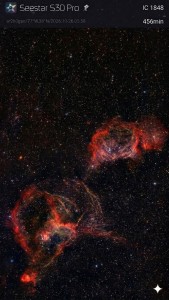
Image of the day

Captured by
Arthur Hogan

Heart and Soul Nebulas

My Account

New to Astromart?

Register an account...

Need Help?

Posts Made By: Lorne Johnson

November 30, 2004 07:01 PM Forum: Beginning Astronomy?

Re: What would you do if?

Posted By Lorne Johnson

George,
I started back into astronomy after a 32 year break by buying an mn 56 and a super polaris mount. (My introduction had been with an f 15 5" Alvan Clarke which would get 1/2 a degree true field, and in was hard to find objects with it.) While I was waiting for ITE to actually deliver (7 months), I got a good deal on a very good 8 inch dobsonian (mirror by Mike Spooner). The MN 56 is great, but the dob crushes it on planetary and deep sky (although a drive would be nice). It's easier to set up and my eight-year -old daughter is comofortable using it. The MN 56 will give me a full three degrees, which is nice for some things, and if I go into some kind of photography it will be very useful. But for visual, a good dob is hard to beat, and well within your price range.

December 6, 2004 06:25 PM Forum: Equipment Talk

Telescope for a 12 year old?

Posted By Lorne Johnson

I am inclined to agree with Tim. A 6-8 inch dob does and awful lot, and does enough so that one doesn't get board. They are all that expensive new, and should turn up used as well.

December 7, 2004 12:21 AM Forum: Eyepieces

Siebert 36 Observatory first light

Posted By Lorne Johnson

I have the Siebert 36 and it appears to be a permanent eyepiece for me. I put a clamp on the skirt to make it parfocal with my televue eyepieces. I also compared it briefly with a 35 mm panoptic and prefer the siebert (although the panoptic may have slightly better edge performance). It is far superior in flatness of field and edge performance to the B&W 30 mm superwide (which is still a good deal at $95). Field stop appears to be 40mm on the Siebert.

December 30, 2004 06:06 PM Forum: Eyepieces

Light Pollution Filter

Posted By Lorne Johnson

The threads for filters are pretty standardized. So unless Astrola has a proprietary thread, you should be fine (in the unlikely event that Astrola is proprietary I'd replace it with a standard 1.25 barrel eyepiece).

December 30, 2004 06:24 PM Forum: Reflectors

Is there really any difference?

Posted By Lorne Johnson

Here are the differences on the PDHQ.

Better construction of the mount (plywood vs particle board, lighter stronger and more water resistant).

2 inch Crayford focuser (quite nice).

Pyrex mirror substrate.

Better quality control on the primary and secondary mirror. You are sure of a very good mirror vs. likely to get a very good mirror.

This difference is more likely to show to an experienced observer when the seeing conditions are very good (ie not all the time, several nights a year 3 to 5 percent where I live). It makes more of a difference on planetary, but it is there on deep sky as well. A 8 inch f 6 scope has the makings of a real keeper. You can see a lot with it, and move it around by yourself comfortably (The PDHQ 10 inch weighs almost twice as much as the 8"). This may mean that the PDHQ has a real advantage in longevity for you (but those Chinese scopes are good scopes). The other side is that many in this hobby buy and sell a lot of different scopes-- so you could get the Hardin trade it for an Apo trade that for a 20" dob, rupture a disk and then trade for an 8 inch PDHQ 8'. Of course if you start with an 8" PDHQ and then do all those trades you will feel (slightly) more foolish.

Another useability vs costweight point seems to be between 12.5 and 14.5 inches. (That's what I want to add to my 8" f6 dob.)

November 15, 2005 04:46 PM Forum: Beginning Astronomy?

Barlow Basics: Stubby or Long?

Posted By Lorne Johnson

I believe that the theory is that the stubby barlows require a more radical alteration of the light cone, and are therefore more difficult to correct for aberations, especially in faster scopes.

In practical terms it's another matter.

November 22, 2005 05:24 PM Forum: Beginning Astronomy?

Mak Questions

Posted By Lorne Johnson

A 6" Maksutov has many fine qualities. It is compact, the Intes Micro and the Tecs are of very high opitical quality. The corrector plate does correct for coma. They don't require huge mounts, a 6" will go an a Great Polaris for visual use.

Nothing is perfect, of course. The Maks tend to have less throughput for their size than a standard Newtonian or APO refractor. They seem to take a long time to aclimate to temperature change. That has been the biggest frustration that I have heard. They also have long focal ratios, f 10 to f15. That means that it is harder to get a broad true field of view. That can make it hard to find objects for a beginner.

There are also Mak Newts which run around f5 to f6, have the same corrected coma, small secondaries, and seem to cool down a good deal faster. They are also bigger, I run my MN 56 on the GP, the MN 66 would be pushing it.

December 1, 2005 10:28 PM Forum: A Day in the Life of the Administrator

Is it fair?

Posted By Lorne Johnson

I'm pretty sure that a number of those big users have supported Astromart at various times (or atleast at some point). Obviously, they are not supporters right now.

December 3, 2005 07:05 PM Forum: Eyepieces

Eyepiece selection help!

Posted By Lorne Johnson

Personally, I don't think the space between the 35 and the 22 is much of a gap. At f5 22mm is a pretty big ext pupil, so the purpose of the 35 is mostly for finding and a few widefield objects like the veil. or M31.

I use the 22 panoptic and 35 mm on my f 5.7 8" (I switched to a 36mm Siebert for balancing issues), and I would like to replace the 22 panoptic with a 20 nagler type 5. Which makes the gap slightly wider than what you are looking at.

December 20, 2005 09:07 PM Forum: Beginning Astronomy?

how to read eyepiece ads

Posted By Lorne Johnson

The purpose of a 2 inch eyepice is to give a wide field of view, without vignetting from the 1.25 inch barrel. This usually means that 2'' becomes important around 25 to 30mm of focal length, depending on the apparent field of view. You are thus likely to want one or maybe two 2 inch eyepieces. Such as a 35mm Panoptic and a 20 mm Nagler (I happen to have a 22 Panoptic which is set up as a two inch, but need not be, and a 36 mm Siebert Observatory grade, which definitely needs to be 2 inch).

Next, the focal length of the eyepiece divided by the focal ratio of your telescope gives the exit pupil of the eyepiece. Exit pupils larger than 5 mm for most people begin to functionally reduce the acting aperture of the telescope. 7mm is considered the useful limit. (I have a 36 mm that give me an exit pupil of about 6.2 mm and it works just fine, especially for finding. It also gives me 2 degrees of true field which is very useful, and breathtaking on extended objects such as the Veil or Pelican Nebulae, or eight galaxies in one field frpm the Virgo cluster. But I wouldn't go above a 7mm exit pupil in a telescope (especially a reflector).