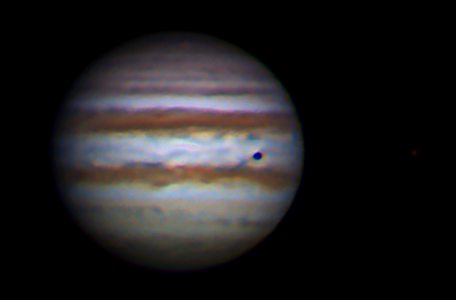
Image of the day

Captured by
John Roach

Jupiter IO Transit 12-10-26

My Account

New to Astromart?

Register an account...

Need Help?

Posts Made By: Curt Renz

July 29, 2006 08:08 PM Forum: Solar System Observing

Venus Kisses Saturn

Posted By Curt Renz

Venus will appear to pass very near to the north of Saturn on Saturday 2006 AUG 26. I calculate that the closest geocentric approach will occur at 23:36 UT with a separation of 4.3 arcminutes. From Chicago this will occur during the daytime at 18:37 CDT with a separation of 4.2 arcminutes. That separation would be about 1/7 of the apparent diameter of the Moon. The pair will be 16.3° west of the Sun.

It should be possible to view the pair’s closest approach in daylight with a telescope, but great care should be taken to avoid looking at the Sun. They can be viewed in nighttime at greater separations during both the previous and following mornings before dawn. Those separations will be about 36 and 31 arcminutes respectively.

I’ve created graphics previewing the event as it will be seen from Chicago’s Adler Planetarium. One shows a wide-angle view while the other is telescopic. To see them, click http://www.curtrenz.com/astronomical.html


August 5, 2006 05:28 PM Forum: Solar System Observing

Transit of Mercury - 2006 NOV 08

Posted By Curt Renz

A transit of Mercury across the Sun’s apparent disk will occur on Wednesday 2006 NOV 08. Mercury transits happen about 14 times per century (much more frequently than for Venus.) The last one was in 2003, and the next one following will be in 2016.

For those of us in Chicagoland, this year’s transit will be an afternoon event interrupted by the setting of Mercury beneath our horizon at 16:37 CST. The local exterior contact at ingress will occur at 13:12:26 CST and interior contact at 13:14:19 CST. Mercury will appear closest to the center of the solar disk at 15:40:53 CST. CST is UT - 6.

I’ve created a graphic previewing the transit as it will be seen from Chicago. To see it, click:

http://www.curtrenz.com/astronomical.html

The graphic may be removed soon after the event occurs. wink

August 7, 2006 03:34 AM Forum: Solar System Observing

Unusually Large Full Moons - Aug, Sep & Oct

Posted By Curt Renz

The Full Moons in August, September and October of 2006 will appear unusually large due to their occurrences nearly coinciding with perigee. These three perigees will all be especially close ones of less than 360,000 km (some perigees are over 370,000 km.) Apogees are all between 404,000 km and 407,000 km.

A Full Moon at extreme perigee can appear as much as 14% wider than one at extreme apogee. The angular surface area of the apparent lunar disk, and therefore its total brightness, can be 30% greater. The distance to the Sun is a brightness consideration but a much lesser one.

Full Moon (geocentric opposition in ecliptical longitude)

AUG 09 10:54 UT 361,257 km
SEP 07 18:42 UT 357,295 km
OCT 07 03:13 UT 357,696 km

Full Moon (time of greatest illumination for Chicago - geocentric distance)

AUG 09 13:10 UT 361,049 km
SEP 07 18:44 UT 357,295 km
OCT 07 02:23 UT 357,661 km

Perigee (geocentric)

AUG 10 18:35 UT 359,752 km
SEP 08 02:52 UT 357,177 km
OCT 06 14:16 UT 357,415 km

The September Full Moon will be partially eclipsed with 17.8% of its diameter covered at 18:51 UT. Unfortunately, the event won’t be visible in the Americas.

Since the 2006 Autumnal Equinox will occur almost exactly midway between the September and October Full Moons, either one could be referred to as the Harvest Moon. Although the October one has a slightly better claim to the title.

Enjoy the spectacle of each of this year’s late summer and early autumn Full Moons. If you take photographs, they would be welcome additions to this thread. wink

August 20, 2006 03:42 PM Forum: Solar System Observing

August New Moon Spotting Contest

Posted By Curt Renz

Who will be first ground based observer to spot the New Moon after sunset by naked-eye following its conjunction with the Sun on 2006 AUG 23 at 19:10 UT (14:10 CDT)?

The slender crescent Moon, a day or two old, was traditionally referred to as the New Moon. On the day of conjunction our ancestors called it the Dark of the Moon (or Change of the Moon.) However, most modern calendar makers insist on labeling the conjunction day as that of the New Moon.

The late summer celestial geometry is unfavorable for North American observers. It will require both skill and luck to spot the Moon aged about 30 hours on the 24th. A sighting on the 25th should be much easier.

Please report your August observation within this thread, including location and time with zone. Even negative results would be interesting. Photos would be especially nice. No prizes, just bragging rights.

I've created a graphic representing the western sky 20 minutes after sunset on August 24 as seen from Chicago's Adler Planetarium. Nevertheless, the diagram should be useful for most North American observers. To see it, click:

http://www.curtrenz.com/astronomical.html

The graphic may be removed soon after August 24.

September 14, 2006 05:32 PM Forum: Solar System Observing

Moon Occults Pleiades - The Americas - Oct 9/10

Posted By Curt Renz

The 86% illuminated waning gibbous Moon will occult stars in the Pleiades cluster (M45) during the night of 2006 OCT 09/10 for observers in the Americas. Immersions will occur on the bright limb and emersions on the dark limb. Grazes can be seen by those located on the narrow (2-3 km) paths. During a graze one can witness a star winking on and off as lunar hills and valleys sweep by.

Your photos, drawings or descriptions of the event will be welcome additions to this thread. For predictions applicable to your location, please feel free to reply within this thread with your latitude, longitude, altitude and time zone.

I’ve created a map of the Americas showing the graze paths of the seven brightest Pleiades stars. I’ve also drawn a graphic previewing the event as seen from Chicago at the time when Alcyone will be most deeply occulted. Both images can be viewed by going to:

http://www.curtrenz.com/astronomical.html

Of the 21 Pleiades stars no dimmer than sixth magnitude, 18 will be occulted. But fewer occultations will be observed at specific locations. Six will be seen from Chicago.

Below are my calculations for occulted stars in order of brightness for an observer at Chicago’s Adler Planetarium, W 87°36’24”, N 41°51’59”, alt 180 m. The stars’ coordinates are for the date of the event (not 2000.0). Times are CDT. The Zenith Angle (ZA) is the location of the star on the lunar limb measured counter-clockwise from the zenith.

#1 Mag 2.9 Alcyone
RA 03:47:54.4 Dec 24°07’43”
CDT 00:07:58 ZA 169.9° Immersion
CDT 00:49:55 ZA 244.4° Emersion

#3 Mag 3.7 Electra
RA 03:45:17.8 Dec 24°08’14”
CDT 22:55:47 ZA 109.2° Immersion
CDT 23:56:43 ZA 309.2° Emersion

#4 Mag 3.9 Maia
RA 03:46:14.9 Dec 24°23’29”
CDT 23:37:40 ZA 076.4° Immersion
CDT 00:25:18 ZA 340.6° Emersion

#5 Mag 4.2 Merope
RA 03:46:44.8 Dec 25°58’19”
CDT 23:37:09 ZA 181.4° Immersion
CDT 00:07:04 ZA 236.3° Emersion

#10 Mag 5.4 Celaeno
RA 03:45:13.5 Dec 24°18’48”
CDT 23:13:32 ZA 067.5° Immersion
CDT 23:51:59 ZA 351.2° Emersion

#17 Mag 6.3 24 Tauri
RA 03:47:46.3 Dec 24°08’23”
CDT 00:02:11 ZA 162.9° Immersion
CDT 00:50:17 ZA 251.6° Emersion

October 15, 2006 06:52 PM Forum: Solar System Observing

Transit of Mercury - NOV 08

Posted By Curt Renz

A transit of Mercury across the Sun’s apparent disk will occur on Wednesday 2006 NOV 08. Mercury transits happen about 13 times per century (much more frequently than for Venus.) The last one was in 2003, and the next one following will be in 2016.

For those of us in Chicagoland, this year’s transit will be an afternoon event interrupted by the setting of Mercury beneath our horizon at 16:34 CST. The local exterior contact at ingress will occur at 13:12:25 CST and interior contact at 13:14:18 CST. Mercury will appear closest to the center of the solar disk at 15:40:53 CST. Although Mercury will have set before egress for Chicagoans, interior contact at egress will occur at 18:07:41 CST and exterior contact at 18:09:34. CST is UT - 6.

Except for the sunset time, the figures shown above should be correct within one minute for any location in sunlight (allowing for time zone adjustments.) If the Sun is up for you, and clouds are not intervening, you will be able to witness the transit.

I’ve created a graphic previewing the transit as it will be seen from Chicago. To see it, click:

http://www.curtrenz.com/astronomical.html

The graphic may be removed soon after the event occurs.

November 9, 2006 06:18 AM Forum: Solar System Observing

Saturn Enters the Evening Sky

Posted By Curt Renz

Saturn has now become a Midnight Star, i.e. rising before Local Midnight (midway between sunset and sunrise) for those of us at mid-northern latitudes. This should make it easier for more of us to observe the ringed beauty of the heavens. It will continue to rise about four minutes earlier each evening. Saturn’s 2006-07 apparition occurs in a region of Leo with few naked-eye stars, although it will approach within 5° of Regulus on DEC 05 before it begins its retrograde motion. Its rings are now tilted about half as much as at the maximum in 2003. I’ve created a graphic demonstrating Saturn’s 2006-07 retrograde loop in ecliptical coordinates. It can be seen at http://www.curtrenz.com/astronomical.html

Saturn was in Conjunction behind the Sun on 2006 AUG 07. I calculate that it will reach its Western Quadrature (90° elongation from the Sun) on NOV 17 at 5:58 UT. It will then be rising around local midnight for observers in the tropics and somewhat earlier for those of us further north. Saturn will become stationary in celestial longitude and begin its apparent Retrograde motion on DEC 06 at 04 hr UT.

The following are my predictions of oppositional extremes during Saturn’s current Synodic Cycle (the period for Earth lapping Saturn: 1.035 years.) I estimate that Saturn will achieve its Greatest Brilliance at magnitude 0.0 on 2007 FEB 06 at 04 hr UT. That is similar to the magnitude of Arcturus, the brightest star in the northern celestial hemisphere. Saturns's Closest Approach to Earth of 8.20035 AU will come on FEB 10 at 15 hr UT. Shortly thereafter it will achieve all three types of Opposition:

FEB 10 at 18:42 UT: Opposition in Celestial Longitude
FEB 10 at 19 hr UT: Greatest Elongation of 178.7°
FEB 11 at 04:30 UT: Opposition in Right Ascension

Around the time of Opposition, Saturn will be rising near sunset, transiting the southern meridian around local midnight, and setting near sunrise. Its ecliptical latitude at that time will be N 1.3°, and its declination will be N 15.5°. That means for northern hemisphere observers, at meridian transit Saturn will culminate at an altitude that is equivalent to one’s co-latitude (90° minus one’s geographic latitude) plus 15.5°. For example, I live at N 42°, therefore it will culminate at 63.5° above my horizon.

At Opposition, Saturn’s apparent equatorial angular diameter will be 20.2 arcseconds and its rings will cover 45.8 arcseconds. Its axial Tilt relative to Earth will be –13.9°. That means we will still be viewing the southern side of its rings, which orbit above its equator. The Tilt will reach its extreme of –15.4° for this Synodic Cycle on APR 18. The extreme Tilt for its 29.5-year Orbital Cycle came in 2003 at -27.0°. The rings will seem to disappear around the period when Earth moves through Saturn’s equatorial/ring plane on 2009 SEP 04.

After Saturn’s 2007 Opposition, it will again become stationary in celestial longitude and resume its apparent Direct motion on APR 19 at 22 hr UT. It will reach Eastern Quadrature on MAY 09 at 12:05 UT. It will then be setting around local midnight for observers in the tropics and somewhat later for observers further north. Eventually it will again move in Conjunction behind the Sun on AUG 21.


Saturn presents a marvelous image in even a small telescope. Those who observe it for the first time are often thrilled. As a 12-year-old in 1958, I “discovered” Saturn when I aimed my new “Moonscope” at a pair of equally bright stars in Scorpius, where my star map showed only Antares should have been. After my own initial excitement, my brothers and neighborhood friends became awestruck when I allowed them views.

For alerts regarding the viewing seasons of the naked-eye planets, you may want to download my monthly astronomical calendar. Many use it as their computer’s desktop background wallpaper.

Let’s all enjoy the 2006-07 apparition of Saturn. 8)

November 12, 2006 06:26 PM Forum: Solar System Observing

Mercury as Nov-Dec Morning Star

Posted By Curt Renz

Are you wondering where Mercury went following its transit over the Sun on November 8? It is entering the pre-dawn southeastern sky. It's about to commence a fine apparition as a morning star during November and December.

The elusive little planet will end its apparent retrograde motion on November 17. As viewed from Chicago, Mercury's greatest altitude at 30 minutes before sunrise will be 12.2° on November 24. It will reach its Greatest Western Elongation of 19.9° on November 25.

On December 10 Mercury will form part of a trio with Jupiter and Mars. At the grouping's tightest, Mars will be separated by 58.7 arcminutes from both Mercury and Jupiter. The trio will be about 15° west of the Sun. Considered as pairs, Mercury will pass Jupiter by only 7.4 arcminutes on December 10. It will pass Mars by 34.6 arcminutes on December 11. Also on December 11 Mars will pass 47.6 arcminutes from Jupiter.

The waning crescent Moon will be in the vicinity of Mercury on November 19 and December 19. But on neither occasion will the two get as close as 5°.

Mercury will be brightening in stellar magnitude from +3.1 to –0.7 throughout the period of visibility. It will reach Superior Conjunction on the other side of the Sun on January 6.

I’ve created a panoramic graphic that previews the entire apparition. It displays the southeastern sky as seen from Chicago 30 minutes before sunrise from November 11 to December 23, although it should well serve most northern hemisphere observers. To see it, click:

http://www.curtrenz.com/astronomical.html

The graphic may be removed late in December. wink

November 26, 2006 07:20 PM Forum: Solar System Observing

Moon Occults Pleiades - North America - Dec 03

Posted By Curt Renz

The nearly Full Moon will occult stars in the Pleiades cluster (M45) during the evening of 2006 DEC 03 for observers in North America. The 99% illumination is far from ideal, but it will be the last opportunity for those of us in Chicagoland to view a Pleiades occultation for many months. Immersions will occur on the dark limb and emersions on the bright limb. Grazes can be seen by those located on the narrow (2-3 km) paths. During a graze one can witness a star winking on and off as lunar hills and valleys sweep by.

Your photos, drawings or descriptions of the event will be welcome additions to this thread. For predictions applicable to your location, please feel free to reply within this thread with your latitude, longitude, altitude and time zone.

I’ve created two maps of North America showing the graze paths of the brightest Pleiades stars. I’ve also drawn a graphic previewing the event as seen from Chicago at the time when Alcyone will be most deeply occulted. All three images can be viewed by going to:

EDIT: Since the event is past, the graphic has been removed.

Six of the 21 brightest Pleiades stars will be occulted for Chicagoland observers. Below are my calculations for the occulted stars in order of brightness for an observer at Chicago’s Adler Planetarium, W 87°36’24”, N 41°51’59”, alt 180 m. The stars’ coordinates are for the date of the event (not 2000.0). Times are CST. The Zenith Angle (ZA) is the location of the star on the lunar limb measured counter-clockwise from the zenith.

#1 Mag 2.9 Alcyone
RA 03:47:55.3 Dec 24°07’46”
CST 20:14:16 ZA 157.8° Immersion
CST 21:07:44 ZA 247.4° Emersion

#3 Mag 3.7 Electra
RA 03:45:18.7 Dec 24°08’17”
CST 19:03:04 ZA 102.9° Immersion
CST 20:05:47 ZA 313.3° Emersion

#4 Mag 3.9 Maia
RA 03:46:15.9 Dec 24°23’33”
CST 19:50:19 ZA 065.8° Immersion
CST 20:32:20 ZA 346.5° Emersion

#5 Mag 4.2 Merope
RA 03:46:45.8 Dec 25°58’22”
CST 19:40:29 ZA 168.9° Immersion
CST 20:23:25 ZA 244.5° Emersion

#10 Mag 5.4 Celaeno
RA 03:45:14.5 Dec 24°18’51”
CST 19:26:25 ZA 055.5° Immersion
CST 19:55:56 ZA 000.9° Emersion

#17 Mag 6.3 24 Tauri
RA 03:47:47.3 Dec 24°08’26”
CST 20:09:06 ZA 152.1° Immersion
CST 21:07:03 ZA 253.6° Emersion

November 30, 2006 07:21 PM Forum: Beginning Astronomy?

Do Not Pay Good Money to Name a Star

Posted By Curt Renz

Once again it's that time of the year when scam artists flood the media with ads soliciting money for the right to name a star. The International Astronomical Union is the only organization recognized by science as the official namer of celestial bodies. They do not accept payment for naming rights. The IAU is not a governmental entity, therefore anyone can enter star names into a book and have the book copyrighted. That does not make the naming official; it only serves as a warning to others not to plagiarize the book. The chosen stars are often duplicates of those recorded by other bogus companies. They are invariably too faint to be seen with naked eyes.

If you want to name a star after someone, then print up a nice certificate using a program such as Photoshop. Rename a star that can actually be seen. The personal touch should be appreciated. Just don't send money to a scammer.

Here's a link to a nice discussion of the matter on the message board of the Chicago Astronomer:

http://astronomer.proboards23.com/index.cgi?action=display&board=currentdiscussions&thread=1164854885&page=1

And here are more links to other sources:

http://www.space.com/spacewatch/mystery_monday_030915.html
http://www.iau.org/IAU/FAQ/starnames.html
http://home.carolina.rr.com/nirgal/buyastar.html
http://www.nmm.ac.uk/server/show/conWebDoc.309
http://www.ras.ucalgary.ca/~gibson/starnames/isr_news.html
http://www.csicop.org/si/2006-05/stars.html