Image of the day

Captured by
Arthur Hogan

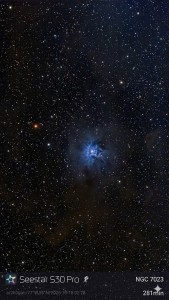
Iris Nebula

My Account

New to Astromart?

Register an account...

Need Help?

Posts Made By: Jason Higley

August 29, 2009 09:23 AM Forum: CCD Imaging and Processing/Solar System

My best Jupiter image using TMB Planetary EP

Posted By Jason Higley

First light for my new 7mm TMB Optical Planetary II eyepiece on Jupiter

http://setisociety.org/jupiterMVI_0881aug29092slroxi.jpg

No barlow used, yay!

The other stats: Jupiter from Aug. 29th A.M., afocal Canon Powershot SX100 (better suited to this EP than the A590 in my opinion) in video mode (but I did not use all of the camera's optical zoom which would have required a better tracking mount because it would have filled the entire screen to the edges, and I think it could have held up too!), Orion SteadyPix afocal camera mount, retro 8" Criterion RV-8 newtonian telescope on an RV-6 clock drive, Registax 5, Roxio PhotoSuite 5. No PC or laptop present to capture (camera only.)

Yay! Jason H.

September 7, 2009 07:34 AM Forum: CCD Imaging and Processing/Solar System

Two Jupiter GRS shots, Sept 7 2009, a.m.

Posted By Jason Higley

Hi, here's Jupiter as GRS came around the limb

http://setisociety.org/jupiterMVI_0916sept709rbest3sl.jpg
(also attached to this post)

That's about 70% of original (noise)

And here's the GRS a little later

http://setisociety.org/jupiterMVI_0952sept709sixslrgb.jpg
(also attached to the following post)

In the second one I messed up the focus a little more so I reduced the scale to only 60% of original.

The seeing was somewhat less than ideal.
Gear stats: Afocal with the TMB 7mm eyepiece (no barlow), Criterion RV-8, Canon Powershot SX-100 (has 10x optical zoom, I used some of it) Orion SteadyPix (the old one), Registax 5, Roxio PhotoSuite 5.

Regards, Jason Higley

September 9, 2009 06:33 AM Forum: CCD Imaging and Processing/Solar System

Jupiter w/GRS Sept. 7th via TMB EP, different run

Posted By Jason Higley

A different Jupiter w/GRS - Sept. 7th a.m. (U.T.) from a 1 minute video. I didn't increase the color saturation (doing so didn't net any new details). 70% of original size.

I post this one because it has different details than my previous post for that night/morning.

Same gear stats: Canon Powershot SX-100 at 7mm TMB Planetary EP (no barlow), Criterion RV-8, Registax 5, Roxio PhotoSuite 5, no PC/Laptop present to record.

Regards, Jason H.

September 13, 2009 04:56 AM Forum: CCD Imaging and Processing/Solar System

Jupiter rotating w/GRS Sept. 7th

Posted By Jason Higley

Jupiter rotating with GRS from Sept. 7th

http://setisociety.org/jupitersept7movie.GIF

I made it for my avatar at my astronomy club's website (which is why it's 169 pixels wide and only 55k in size.)

Acquired using the afocal Canon Powershot SX-100 at the TMB 7mm EP via the Criterion RV-8.

Regards, Jason H.


September 22, 2009 06:21 AM Forum: CCD Imaging and Processing/Solar System

Jupiter, GRS Sept. 22 a.m. UT, MY BEST SCALE

Posted By Jason Higley

Here's GRS after passing Jupiter's (and my) meridian

http://setisociety.org/jupiterMVI_0013sept22amUT2sl.jpg

1312 stacked frames at 30 FPS (~43 seconds), 99% of original size (knocking it down 1% improved it), Canon Powershot SX100 at a TMB 7mm EP, Criterion RV-8, Registax 5, Roxio PhotoSuite 5. Shot in Central FL. No PC/laptop present to record.

Jason Higley

September 30, 2009 04:48 AM Forum: CCD Imaging and Processing/Solar System

Jupiter 22 Sept. RE-STOMPED

Posted By Jason Higley

I've re-trampled my run from Sept. 22 a.m. UT into this

http://setisociety.org/jupiterMVI_0013sept22amUTdiff.jpg

Crueler, flatter, more granular, and smaller, but I think I've eeked out a little more cloud info.

Stats: Criterion RV-8, Canon Powershot SX-100 held up to a 7mm EP using an Orion SteadyPix camera mount. Re-processed the AVI of 1313 frames, more granular on this re-process but increased the contrast this time while still in Registax 5 (I've always avoided messing with the contrast in R5, but this time I needed the boost as my regular software wasn't up to it.) Also different this time I tried tracking using Center of Gravity (haven't used it before), net result seemed noiser as I couldn't get away with as many wavelets sliders as the previous version of this run, but I'll keep trying it though, I bet it'll be great on Mars and smaller objects! Also tried a 200 frame alignment image instead of 50.

Jason H.

October 21, 2009 11:44 PM Forum: CCD Imaging and Processing/Solar System

Meteor near Orion October 21 2009

Posted By Jason Higley

Here's a meteor I caught with a camera early this morning (that's Sirius on the right)

http://setisociety.org/meteorat125IMG_0579.jpg

And here is the same meteor showing which way is was going with respect to Orion

http://setisociety.org/MeteorNearOrionIMG_0579.jpg

The time was close to the estimated peak time for the Orionids, but the direction of it makes me wonder if it was a transient (seemingly against the radiant.)

The way I caught it was by using the widest possible view on a Canon Powershot A590, shooting 6 second exposures (that was one shot out of hundreds). The camera was on a regular camera tripod (not tracking), ISO 1600. I clamped down the shoot button with an Irwin Quick-grip clamp while in the multi-shoot mode; that made it a mostly hands-off affair.

Having fun, Jason Higley

October 23, 2009 09:01 AM Forum: CCD Imaging and Processing/Solar System

1 CERES ROTATION MOVIE W/SURFACE FEATURES

Posted By Jason Higley

This is a 17 frame movie I made of the dwarf planet 1 Ceres (AKA the biggest asteroid in the asteroid belt) via Hubble data from December 28, 2003 with the ACS

http://setisociety.org/CERES-THE-MOVIE.GIF

This movie represents ~8 hours and 40 minutes of rotation.

It took me quite some time to process this, and I had to learn a lot on the way. Also, I searched around the Hubble site trying to find these files because I saw a reference on Wikipedia and a color image of Ceres and read that they had acquired shots over many hours, however, I couldn't find an animation on the internet, only 6 small shots were on the Hubble site, and the original FITS format files were not available on the Hubble archive site, but I did find a reference to them being on a University website, which after un-compressing ended up being over a gigabyte. I went through 279 files to select these frames, which used the same filter F555W, which although cited in an article related to this project as as a Red filter, I've found other references to the F555W as being Green, which seems to make more sense to me if the Hubble filter number is referring to how many nanometers the wavelength of light is.) In the FITS data file I find a citation and assume that this data was originally acquired by an astronomer team made up of J.-Y. Li, , E. F.Young, , P. C. Thomas, , J. Wm. Parker, , L. A.McFadden, , C. T. Russell, , S. A. Stern, , and M. V. Sykes.

For comparison, here's a somewhat lacking picture of Ceres that was on APOD in 2006

http://apod.nasa.gov/apod/ap060821.html

I hope you've enjoyed the movie; I think that perhaps it's the first time non-researchers have seen it.

Regards, Jason Higley

December 24, 2009 02:22 AM Forum: CCD Imaging and Processing/Solar System

Mars Dec. 23 a.m.

Posted By Jason Higley

Hi, this is Mars from this morning at 12 arc seconds wide

http://setisociety.org/MVI_0838vdubbrt.jpg

Stats: Criterion RV-8, 7mm TMB Planetary II eyepiece, Parks PL filter, Canon Powershot SX-100 in video mode ~3400 frames, this is the first time I've used VirtualDub to convert the movie to an un-compressed AVI, Registax 5 and post-processed in Roxio PhotoSuite.

Jason Higley

January 4, 2010 07:07 AM Forum: CCD Imaging and Processing/Solar System

Prometheus RGB, a different view

Posted By Jason Higley

Hi, I've just stacked the following RGB composite of Saturn's ring shepherding moon

http://setisociety.org/PrometheusRGB.jpg

It shows different details than the one recently posted by others at

http://www.skyandtelescope.com/news/80364597.html

including the relationship of the ring angle to the mini-moon.

I grabbed the three individual grey scale RGB images from the Cassini raw-images site before they cycled off of it.

The red, green and blue dots are noise artifacts from their respective images; I still have to learn how to mask them out using GIMP (the program I stacked them with.)

Regards, Jason Higley