Image of the day

Captured by
John Roach

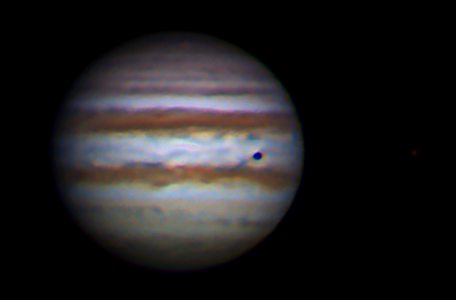
Jupiter IO Transit 12-10-26

My Account

New to Astromart?

Register an account...

Need Help?

Posts Made By: Curt Renz

January 17, 2006 12:18 AM Forum: Solar System Observing

Moon Occults Spica & Antares - Jan 22 & 25

Posted By Curt Renz

The first magnitude stars Spica and Antares will be occulted for some observers on January 22 and 25 respectively. The Spica event will be visible in Asia. The Antares event will be seen in portions of South and Central America, including Mexico.

I’ve created graze maps for the occultations. Those located between the northern and southern graze paths will see an occultation. Those directly on a path will witness the star winking on and off as lunar hills and valleys pass by. To see the maps, click: http://www.curtrenz.com/astronomical.html

If you would like specific occultation or graze data for your location, please reply within this thread with your Longitude, Latitude, Altitude and Time Zone.

Coming Attraction: On the night of February 5/6 observers in western North America and Hawaii will be able to watch the Moon occult the Pleiades cluster. Later this month I will upload a graphic and map related to that event. wink

January 23, 2006 07:01 AM Forum: Solar System Observing

Saturn at Opposition and Conjunct Beehive

Posted By Curt Renz

Saturn will reach opposition to the Sun in ecliptical longitude on 2006 JAN 27 at 23 hr UT. It will appear at stellar magnitude –0.2, while its axis will be tilted by –18.9° to the perpendicular of the line of sight and its rings slanted accordingly. The planet will reach a minimum of 8.1268 AU or 1.216 billion km from Earth when it will appear to have an equatorial angular diameter of 20.4 arcseconds.

As viewed geocentrically on 2006 FEB 04 at 03:33 UT, Saturn will be retrogressing to the south of Mag 6.3 Epsilon Cancri (the brightest of the Beehive cluster – M44) at an angular separation of only 52.2 arcminutes.

I’ve created a graphic demonstrating its entire opposition loop, appearance at opposition and triple conjunction with the Beehive. To see it, click: http://www.curtrenz.com/astronomical.html wink

January 25, 2006 10:31 PM Forum: Solar System Observing

Moon Occults Pleiades - Feb 5/6

Posted By Curt Renz

During the night of 2006 FEB 5/6 the Moon will occult many of the stars in the Pleiades cluster (M45) in Taurus for observers in Hawaii and western North America. It should be a pretty sight. The apparent disk of the waxing gibbous Moon will be 60% illuminated. Therefore, occulted stars will disappear behind the Moon’s dark limb and reappear from its bright limb. The northern graze path for the third brightest Pleiades star, Mag 3.7 Electra, will pass through Los Angeles.

To see my occultation graze map, click:
http://www.curtrenz.com/astronomical.html

Observers located on a star’s graze path will see that star winking on and off as hills and valleys on the lunar limb pass by. A graze path is roughly as wide as the difference in elevation between the lunar topographic features, generally a couple of kilometers. Those observers located north of a star’s southern graze path and south of that star’s northern graze path will witness a full occultation. The distance between the two graze paths is at least as great as the polar diameter of the Moon, 3472 kilometers. In some cases only one of the graze paths exists, because the other would be in outer space above a polar region.

The graze paths for each of the seven brightest Pleiades stars are plotted on my map. Below the stars’ apparent coordinates are for the date of the event (not 2000.0):

RA 03:47:50.9 Dec N 24°07’35” Mag +2.9 Alcyone
RA 03:49:31.3 Dec N 24°04’28” Mag +3.6 Atlas
RA 03:45:14.7 Dec N 24°08’05” Mag +3.7 Electra
RA 03:46:11.5 Dec N 24°23’21” Mag +3.9 Maia
RA 03:46:41.4 Dec N 23°58’11” Mag +4.2 Merope
RA 03:45:34.3 Dec N 24°29’19” Mag +4.3 Taygete
RA 03:49:33.1 Dec N 24°09’27” Mag +5.0 Pleione


Southern Californians take special note. The northern graze path for Electra will pass through your area, including the city of Los Angeles. Those on the path will witness a graze. Those south of the path will see a full occultation.

Below is my graze interpolation algorithm for Electra, which is accurate between 114° and 122° of western longitude but not outside those limits. The results should be rounded to no more than four places after the decimal point. The only input value is the western longitude. All values are decimal, including the hours. The Zenith Angle is the position of the star on the lunar limb measured counter-clockwise from the Zenith.

W = Western Longitude (input)
N = Northern Latitude (output)
H = Hours PST (output)
Z = Zenith Angle (output)

L = W – 118 (L is a negative value when W is less than 118)

N = 33.8749826 + 0.38708718 L – 0.00320651 L²
H = 0.1608787 – 0.00867207 L – 0.00023953 L²
Z = 292.7329 - 0.03015 L + 0.000286 L²


Please reply within this thread to receive specific occultation or graze data for your location. I’ll need your Longitude, Latitude, Time Zone, approximate Altitude above sea level, and the name of the stars that interest you. If your desire is to find the latitude for a certain star’s graze point that matches a specific longitude, please say so. wink

February 5, 2006 12:29 AM Forum: Solar System Observing

Mercury as Late Winter Evening Star

Posted By Curt Renz

Mercury is about to commence a fine apparition as an evening star for northern hemisphere observers. If you’ve never seen the Sun hugging planet, here’s your chance to view it for a few weeks after sunset in the western sky.

Mercury passed through Superior Conjunction on the other side of the Sun on 2006 JAN 26 at 22 hr UT. It will achieve Greatest Eastern Elongation of 18º08’ from the Sun on FEB 24 at 05 hr UT, before passing between the Earth and Sun in Inferior Conjunction on MAR 12 at 03 hr UT. For North Americans on FEB 28, Mercury will serve as a guidepost for spotting the one-day-old Moon.

To see my graphic demonstrating Mercury’s entire apparition, click: http://www.curtrenz.com/astronomical.html wink

February 12, 2006 03:57 AM Forum: Solar System Observing

Moon Occults Spica - Feb 17

Posted By Curt Renz

The Moon will occult the Mag 1.0 star Spica in Virgo during the late evening of 2006 FEB 17 for observers on the east coast of North America and during the early morning of the 18th in central Africa. Those on the coast from Georgia through New York will witness only the emersion (reappearance) of Spica. Observers on the New England and Canadian coasts will see a full occultation with immersion (disappearance) beginning shortly after moonrise. smile

I have created a pictorial preview with data for the event as it will be seen from Boston. I also made a graze map showing the limits of observability, which are the paths from which lucky viewers will see the star winking on and off as lunar hills and valleys pass by. To see the graphics, click: http://www.curtrenz.com/astronomical.html

February 21, 2006 09:50 PM Forum: Solar System Observing

Spot the Moon Aged Less than 24 Hours - Feb 28

Posted By Curt Renz

Who will be first ground based observer to spot the New Moon after sunset by naked-eye following its conjunction with the Sun on 2006 FEB 28 at 00:31 UT (FEB 27 at 18:31 CST)?

This will be a terrific opportunity for observers in the eastern half of North America to spot a Moon aged less than 24 hours. Unlike last autumn, the angle of the ecliptic into the western horizon after sunset has come to our advantage. The current extreme point in the Moon’s 18.6-year nodal cycle will further enhance the angle, however it will keep the Moon at a slightly adverse southerly latitude from the ecliptic. The speed of the Moon near perigee will be another beneficial factor.

The slender crescent Moon, a day or two old, was traditionally referred to as the New Moon. On the day of conjunction our ancestors called it the Dark of the Moon (or Change of the Moon.) However, most modern calendar makers insist on labeling the conjunction day as that of the New Moon.

Please report your February observation within this thread, including location and time with zone. Even negative results would be interesting. Photos would be especially nice. No prizes, just bragging rights.

I've created a graphic representing the western sky 25 minutes after sunset on February 28 as seen from Chicago's Adler Planetarium. Mercury will serve as a guidepost. The diagram should be useful for most North American observers. To see it, click:

http://www.curtrenz.com/astronomical.html

The graphic may be removed soon after February 28. wink

March 1, 2006 06:15 PM Forum: Solar System Observing

"Total" Penumbral Lunar Eclipse - March 14

Posted By Curt Renz

An unusual “Total” Penumbral Lunar Eclipse will occur during the night of 2006 MAR 14/15. The penumbra is the outer fringe shadow of the earth. At mid-eclipse the Moon will be fully immersed in the penumbra and not at all in the dark inner shadow called the umbra. At that moment anyone standing anywhere on the half of the Moon’s surface facing Earth would be observing a partial occultation of the Sun by the Earth. Those of us on the nighttime portion of the Earth will notice that the area around one limb (edge) of the Full Moon has darkened. The Moon’s magnitude in the penumbra will be +1.027 and in the umbra will be –0.066, meaning it will miss the umbra by 0.066 lunar diameters.

The last such TPLE occurred in 1999, but the next one following this month’s event will be in 2053. In fact only one occurs in each of the periods 1666-1899 and 2158-2428.

2006 MAR 14/15

21:24 UT Moon Enters Penumbra
23:48 UT Maximum Eclipse
02:11 UT Moon Exits Penumbra


My calculations employ the “French rule” and account for the oblate shape of the Earth. To see a graphic that I created demonstrating the event, click: http://www.curtrenz.com/astronomical.html

March 9, 2006 10:01 PM Forum: Solar System Observing

Moon Occults Pleiades - Americas - Eve - April 1st

Posted By Curt Renz

An occultation of the Pleiades star cluster (M45) by the Moon will occur during the evening of 2006 APR 01 (Saturday) and will be a nighttime event across the eastern half of North America and northwestern South America.

Since the crescent Moon’s apparent disk will be only 17% illuminated, this will make for a better photographic event than its immediate predecessors in this series. Additionally, the fact that the Moon will be waxing will enhance the ability to observe immersions (disappearances) of individual stars. This should be the finest opportunity for observers in eastern North America during the entire 2005-10 Pleiades occultation series.

I’ve created three graphics that are related to the event. They can be seen by going to:

http://www.curtrenz.com/astronomical.html

1) The first graphic is a pictorial preview of the occultation as it will be seen from Chicago’s Adler Planetarium when the Pleiades brightest star, Alcyone at Mag 2.9, is most fully covered by the Moon.

2) The second graphic is a map of the Americas depicting the graze paths of the Pleiades 7 brightest stars. Any person located between the northern and southern graze paths of any particular star can witness a full occultation. Anyone directly on a graze path will be able to observe a star winking on and off as hills and valleys of one of the Moon’s polar regions pass by.

3) The third graphic is a map of the region south of Chicago depicting the northern path for the twilight graze of the Pleiades 4th brightest star, Maia at Mag 3.9.

If you have questions related to the circumstances of the occultations or grazes for your location, feel free to reply within this thread. Please include your Longitude, Latitude, Time Zone and approximate Altitude above sea level. wink

March 27, 2006 09:30 PM Forum: Solar System Observing

March New Moon Spotting Contest

Posted By Curt Renz

Who will be first ground based observer to spot the New Moon after sunset by naked-eye following its conjunction with the Sun on 2006 MAR 29 at 10:15 UT?

The slender crescent Moon, a day or two old, was traditionally referred to as the New Moon. On the day of conjunction our ancestors called it the Dark of the Moon (or Change of the Moon.) However, most modern calendar makers insist on labeling the conjunction day as that of the New Moon.

The celestial geometery near the vernal equinox should make it relatively easy for North Americans to view the Moon aged a little over 1.5 days after sunset on the 30th. However, it would take a near miracle to spot it on the 29th.

Please report your March observation within this thread, including location and time with zone. Even negative results would be interesting. Photos would be especially nice. No prizes, just bragging rights.

I've created a graphic representing the western sky 30 minutes after sunset on March 30th as seen from Chicago's Adler Planetarium. Nevertheless, the diagram should be useful for most North American observers. To see it, click:

http://www.curtrenz.com/astronomical.html

The graphic may be removed soon after March 30th.

April 25, 2006 04:20 PM Forum: Solar System Observing

April New Moon Spotting Contest

Posted By Curt Renz

Who will be first ground based observer to spot the New Moon after sunset by naked-eye following its conjunction with the Sun on 2006 APR 27 at 19:44 UT?

The slender crescent Moon, a day or two old, was traditionally referred to as the New Moon. On the day of conjunction our ancestors called it the Dark of the Moon (or Change of the Moon.) However, most modern calendar makers insist on labeling the conjunction day as that of the New Moon.

The favorable springtime celestial geometery should aid North Americans in spotting the one-day-old Moon low in the west-northwest after sunset on the 28th.

Please report your April observation within this thread, including location and time with zone. Even negative results would be interesting. Photos would be especially nice. No prizes, just bragging rights.

I've created a graphic representing the western sky 30 minutes after sunset on April 28th as seen from Chicago's Adler Planetarium. Nevertheless, the diagram should be useful for most North American observers. To see it, click:

http://www.curtrenz.com/astronomical.html

The graphic may be removed soon after April 28th.
