Image of the day

Captured by
Arthur Hogan

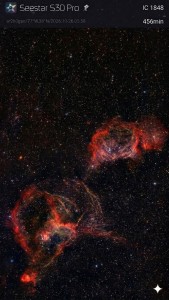
Heart and Soul Nebulas

My Account

New to Astromart?

Register an account...

Need Help?

Posts Made By: Herbert Kraus

December 14, 2007 11:57 PM Forum: Deep Sky Observing

NGC1275

Posted By Herbert Kraus

Inge Skauvik said:The negative photo [of NGC1275] in the NSOG is a bit difficult to use for identification, therefore I would be grateful if anyone could give me a reference to a better photo of this galaxy cluster. Inge S

Inge: NGC 1275 is apparently No. 24 of the "Caldwell Objects," and there is an excellent photo of it among the other galaxies in its cluster (all appropriately identified) on page 100 of O'Meara's book "The Caldwell Objects." I hope you have access to a copy of that book.

January 9, 2008 10:20 PM Forum: Equipment Talk

Whoa!

Posted By Herbert Kraus

Gregg: The rant quoted in your entertaining posting tells us more about its author than about any kind of telescopes. I wonder if that author is the same person as the Astromart user of the same name who lives in Cambridge, England, where Isaac Newton, among other achievements, designed the fore-runner of most modern reflector telescopes.

January 26, 2008 11:15 PM Forum: Deep Sky Observing

Bright NGC Objects this winter

Posted By Herbert Kraus

John Meiners said: Don't get me wrong I am not getting tired of the Messier objects.. but was going to go after some of the brighter NGC targets that are within the grasp of my 9.25" SCT.... So if there are any "easy capture" NGC object that you have found interesting.. I would love to hear about them. John M
John: I would recommend you obtain a list of the "Herschel 400" objects and make your selections from the objects on this list that are currently in our evening skies (e.g., right ascension about 0 to 7 hours, and declination well above your southern horizon). You might also check the list of deep-sky objects for January that Dave Mitsky has posted on this Astromart forum.
I could mention a few of my favorites among those now in our skies, but most of them would be open clusters which may not be as interesting to you as some of the nebulae and galaxies that I usually ignore.

March 8, 2008 04:50 PM Forum: Beginning Astronomy?

How to use Konus polar scope

Posted By Herbert Kraus

Nick McMillan said:I dont understand how to use the polar scope, I attached a picture.
Nick: I believe the 3 circles around the center show the distances of Polaris from the true celestial north pole in the years 2000, 2010 and 2020, and the pattern in the upper right constitutes the explanation for this use of the 3 circles around the center. The pattern in the lower left is for use of the polar scope in the southern hemisphere, showing the relationship of some stars in the constellation Octans to the celestial south pole.

April 6, 2008 06:52 AM Forum: LUNATICS

rukl atlas

Posted By Herbert Kraus

Sharon Bourgeois said:I've got a Hamlyn version of Rukl's Moon atlas and am trying to find out if is has any value in the astronomical community at large.
The original English language edition of Antonín Rükl's Atlas of the Moon was published by Paul Hamlyn Publishing, London, in 1990 and was quite well received by amateur astronomers. See the book review by John E. Westfall of the ALPO on page 404 of the April 1992 issue of Sky & Telescope. Before the revised edition was published by Sky Publishing Corporation in 2004, the Hamlyn edition apparently became out of print and was fetching exorbitant prices in the used book resale market. Although the revised edition updated the original one and made some changes in it, including updates to some of the lunar nomenclature, the core contents of both editions are Rükl's 76 magnificent maps of the moon, and I see no reason why the Hamlyn edition would not continue to be useful to any devoted lunar observer. Just don't expect to be able to sell it for the prices that prevailed before 2004.

April 6, 2008 04:21 PM Forum: After Dark

Mystery Object?

Posted By Herbert Kraus

Darryl Simmons said:On 4/3/08 I observed Mizar with my 20x80 Binocs. In-between the two stars, I observed a third object! It is just a little off-center and a little south of the line between Mizar and it’s double...Does anyone know what this is?
Since you were observing with 20x80 binoculars, I don't believe you were seeing Mizar and its "double," but that you saw Mizar and Alcor, two stars that are 11.8 arcminutes apart. There is an 8th magnitude star that is more or less between these two that was once named Sidus Ludovicianum. Look at this field with a telescope, and the relationship between these three stars will become obvious; Mizar itself is an easily split -- bright and beautiful -- double separated by about 14.3 arcseconds.

April 6, 2008 04:25 PM Forum: Beginning Astronomy?

Mystery Object?

Posted By Herbert Kraus

I responded to your posting in the After Dark forum.

April 21, 2008 04:38 PM Forum: Pictures of Me and My Telescope and........

Joshua Tree the morning after...

Posted By Herbert Kraus

Linton: Never mind the Joshua trees. You know darn well that they're in the northern -- Mojave Desert -- portion of JTNP, where I would guess any star-gazing would be compromised not just by those plants but also by the lights from 29 Palms and its surroundings. Come to think of it, however, some years ago someone recommended the Jumbo Rocks Campground area of the park as a place to take my telescope. Have you ever tried that?

April 30, 2008 05:03 PM Forum: Deep Sky Observing

Globulars clusters and planetaries of Ophiuchus

Posted By Herbert Kraus

Inge Skauvik said: Can you tell me about your favourite objects (both showpieces and challenges) in Ophiuchus. I know that the region contains many globulars and planetaries, but any deep-sky objects are of interest.
Since you asked, I would like to mention a favorite object which is probably not among the myriad globulars, etc. that others may list in response to your posting: IC 4665 is an open cluster, close to Beta Ophiuchi (Cebalrai), of which the principal dozen or so brightest stars look to be of nearly equal magnitudes (magnitudes 7 and 8 ) and are scattered across a rather wide field of view. To me this rather extensive and bright but sparse cluster is like a more distant version of the Pleiades, and when Ophiuchus is in my sky I usually try to seek it out with a low power eyepiece, among other things to test whether I have successfully aligned my "go-to" telescope.

May 4, 2008 08:51 PM Forum: ASTRONOMY

Astronomy Magazine's lastest slip up

Posted By Herbert Kraus

It was apparently just a typographical error -- they dropped the word "million." Although other sources don't indicate that NGC2770 is 102 million light years away, this is its distance according to http://io9.com/tag/ngc-2770/ I suspect "Astronomy's" authors and editors know astronomy well enough, but their proofreaders -- assuming they have any -- may not.