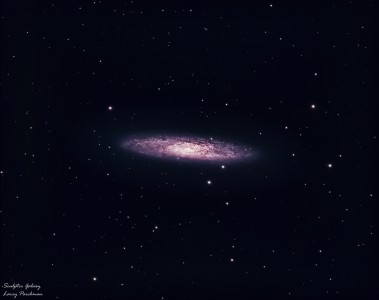
Image of the day

Captured by
Lawrence Parchman

Sculptor Galaxy (NGC 253)

My Account

New to Astromart?

Register an account...

Need Help?

Posts Made By: Alex McConahay

May 1, 2008 04:59 AM Forum: CCD Imaging and Processing/Deep Sky

focal reducer field flatness question

Posted By Alex McConahay

A few months back I asked the question--just how far shoulr the Reducer/Corrector be from the focal plane. Nobody on the forum gave me a solid answer, and there was not much interest in the question.

I was later told by an astroimager I respect that the ideal length (for the standard Meade/Celestron Reducer/Corrector) is about 85 mm. So that is where I put it.

Anybody have better ideas? More discussion?

Alex

May 8, 2008 05:55 AM Forum: Beginning Astronomy?

Go To setup time

Posted By Alex McConahay

You can probably get a small GEM equatorial mount like the lxd 75 running in less than 10 minutes. I judge this from watching people start up at outreaches, from trunk to observing in ten minutes. However, this does not allow for cool down.

Alex

May 8, 2008 03:20 PM Forum: After Dark

Midwest

Posted By Alex McConahay

The Nebraska and Okie Tex star parties are supposed to be pretty dark.....and there certainly are other examples of good places to observe in the midwest.

However, amateur observing and professional observatory building are two different things. And darkness alone is not the chief factor.

ONe build observatories on mountain tops so there is less atmosphere to peer through. Not a lot of mountaintops in the midwest.

One builds observatories closer to the equator so there is more sky to see. Midwest does not qualify here.

One builds observatories where the air is more stable. Extensive "seeing" studies precede the construction. This favors mountaintops, where the laminar flow of the air has not been disturbed as it moves across the continent. And it favors being near the ocean, which has fairly stable temperatures compared to land. Midwest tends not to have these mountaintops, and large bodies of water. And it has other seeing problems with the jet stream and the gulf air mixing with the continental air mass.

One builds observatories where the air is more clear. The midwest has more clouds, and even when it is not cloudy the heavy humid air has lots of water vapor to cut down on transparency. In the winter it may be more transparent, but not enough to make up for the loss at other times of the year.

I am sure there are other things to think about also. But, if my institution is about to build a mega dollar observatory, I would rather pay for travel to a naturally favored site than fight the elements in the midwest.

Alex

May 12, 2008 07:37 PM Forum: Digital SLR AstroPhotography

DSLR Focus problem

Posted By Alex McConahay

Sorry, I get confused on the terminology here.

Does not enough "backfocus" mean you run out of travel on the way in or the way out?

If you run out on the way out--just loosen the setscrew, and pull the camera out a bit, or add an extender tube--both of which are pretty easy.

If you run out on the way in, it is somewhat more difficult. Assuming you have the shortest possible imaging train--the thinnest adapters, etc, the easiest thing on a dob is to screw or unscrew the collimation bolts so that the mirror moves as far forward as possible. (After years of re-collimating, it seems the primary mirror migrates towards the back of the tube.) If that does not give you enough, and this is a true Dob, then it is generally pretty easy to move the whole mirror cell up a bit. Just redrill the holes in the side of the tube that hold the screws to the primary mirror cell.

Hope that helps.

Alex

May 21, 2008 01:55 PM Forum: CCD Imaging and Processing/Deep Sky

Silver Medal... not too shabby...

Posted By Alex McConahay

Congratulations, Ivan. Nobody deserves an honor more than you!

Alex

May 28, 2008 11:58 PM Forum: Eyepieces

need help with calculations

Posted By Alex McConahay

You know the focal length of the telescope is not changing. That is a fixed thing completely dependent on the shape of the primary.

The real field stop of the eyepiece will always need to be at exactly the same point for any given primary. But where that "real field stop" is depends on the design of the eyepiece. It can even be past the first piece of glass in some designs. In other words, it does not matter where the "end of the barrel" is, but rather the real field stop--which point can be hard to determine.

Luckily, you do not need to figure it out exactly if you just want to figure out where you place the focuser.

All you need to do is establish a standard, and that standard is your shortest focusing eyepiece when the focuser is racked almost all the way in.

You can determine where to place the focuser by basing the decision on the shortest focusing eyepeice. Go to another scope. Any functioning scope that can hold all your eyepieces and bring them to focus will work for a start. Try each of your eyepieces, and find the one that focuses closest, and the one that focuses farthest. The difference in focuser travel between the closest and the farthest is what you want in focuser travel on your new focuser. (Note that closest and farthest are not related directly to the focal length of the eyepiece but is a mechanical consideration dependent on the physical (not optical) design of the eyepiece.)

Then put your shortest eyepiece in your optical bench and see where it focuses. You want your focuser mounted such that the closest focusing, when almost fully racked in focuses at infinity.

It can get more complicated----for instance, simply collimating a newtonian can change the distance from the focuser to the mirror. And a Barlow or a Para-Corr can change your in-focus and outfocus demands. So, it is best to have some extra travel on either end.


Alex

June 4, 2008 01:23 AM Forum: Deep Sky Observing

Deep sky object lists besides Messier catalog?

Posted By Alex McConahay

Depends on what level you are at.

Have you taken all the star hops in "Star Hopping for Backyard Astronomers?" (MacRobert?) and found everything in Turn Left at Orion?

Then maybe you need to go after the Herschel 400, the SAC collection, or specialize in some type of object. Maybe begin splitting doubles.

One of my favorite things to do is "Find all the Globulars on Page 22 of Sky Atlas 2000." Or "All the galaxies over 10th magnitude in Virgo."

Alex

June 5, 2008 04:10 AM Forum: Refractors

Electric Focusers

Posted By Alex McConahay

Interesting objection about having the Robofocus getting in the way when you are not using it for astroimaging. I know what you mean, but it has not caused me any problems.

Now, I should say that my Robofocus motors and drives are incorporated into a self-contained focuser unit with a 2 inch snout in front that fits into any of my 2 inch focusers. If you are talking about just adding a Robofocus drive system to an existing focuser--then the case would be different.

What kind of scope? I image (such as it is) with all three types of scopes. The Robofocus is an add-on in each case, and does not get in the way at all.

On the TV85 and the SCT, the existing focusing knobs stay in place. On my newt, I simply have a low profile focuser on the tube, and insert the Robofocus into it as if it were an eyepiece extension.

In short, no matter which tube I am using, I use the existing focuser for the gross focus, and the Robofocus for the electric fine focusing. I can also just pull the Robofocus out (replacing it as needed with a tube extender in the Newt).

In short--the Robofocus does not interfere with manual use.

Alex

June 16, 2008 08:56 PM Forum: Equipment Talk

Mount

Posted By Alex McConahay

If you are handy, you can add the motors and such from an LXD 55 or 75, from what I have heard.

Alex

June 19, 2008 07:46 PM Forum: Digital SLR AstroPhotography

Rho Ophiuchus

Posted By Alex McConahay

Beautiful---what ISO?

Alex