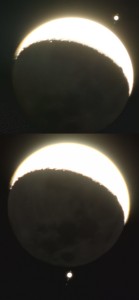
Image of the day

Captured by
John Greenlee

Before and after

My Account

New to Astromart?

Register an account...

Need Help?

Posts Made By: Jason Higley

July 6, 2009 04:05 AM Forum: CCD Imaging and Processing/Deep Sky

M101 section w/6 stacked Hubble ACS frames

Posted By Jason Higley

I think a nebula fan might like this so I post it here (even though it's from Hubble/SCSTI data). I went into the Hubble archives and used 6 images taken (by others) between 2006 and 2007 in the Advanced Camera for Surveys of a section of M101; although there were more frames of this region with different filters, I elected to focus on the exposures/filters that showed the clouds best

http://setisociety.org/m101nebula6framehubbleqk.jpg

The gap you see is due to the imaging chip gap. I started out just trying to experiment with downloading FITS data files and looking at them in AIP for Windows and some of them were opening fine, but when I got to these particular M101 related shots they wouldn't open, so I had to download the the "quickview" GIF versions of images and then convert them to .jpg's so Registax could see them. I used Registax in an attempt at subtracting noise.

Regards, Jason H.

July 7, 2009 04:28 AM Forum: CCD Imaging and Processing/Deep Sky

Crab core, ~1 month period, 4 frame animation

Posted By Jason Higley

I made this 4 frame animation using Hubble/STSCI images taken between Sept 6 2005 and Oct. 25, 2005.

MAKE SURE TO EXPAND TO FULL SIZE!

http://setisociety.org/M1-Crab-Nebula-1-month.GIF

Get out the marshmallows! :^)

Jason H.

July 11, 2009 05:27 AM Forum: CCD Imaging and Processing/Deep Sky

NGC 4647 from Hubble (not a release image)

Posted By Jason Higley

Here's one of NGC 4647 (that's the spiral galaxy in apparent proximity to the elliptical galaxy M60)
MAKE SURE TO EXPAND TO FULL SIZE

http://setisociety.org/3frameNGC4647cropHubble.jpg

I don't see a Hubble 'release image' of this object when doing a google search for it, nor do I see it on hubblesite.org, so for the fun of it I decided to stack together a couple of FITS format image frames that were taken by Hubble/STSCI Astronomers back in 2002.

Regards, Jason H.

July 25, 2009 04:20 AM Forum: CCD Imaging and Processing/Solar System

Kodak M1033 on Saturn from May

Posted By Jason Higley

I've re-re-processed a Saturn run from May with the Kodak M1033 (10 megapixel point-n-shoot camera)

http://setisociety.org/SATURN-10-MAY-2RUN-COMBO-011-12-BIGrereprocess.jpg

As I'm really in the beginning stages of experimenting with this camera and was initially put off by its sensitivity compared to the Canon Powershots I have, and I felt that I had messed it up color and processing the last time I processed this run and really wanted to give this camera a second look. I've applied new post-processing techniques I've just learned and whacked the size down based on where I felt the image was starting to break down. I think it came out better than the last time I processed it, and I hope to try some more experiments with the Kodak M1033.

Regards, Jason H.

July 28, 2009 01:02 AM Forum: CCD Imaging and Processing/Solar System

Afocal Jupiters from Point-n-shoots reprocessed

Posted By Jason Higley

In these days of amazing planet imaging (with dedicated planet cameras), this isn't in the same league, but since I'm one of the few people using the afocal method on planets that posts here, here's a report on an incremental improvement. Here's a Jupiter I shot last year afocally through the Criterion RV-6 and posted here, but I've re-processed it using some of the steps I just learned from Paul Haese's tutorial

http://setisociety.org/JUPITERMVI_0214AUG08.jpg

and here was my first harsh try at the same video run

http://setisociety.org/jupiterMVI_0214reg2rox.jpg

and here's another re-processed one with new (to me) techniques

http://setisociety.org/MVI_0209-2008-50fropt-rgb-1pt5.jpg

And here was my 1st try at that run

http://setisociety.org/JUPITERSEPT19-MVI_0209REG2PT6MOONROXI.jpg

I used less frames this time, but I think they came out better.

Jason H.

July 31, 2009 07:23 PM Forum: CCD Imaging and Processing/Solar System

Uranus rings mosaic w/6 Voyager frames

Posted By Jason Higley

I used 6 Voyager 2 widefield camera images (from NASA's planetary data system) to make the following (rough/eyeballed) mosaic of the rings around Uranus :^)

http://setisociety.org/newringmosaic4.jpg

and here's 2 frame sequence inverting the same to highlight the rings

http://setisociety.org/voyageruranusmosaicinvert.GIF


Regards, Jason H.

August 1, 2009 06:14 AM Forum: CCD Imaging and Processing/Solar System

Neptune rotation movie, white clouds, dark spot

Posted By Jason Higley

I made this 7 frame animation of Neptune rotating using images from Voyager 2 images that used a methane filter

http://setisociety.org/neptunerotation.GIF

The time span is 5 hours and 11 minutes on Aug. 23rd 1989. The spacecraft moved quite a bit between each frame, so I hand-centered each frame using Adobe and animated it with GIF Construction Set Professional. I processed the original images from TMQ format, and fiddled with the gamma levels using AIP4Win and saved as TIF's. Then after centering in Adobe I saved as low-compression jpgs and then as a GIF movie. The black dots are used by NASA to calibrate image scale and spacecraft motion relative to the planet.

Regard, Jason H.

August 2, 2009 04:07 PM Forum: CCD Imaging and Processing/Solar System

URANUS - 14 hours of rotation w/ white cloud

Posted By Jason Higley

I made this 13 frame sequence of Uranus rotating with a white cloud using Voyager 2 methane filter images from NASA's Planetary Data System. It's hard to see, but if you look very carefully, you can see the white cloud near the 8 0'clock position, rotating counter-clockwise near the limb

http://setisociety.org/UranusRotationCloud13frames.GIF

The time span is 14 hours and 24 minutes and were shot between Jan. 22-23, 1986. I've read in many books how Uranus was featureless as a new cue-ball during the Voyager flyby; perhaps this is the 1st Voyager/Uranus cloud rotation movie uploaded to the internet?

I converted the original IMQ images to TIF's using AIP4Win and adjusted the gamma levels. Then I hand centered each frame in Adobe (because of considerable spacecraft movement between each frame.) The black dots are used by NASA for determining image scale and spacecraft movement relative to target.

Regards, Jason H.

August 10, 2009 08:12 AM Forum: CCD Imaging and Processing/Solar System

22 frame Jupiter impact site sequence - July 21

Posted By Jason Higley

Here's a half-sized GIF movie of 280 KB I made from AVI's I shot on July 21 of the dark impact site rotating by (during most of its apparition that morning):

First here's the best still frame from the sequence

http://setisociety.org/Untitled-549.jpg

and here's the slowest sequence

http://setisociety.org/22frameJupiterImpact072109half.GIF

Faster

http://setisociety.org/22frameJupiterImpact072109halffaster.GIF

Fastest

http://setisociety.org/22frameJupiterImpact072109halffasterstill.GIF

I still don't have an astronomy animation program yet; I'm looking for a user friendly one that centers the planet; hand-centering is not fun! De-rotating the images would have been nice too, but my software introduces too much loss when I do that (especially from an already heavily compressed run.)

Stats: Afocal Canon Powershot SX100 at old Meade 26mm Super-plossl EP, Criterion RV-8 scope from early 70's, 2x Ultima Barlow, no. 96 Celestron filter, Orion Steadypix camera holder (the old one), Registax 5, Roxio Photosuite 5, Adobe Photodeluxe (a 90's program I used to hand stack the shots) and GIF Construction Set Professional.

Regards, Jason H.

August 18, 2009 08:57 PM Forum: CCD Imaging and Processing/Solar System

Aristoteles, Eudoxus and polar. afocal (edited)

Posted By Jason Higley

Moon craters with neat floor details

Aristoteles
http://setisociety.org/MOONIMG_0759POUND.jpg

Aristoteles and Eudoxus
http://setisociety.org/MOONIMG_0755POUND.jpg

And a polar shot

http://setisociety.org/MOONIMG_0668TWO.JPG

I had the magnification cranked as far as it would tolerate under the conditions, afocal on the Criterion RV-8, 10 mm EP, 2x Ultima Barlow, 4x zoom on Canon Powershot A590 set at ISO 1600 and 1/40th of a second.

When I originally saw the images, they looked fantastic, but when I got them into the editing software, they looked very noisy. It seems that Windows picture viewer does amazing-on-the-fly processing to make the images look less noisy. Anyway, the run that I thought was great started looking like a total loss of a session, but the above three are the noise-salvaged shots.

Clear skies, Jason H.