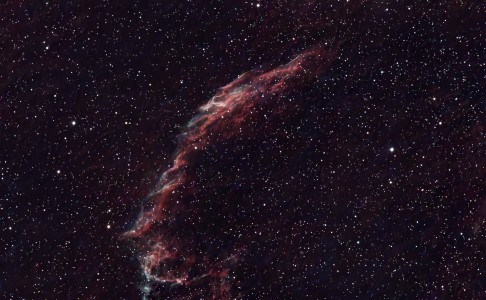
Image of the day

Captured by
GERALD KREITZBURG

Eastern Veil Nebula

My Account

New to Astromart?

Register an account...

Need Help?

Posts Made By: Curt Renz

November 27, 2005 02:01 AM Forum: Solar System Observing

Mercury Shines as a December Morning Star

Posted By Curt Renz

Mercury will soon be jumping into our pre-dawn skies as a December Morning Star. It passed through Inferior Conjunction between the Earth and Sun on November 24. It will achieve a Greatest Western Elongation of 21.1° on December 12 and Superior Conjunction on January 26. The celestial geometry will be far more favorable for northern hemisphere observers than the recently concluded evening apparition. We’ll just have to brave the cold and early hour. wink

I’ve created a graphic that demonstrates Mercury’s appearance in the eastern sky 30 minutes before sunrise from November 27 to January 9 from Chicago, although it should well serve all in the northern hemisphere. To see it, click:
http://www.curtrenz.com/astronomical.html

November 30, 2005 06:22 AM Forum: Solar System Observing

December New Moon Spotting Contest

Posted By Curt Renz

Who will be first ground based observer to spot the New Moon after sunset by naked-eye following its conjunction with the Sun on 2005 DEC 01 at 15:01 UT (09:01 CST)?

The slender crescent Moon, a day or two old, was traditionally referred to as the New Moon. On the day of conjunction our ancestors called it the Dark of the Moon (or Change of the Moon.) However, most modern calendar makers insist on labeling the conjunction day as that of the New Moon.

December should present a better opportunity for northern observers than the previous few months. Although late winter and early spring will be even better.

Please report your December observation within this thread, including location and time with zone. Even negative results would be interesting. Photos would be especially nice. No prizes, just bragging rights.

I've created a graphic representing the western sky 20 minutes after sunset on December 2 as seen from Chicago's Adler Planetarium. Nevertheless, the diagram should be useful for most North American observers. Don't confuse the enlarged depiction of the Moon in the upper left of the image with the plotted version in the lower right. To see it, click:

http://www.curtrenz.com/astronomical.html

The graphic may be removed soon after December 2. wink

December 9, 2005 03:04 AM Forum: Solar System Observing

Virgo Occultations - Dec 23 & 25

Posted By Curt Renz

Get that new Christmas telescope unwrapped early. Spica, the 1.0 magnitude star in Virgo, will be occulted by the Moon for North Americans on Christmas morning. Mag 3.6 Beta Virginis will be occulted for North Americans two days earlier. That event will occur during the wee hours of the night. The Spica occultation will occur at nighttime for those in the west, but will be a daytime event for easterners. Yes, the star can be seen in daylight with optical aid.

I’ve prepared graphics and data for both occultations as seen from Chicago’s Adler Planetarium. To see them, click:
http://www.curtrenz.com/astronomical.html

Spica: RA 13:25.5 - Decl S 11°12'
Beta Virginis: RA 11:51.0 - Decl N 1°44'

If you will reply to this thread with your specific coordinates (Longitude, Latitude, Time Zone and approximate Altitude above sea level), I will provide you with customized occultation data.

The graphics may be removed soon after each event occurs. Merry Christmas! grin

December 14, 2005 06:45 AM Forum: Off Topic Discussions

Monopoly - A Great Rule Change

Posted By Curt Renz

I’ve discovered that resurrecting one of the original rules of Monopoly makes it a much better game. Other than this one exception, the actual printed rules of the long version should be strictly enforced. That especially includes leaving Free Parking as a resting place and not a jackpot as some unofficial house rules allow. The jackpot leaves so much money in players’ hands that the game drags on with no bankruptcies. What fun is that? Eventually someone says, “Let’s just end the game in twenty minutes and declare the richest player the winner.” That changed objective rewards strategies that a true monopoly wizard would not have been employing.

Monopoly was actually invented in 1904 as the Landlord Game. It evolved during the next thirty years into several slightly different versions, the rights to three of which were bought by Parker Brothers in 1935. Originally, when properties were first landed upon, they were immediately sold by the bank during an auction. The first person to land on a property did not have the exclusive right to buy it at the printed price. At a late point during the game’s development, a group of Quakers became enthusiasts. However, they frowned on auctions. It was shortly after they fixed the prices of properties that Parker Brothers began marketing the game under those unrealistic rules.

An auction is a much more natural way to determine the value of investment property. It’s how markets actually operate. Mandatory auctioning shifts the advantage from the lucky to the skillful. The players moving earliest lose much of their edge over the others. Each player can concentrate on bidding for properties that suit his own playing style. Determinations must be made whether to participate in each auction or keep cash in reserve for when more desirable properties become available. Risks and potential rewards must be constantly weighed, just as in the real world.

Frequent auctions also make the game much more fun. It becomes riotous when monopolies are close to forming. Try it this way - I think you’ll like it so much that you would never even consider going back to the fixed price rule.

December 22, 2005 11:52 PM Forum: Off Topic Discussions

"Science" Declares Top Breakthrough of 2005

Posted By Curt Renz

The year-end issue of the prestigious journal Science today declared that freshly gathered evidence of evolution "in action" was the year's number one scientific breakthrough. Science is a principle publication in which scientific theories are exposed to peer review, a major tenet of the scientific method. Click for link: http://www.msnbc.msn.com/id/10574901/from/RSS/

This comes on the heels of a landmark judicial verdict in Pennsylvania outlawing the presentation in classrooms of Intelligent Design as an alternative scientific theory to Darwinian Evolution. It seems obvious to me that the "facts of evolution" have been firmly established. The evidence is overwhelming. Just look at the fossil record. And yes, it has been observed in modern times as species adapt to environmental conditions. The "theory of evolution" seeks to explain how the facts of evolution came into being. Those who propose additions or alterations to the theory are subject to intense scientific peer review. It is the most fully developed and elegant explanation of natural history ever devised. It is also simple and logical.

It has been established by the courts that the first amendment to the Constitution implies that governmental authorities must not impose the precepts of any particular religion on their citizens. Creationism is obviously not science: It is adherence to a fairy tale explanation of the origin of species, which amazingly, many modern American adults still continue to feel comfortable believing. It is a religious concept that our ancestors developed during an earlier time when little was known about the natural world. Intelligent Design was a hastily devised alternative meant to circumvent legal precedent by making something like Creationism appear to be a science. Judge Jones was not fooled. He refused to allow it in a science classroom administered by governmental authorities in a situation in which school attendance is mandatory. He is a great credit to the American judiciary.

Let us hope that the people of our country march forward into the 21st century with the same acceptance of reality that has embraced the rest of the literate nations of the world. Let us think with our highly evolved brains and avoid the automatic acknowledgement of nonsense taught by demagogues seeking to maintain their positions of authority and sources of income. These purveyors of ignorance have actively worked at keeping Americans in darkness for far too long. The Enlightenment of western mankind began over 200 years ago; it is about time that we Americans all join it. If more Americans become well educated and critically thinking adults, the rest of the world will once again look upon us as a people to be respected, imitated and worthy of a position of leadership in international affairs.

December 23, 2005 10:38 PM Forum: Solar System Observing

Occultations of Spica and Antares - Dec 25 & 29

Posted By Curt Renz

There will be two occultations by the Moon of first magnitude stars before 2005 ends. 8)

To see the maps I’ve plotted for the graze paths of Spica and Antares, click: http://www.curtrenz.com/astronomical.html .

During Christmas morning, December 25, Mag 1.0 Spica in Virgo will be occulted across much of North America. For those in the western half of the continent it will be a nighttime event. For easterners it will occur during daylight, but the star should be visible in a telescope. The southern graze path will cut through the western USA from Alaska through Washington State, Texas and into Mexico and Central America. There will be no northern graze path. Spica will be at RA 13:25.5 and Dec S 11°12’. The apparent disk of the waning Moon will be 33% illuminated.

On December 29, Mag 1.1 Antares in Scorpius will be occulted across Southern and Southeastern Asia, Indonesia and Australia (except SW and SE Australia.) This will be a pre-dawn event from India, although the northern graze path will pass through the Chinese portion of the Himalayas. For regions east of India the occultation will occur in daylight, although the star should be visible with a telescope. The southern graze path will cut across Australia. Antares will be at RA 16:29:44.9 and Dec S 26°26’45". The apparent disk of the waning Moon will be 6% illuminated.

Below are my calculated geographic coordinates for the points on the Spica graze path in North America separated by five degrees of longitude. The times are UT. ZA is the Zenith Angle, which is the position of the star on the lunar limb as measured counter-clockwise from the zenith. Sea level is assumed due to the variance in altitude between plotted points. Linear interpolation would be insufficient for intermediate longitudes, but quadratic interpolation should get you close. However, please feel free to reply within this thread to learn the data that go with any specific longitudes and altitudes (above sea level) you provide – that includes requests for more info on the Antares occultation.

13:29:57 UT - ZA 239.0°
W 125° – N 48.12053°
Pacific Ocean, 22 kilometers west of Ozette, WA

13:37:00 UT - ZA 237.7°
W 120° – N 44.71127°
4 kilometers southeast of Waldron, OR

13:46:22 UT - ZA 234.9°
W 115° – N 40.72973°
5 kilometers southeast of Clover, NV

13:58:37 UT - ZA 229.7°
W 110° – N 36.13305°
Navajo Indian Reservation, 6 km SW of Blue Gap, AZ

14:13:58 UT - ZA 220.6°
W 105° – N 30.99516°
16 kilometers west of Van Horn, TX

14:31:43 UT - ZA 206.4°
W 100° – N 25.62933°
5 kilometers north of Cadereyta Jimenez, Mexico

December 27, 2005 10:01 AM Forum: Solar System Observing

Turn of the Year New Moon Spotting Contest

Posted By Curt Renz

Who will be first ground based observer to spot the New Moon after sunset by naked-eye following its conjunction with the Sun on 2005 DEC 31 at 03:12 UT (30 - 21:12 CST)?

The slender crescent Moon, a day or two old, was traditionally referred to as the New Moon. On the day of conjunction our ancestors called it the Dark of the Moon (or Change of the Moon.) However, most modern calendar makers insist on labeling the conjunction day as that of the New Moon.

The turn of the year should present a better opportunity for northern observers than the previous few months. There's a slim chance for North Americans to spot the Moon less than a day old on December 31st. January 1st may be more realistic. Late winter and early spring should bring us better chances for spotting a really young Moon.

Please report your turn of the year observation within this thread, including location and time with zone. Even negative results would be interesting. Photos would be especially nice. No prizes, just bragging rights.

I've created a graphic representing the western sky 30 minutes after sunset on January 1st as seen from Chicago's Adler Planetarium, where the Moon will be 10° directly to the left of a bright Venus. Nevertheless, the diagram should be useful for most North American observers. To see it, click:

http://www.curtrenz.com/astronomical.html

The graphic may be removed soon after January 1st. wink

December 29, 2005 07:53 AM Forum: Solar System Observing

Moon Occults Pleiades - Jan 9 - North America

Posted By Curt Renz

During the evening of Monday 2006 JAN 09 the Moon will occult some of the stars in the Pleiades cluster (M45) in Taurus for observers in much of North America. It should be a pretty sight. The apparent disk of the waxing gibbous Moon will be 82% illuminated. Therefore, occulted stars will disappear behind the Moon’s dark limb and reappear from its bright limb.

To see the graphics I’ve created previewing the occultation and presenting my North American graze map, click:
http://www.curtrenz.com/astronomical.html

For folks in the Chicago area, in a few days I will post local occultation data and upload a detailed Chicagoland map depicting the graze path of Pleione.

Observers located on a star’s graze path will see that star winking on and off as hills and valleys on the lunar limb pass by. A graze path is roughly as wide as the difference in elevation between the lunar topographic features, generally a couple of kilometers. Those observers located north of a star’s southern graze path and south of that star’s northern graze path will witness a full occultation. The distance between the two graze paths is at least as great as the diameter of the Moon, 3476 kilometers. In some cases only one of the graze paths exists, because the other would be in outer space above a polar region.

Among the 21 brightest Pleiades members, 10 will be occulted as viewed from North America when Cuba is included. No single observer will be located within sight of all 10 occultations.

The graze paths for each star are plotted on my North American map. The numerals on the map represent the Universal Time. Each path is labeled with a single yellow capital letter. “A” is the brightest star, “B” is next, etc. Following is the list of 10 stars. The stars’ apparent coordinates are for the date of the event (not 2000.0):

A RA 03:47:51.3 Dec N 24°07’35” Mag +2.9 Alcyone
B RA 03:49:31.9 Dec N 24°04’28” Mag +3.6 Atlas
C RA 03:45:14.7 Dec N 24°08’05” Mag +3.7 Electra
E RA 03:46:41.7 Dec N 23°58’11” Mag +4.2 Merope
G RA 03:49:33.4 Dec N 24°09’28” Mag +5.0 Pleione
I RA 03:48:42.9 Dec N 23°26’32” Mag +5.4 HD 23753
O RA 03:50:05.7 Dec N 23°43’58” Mag +6.2 HD 23923
P RA 03:57:48.7 Dec N 24°28’55” Mag +6.2 HD 24802
Q RA 03:47:43.2 Dec N 24°08’15” Mag +6.3 24 Tauri
T RA 03:49:19.1 Dec N 23°52’41” Mag +6.5 26 Tauri

Please reply within this thread to receive specific occultation or graze data for your location. I’ll need your Longitude, Latitude, Time Zone, approximate Altitude above sea level, and the name of the stars that interest you. If your desire is to find the latitude for a certain star’s graze point that matches a specific longitude, please say so. wink

January 2, 2006 01:38 AM Forum: Solar System Observing

Goodbye/Hello Venus - Contests

Posted By Curt Renz

Perpetually beautiful Venus will soon pass between the Earth and Sun, achieving Inferior Conjunction in celestial longitude on 2006 JAN 13 at 23:59 UT. That will end her latest nine-month apparition as our scintillating Evening Star, while she takes a moment to transform herself into an equally brilliant Morning Star.

That presents contest opportunities. Who will be the last to sight Venus as the Evening Star? Who will be the first to spot her as the Morning Star? Such observations were highly regarded rituals in the societies of many of our ancestors. We can have winners in each of three categories: Naked Eyes, Binoculars and Telescopes. That’s a total of six contests. No prizes, just bragging rights.

The first ground rule is just that: The observer must be on the ground or a structure attached to it. Then for the Evening Star contest, Venus must be seen after sunset. For the Morning Star contest, she must be viewed before sunrise. Daytime sightings do not count. They could also be dangerous. Since the planet will appear to pass north of the Sun by 5.5°, observers in the northern hemisphere will have an advantage.

I’ve created a graphic that depicts Venus in the western sky 15 minutes after sunset as viewed from Chicago’s Adler Planetarium for 12 evenings leading to conjunction. Nevertheless, the images should well serve most northern hemisphere observers. Venus is greatly enlarged in the diagram. Each depiction is labeled with the planet’s stellar magnitude, the date and the percentage illumination of the apparent disk. To see the graphic, click: http://www.curtrenz.com/astronomical.html

EDIT: The evening apparition graphic has been removed and replaced by two for the morning apparition.

Shortly before the conjunction I will upload a similar graphic depicting Venus in the eastern sky 15 minutes before sunrise for the 12 mornings following conjunction. I’ll also be putting up an image that demonstrates the planet’s entire morning apparition through October.

You are invited to report your sightings within this thread, including your location and time of observation. Anecdotal details would be nice, and photographs would especially be appreciated. Good Luck to All. wink

January 4, 2006 09:23 PM Forum: Off Topic Discussions

Stratego

Posted By Curt Renz

Are there any Stratego players here? It’s a marvelous two-player war game, despite the manufacturer’s denial that it’s a war game. Perhaps that’s to lessen the concern of protective mothers. The pieces have depictions of Napoleonic era soldiers. It’s rather a combination of Chess, a trick-taking card game and Battleship. As in Chess, pieces are moved and the object is to capture a particular one of them: the Flag in this case rather than the King. As in card games, only the blank backs of enemy pieces are seen. And as in a card game trick, only the higher-ranking piece wins a confrontation. As in Battleship, each player sets up the secret configuration of his 40 pieces. That includes the placement of one’s Flag, Bombs and Spy, who defeats the highest-ranking piece (the Marshal) but loses to all others. smile

Here’s a link to a really nice website run by a devoted fan of Stratego: http://www.edcollins.com/stratego/