Image of the day

Captured by
Arthur Hogan

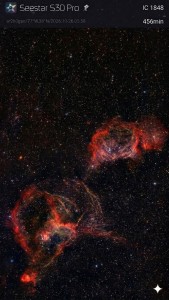
Heart and Soul Nebulas

My Account

New to Astromart?

Register an account...

Need Help?

Posts Made By: Michael Connelley

February 16, 2006 09:44 AM Forum: Equipment Talk

Broadband vs. narrowband

Posted By Michael Connelley

Hello:
Please note that no filter will help cut through the light pollution when observing star clusters, galaxies, or reflection nebulae. They only work on emission nebulae since. These filters work by allowing the narrow line emission of the emission nebulae to pass through while rejecting everything else. Since stars and galaxies are broadband sources, the filters don't help them.
I personally use a narrowband filter, which helps nebulae a lot even from very dark sites.

Cheers
Mike Connelley

February 20, 2006 10:33 AM Forum: Beginning Astronomy?

A Few Basic Questions

Posted By Michael Connelley

Hello:
It is possible to get matching images with Newtonian binoculars. They won't be right-side-up, which is normal for a Newtonian.
With the hinge method of adjusting interpupiliary distance, it is critical that the two optical axes are aligned with the hinge's rotation axis as well as being aligned to eachother. From what I've read, just getting the two optical axes aligned to each other with both scopes in collimation is quite challenging. This may be why (to my knowledge) no one has done a hinged bino-newtonian. Apparently there are other ways to skin this cat. One of them is that if you want, say, 4" binoculars, get a 6" scope and a binoviewer.

Cheers
Mike Connelley

February 20, 2006 10:44 AM Forum: Film Astrophotography - Imaging and Processing

Mauna Kea star trail

Posted By Michael Connelley

No pictures of IRTF?

Weren't you supposed to be working instead of taking pretty pictures? wink

And none of the pictures that you took with the BIG camera?

Cheers
Mike

March 2, 2006 08:32 AM Forum: Telescope Making

Looking for 22x22" Formica for Dob Base

Posted By Michael Connelley

Hello:
I found ebony star formica at a local shop that specializes in counter tops. I don't recall how much it was, but the smallest piece they'd sell was 48"x48", which has lasted me through two dob projects.

Cheers
Mike Connelley

March 9, 2006 03:38 AM Forum: Deep Sky Observing

Help Me Choose!

Posted By Michael Connelley

Hello:
A few things that come to mind:
1) the twin quasar in Ursa Major
2) the host galaxy of 3C273. I don't know if anyone has visually seen this, or even tried, but the host galaxy is (at least theoretically) visible at around 15th magnitude. Unfortinately, there's a magnitude 12.7 "star" smack in the middle. I suspect that all you could see is a little extra fuzz around the quasar compared to nearby field stars
3) There's a nice IC galaxy next to the Ring Nebula. Easy to roughly locate, hard to see.
4) There's another nice IC galaxy near M13, between M13 and the bright(er) NGC galaxy to its north
5) The jet coming out of M87. I've read it should be visible with amateur equipment, but I haven't seen it
in anything up a 16".

Happy hunting
Mike Connelley

March 10, 2006 09:25 AM Forum: Beginning Astronomy?

How do you do it?

Posted By Michael Connelley

Hello:
I'm a graduate student, so I don't make much, but my girlfriend makes twice as much as I do. Asside from food, gas, and rent, astronomy (any my other hobby) is pretty much all I spend money on. I also only do visual observing, so no need for big mounts, CCDs, etc. I've also built the two scopes I use. I got the optics for one of them from a guy I used to work for, and it turns out they're really good. So, that's how I've done it. I don't spend money on much, I build my own scopes, and I've also gotten quite lucky.

Cheers
Mike

March 15, 2006 10:18 AM Forum: Deep Sky Observing

Max magnificationg for galaxy viewing

Posted By Michael Connelley

Hello:
It's interesting that you ask. I have both as 12.5" dob and a 12.5" cassegrain on a german equatorial mount. They both have the same light grasp, but I find myself seeing more details in the cassegrain. I believe this is becuse I can use higher powers since I don't have to worry about the faint fuzzy drifting out of the field while switching eyepieces and refocusing. For a detailed look at galaxies, i tend to use a 17mm Nagler, which gives about 280x and an 82 degree AFOV. The wide AFOV is useful in case I didn't center up on the galaxy well when I had the wider field eyepiece in, and to see more of the surroundings. For planetary observations, I'll use a Plossl since it'll give better contrast than the Nagler, but for the faint fuzzies I like the wider field of view. Naturally, this assumes that the galaxy will fit in 0.3 degree FOV. It is fun to look at some of the larget galaxies (M33, NGC253, etc.) at such high power to pick put details in them.

Cheers
Mike Connelley

March 15, 2006 10:39 AM Forum: Equipment Talk

Enhanced coating vs. Standard Coatings and 6%

Posted By Michael Connelley

Hello:
Actually, the difference in performance should be even smaller than you state. With a 6% gain in reflectivity, you get 6% more light from the star AND 6% more from the sky. A 15" mirror with 89% coatings acts like a perfect 14.15" mirror, whereas one with 95% coatings acts like a 14.62, roughly a 1/2" gain in effective aperture. If this calculation is applied to both the primary and secondary mirrors, then the 15" with 89% coatlings acts like a 13.35" while the one with 95% coatings acts like a 14.25". A difference in an inch of aperture is getting to the point where it can be noticable. I read an account of a side by side test of a 20" and a 22", and the 22" went noticably deeper (I don't know if they had the same coatings, equally effective baffleing, etc.). If you have something like a cassegrain with 3 reflections, then the efficiency of the coatings starts to matter (12.59" vs. 13.88"). The scope may appear to go deeper just after recoating since the coating is new and clean, and doesn't have all of the little scratches, pin holes, dust and all of those other things that scatter light that the mirror had before it was shipped off to the coaters.

Cheers
Mike Connelley

March 16, 2006 11:17 AM Forum: Telescope Making

Mirror Rinse

Posted By Michael Connelley

Hello:
I also built a light weight 12.5" dob. I too was worried about the mirror being so exposed close to the ground, near dirt, pebbles, people's shoes kicking up dirt and pebbles, etc. I found that a large vinyl flower pot (the largest they had at the local WalMart) would fit around the mirror. I cut a large hole in the bottom for ventilation, and so that the bottom of the flower pot was trapped between the back of the mirror cell and the tailgate structure. When the telescope is stored, I put a lid on the flower pot. This seems to keep the mirror pretty clean.
As far as cleaning an already dusty mirror, this is a bit trickier. Canned air can spit out drops of liquid air, which is very cold. The thermal shock can shatter a good sized lens, but I haven't heard of this happening to a 12.5" mirror. I have considered using my airbrush (without the paint, of course!) to blow the dust away. At the observatories here, they use CO2 snow to blow dust off of the mirrors. Most amateurs would probably be shocked to see how dirty the BIG mirrors get before they get a water wash. So, I'd recommend making a mirror cover for your mirror to protect it, clean it off in the sink as usual, then leave it covered at all times it's not catching star light.

Cheers
Mike Connelley

March 20, 2006 10:48 AM Forum: Telescope Making

Discovery & Parks mirrors

Posted By Michael Connelley

Hello:
Things made by Parks tend to be rather expensive. It seems to be a company left in the 60's. I've had quite a hard time finding information about what they sell, and how much it costs. That said, I've also heard that what they build is quite good.
Regarding Discovery, I have a 12.5" f/6 mirror from them that is quite good. On nights of good seeing, I can resolve the disks of the Galilean satellites, and see that they are different sizes and colors. In short, I'm quite happy and would seriously consider buying from them in the future.

Cheers
Mike Connelley
