Image of the day

Captured by
Lawrence Parchman

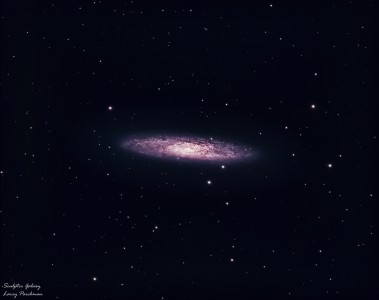
Sculptor Galaxy (NGC 253)

My Account

New to Astromart?

Register an account...

Need Help?

Posts Made By: Alex McConahay

January 25, 2008 02:24 PM Forum: After Dark

RC Telescope Design

Posted By Alex McConahay

It's a touch more complicated than the shapr of the mirrors, though.

For instance, by definition, all Cassegrain's have a hole in the central mirror through which the light passes to focus behind the main. Schmidt's have a thin, relatively flat corrector plate (which your P/S/F doesn't account for) and Maksutov's have a significantly deeper, thicker corrector plate.

I admit, I really cannot memorize all the definitions, and have to look them up if I need them for some reason.

Alex

January 28, 2008 04:59 PM Forum: Refractors

Refractor Geek Seeks a Peek

Posted By Alex McConahay

Shouldn't there be a few at Stellafane? That's just another Springfield up the highway!

Alex

January 29, 2008 12:33 AM Forum: Digital SLR AstroPhotography

Dumb question of the day - Eclipse/D80/C-11

Posted By Alex McConahay

Here's a screenprint of Ron Wodaski's ccd calculator using an 11 inch F6.3, with a D70. You might enjoy going to Ron's website for a free download and then playing with your different combinations of scopes, cameras, and images for your own edification.

Alex


January 29, 2008 02:34 AM Forum: Beginning Astronomy?

Beginning Observing

Posted By Alex McConahay

I think there are several approaches. But yes, you in general have the right idea.

There is a book called "Star Hopping for Backyard Astronomers" Alan MacRoberts. In it the author takes you for tours through a constellation. (He also describes star hopping in general.) I would suggest you make up some "Star Hops" like he has in his book.

The idea is to learn what one constellation has to offer, and then move on to the next constellation. But do not abandon your first one. For instance, Orion is a good one to try right now. Look for its highlights. Then next month do it again quickly in Orion, and study in depth a second constellation. The next month quickly review your Orion "oldies" and the objects you met the second month, and then spend some time studying a third constellation. By the fourth month, Orion has slipped from center stage, but review your second and third constellations quickly before going on to study your fourth. ETC...

Next year, when Orion comes around again, go back to your old friends and try to find them.

By the way--when I say "constellation" I probably mean "area of the sky," which may include several constellations.

One of the methods I have is to pick a page in Sky Atlas 2000, and find all the Messier Objects in it. Or All the Galaxies over twelfth magnitude.

Alex

January 29, 2008 07:07 PM Forum: Digital SLR AstroPhotography

Flats and Bais ???

Posted By Alex McConahay

Flats are important, but biases are not so important.

Flats are important because they compensate for areas that are not illuminated evenly across the image.

The easiest example is a little dust bunny. Imagine you have a piece of dust on the sensor. It blocks most light from getting through, and leaves a dark spot on the sensor, and therefore in the image. Flats take a picture of that dark spot, and then when applied to the real exposure, mathematically compensate for the dark area.

(Let's say the perfectly clean exposure should have been 150 exposure values. The flat shows the exposure everywhere across the image at 150 except under the dust bunny, where it is 120. The dust bunny made a diffference of 30 exposure values. The software adds 30 ev's (exposure values) to the Light frames (your real celestial exposures)in those pixel locations, thereby bringing them back up to the values they would have had if the dust bunny not robbed them.)

After compensating with the flats, there is no dark shadow area where there might have been.

The uneven illumination could come from light fall-off due to an undersized secondary, or a focal reducer, or a baffle, or any one of a number of other things (including dust bunnies. A famous place is on the bottom of a frame of a Canon camera (and perhaps others). Ever notice that the exposures on about the bottom tenth of a Canon is significantly underexposed compared to the rest of the sky? Flat fielding can remove much of that.

Bias is not nearly so important. Most cameras ready their sensors for receiving data by having a floor of some exposure value. Let's say it is 10. All exposures will run from 10 to whatever (65K for 16 bit sensors), not 0 to whatever. The 10 value is subtracted from the rest of the image automatically in most cases before processing. However, in some cases you need to know it is there. For instance, if you are using darks with one time value on lights from another time value, you need to cscale the darks to know how much noise there really is. And to do that, you have to subtract the "floor" from each..

(For instance, let's say that the amount of electronics and read noise is perfectly linear: If you expose a dark for two minutes, your dark will have exactly twice as much noise as if you expose for one minute. ANd let's assume in a minute you get 30 ev's worth of noise. Therefore 60 in two minutes. The actual ev readings on these two exposures would not be 30 and 60, but 30 PLUS the bias value, and 60 PLUS the bias value. (If the bias value is 10, then you would get 40 and 70.) Your "bias" frames tell your software how high the floor was so it will know how much to compensate.

The only time it really gets to be important is if you want to scale your darks. That is using darks taken at one time with light frames taken at another. (Or if you know thetemperature characteristics of your sensors from one temperature to another.)

I believe if you are using darks taken at the same time and temperature as your lights, you can skip worrying about bias frames.

Alex
January 31, 2008 05:06 PM Forum: Equipment Talk

Losmandy G11 Gemini vs Celestron CGE Go-To for ima

Posted By Alex McConahay

I've always admired the Celestron version of the mounts. However, just reading their specifications, it seems that the Losmandy does everything just a bit more beefy and precision. (360 teeth v. 180, 1.5 inch shafts v. 1 inch, etc.) You can look them up next to each other and see for yourself.

The Celestron advertizes a capacity of 65 lbs v. the Losmandy 60. That is pretty much to Celestron's advantage--but then again, I would not want to image with a G-11 loaded at 60 lbs....I don't know how accurate the Celestron rating system is--but to be sure there is no independent rating system or standards for "capacity ratings."

Now, does that answer your question about accuracy, usability, the final picture--Sorry, I won't go there until I have had a chance to use both for an extended period of time.

Alex

January 31, 2008 08:46 PM Forum: Beginning Astronomy?

Getting a Little Heavy

Posted By Alex McConahay

C's are generally lighter than LX's.....although I think that may be mostly in the fork systems, etc., and may not matter on a separate GEM.

If the only reason you are changing is weight, well, then it might make sense. However, this may be a good time to try a completely different option. Maybe keep the SCT for around the house (in a more convenient part of the house, of possible), and get a portable dob for the away games.

Alex


February 11, 2008 03:45 AM Forum: After Dark

Winter Alternatives To Mt Pinos

Posted By Alex McConahay

Sorry I missed this, guys, but I have been out of town....

You are always welcome in Landers, at Goat Mountain Astronomical Research Station. It is not further than the places you guys have been mentioning, and has the facilities you need.

See details at rivastro.org.

Alex

February 11, 2008 10:14 PM Forum: CCD Imaging and Processing/Solar System

Magnifications

Posted By Alex McConahay

There is something from Burgess or Denkmeier or somebody that allows a wide-field reducer, a blank, and a barlow lens--all on a slider. Slide it back and forth from one to the other. I have seen it used with Binoviewers.

Anybody have the details or do I have to figure this one out myself?

Alex

February 14, 2008 04:06 AM Forum: Digital SLR AstroPhotography

shooting the eclipse

Posted By Alex McConahay

What Jean-Denis recommended is real good.

My advice--There is no one answer to your question. The difference between the umbral eclipse and the still uncovered (full light) moon is many many stops. And there are times when you can have both at the same time. During August's eclipse, I took photos at 1/1000th of a second and 4 seconds. There will be many times during the eclipse that your sensor simply does not have the dynamic range it needs to handle both the bright and dark areas.

At some points, you may want to get two different exposures--short for the brighter parts of the moon, long for the dimmer parts. Then you can put them together in Photoshop later.
Learn to use the histogram display on the back of your camera. Expose for a hump about a third of the way up on a full moon. That will be your first exposure (before the eclipse starts) and your fastest. As for F stop, go wherever your lens is sharpest.


You do not need a guided or even driven scope, but it helps if you are going for a sequence or movie.

Practice on the evenings leading up to the eclipse. Don't wait to try it until the last night.
Alex
