Image of the day

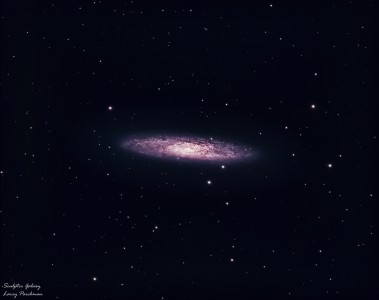
Captured by
Lawrence Parchman

Sculptor Galaxy (NGC 253)

My Account

New to Astromart?

Register an account...

Need Help?

Posts Made By: Alex McConahay

August 27, 2007 03:26 AM Forum: Equipment Talk

So what's the next "big thing"

Posted By Alex McConahay

Did you see the threads about electronic eyepeices and television monitors?

Alex

August 28, 2007 02:25 PM Forum: CCD Imaging and Processing/Solar System

Moon

Posted By Alex McConahay

Guys, Wasn't the moon red tonight?!?!?!?!?!

Alex

August 31, 2007 02:18 AM Forum: Digital SLR AstroPhotography

September 3, 2007 01:51 PM Forum: Beginning Astronomy?

What is this strange effect?

Posted By Alex McConahay

I agree that you are simply looking at normal vignetting on the center of M31. That, combined with processing choices, makes the glow stand out.

Your sky was a bit bright, probably the result of the moon, but perhaps light pollution.

From what I can see, you need to reduce the image scale by at least half. (In other words, you will be able to image only the central half or less of the galaxy with that field of view.)

What makes it look so dramatic is that you have vignetting, especially on the right part and the bottom of the frame.

You could try flat fielding the exposure some, and see if that helps.

ALex

September 6, 2007 04:52 AM Forum: Digital SLR AstroPhotography

point in the right direction

Posted By Alex McConahay

Michael,

You are asking two different questions:
What does it take to attach a DSLR (or 35 mm) to a Telescope and
What does it take to take images like those you see here.

The answer to the first is easy. Call Anacortes, and tell them you want a camera adapter and a t-ring for your camera. They will know what you want. It will cost you twenty to forty dollars for the adapter, and twenty or so for the T-ring. (I did not look up those prices--just guessed.) Just attach the camera this way.

The second question is a lot harder to answer. It takes lots of practice, lots of equipment, a good mount, a laptop, and......the list goes on!

Alex


September 10, 2007 03:04 AM Forum: Digital SLR AstroPhotography

I got a new 20Da camera

Posted By Alex McConahay

Frankly, with as many images as you are combining, you won't see much difference with most of the different methods.

But what method one should use depends on a lot of factors.

If you have done things right (and you have), you have lots of images to use. I think I see 24 images in one set, and 25 in another set. (Why is it that you don't just consider it 49 total images?)

With that many images, I would be using a sigma combined in IP. (Assuming you have sufficient exposure, and with 8 minutes at ISO you should have.) Sigma combined runs a statistical analysis of all the values for that pixel in the array, and then rejects all the values that are not within a given standard deviation of the mean, while combining the rest. That means that all values are considered, and the center is weighted.

Median combine instead uses only the median value. One value out of the twenty four possible values. Now, with twenty four exposures, this has got to be pretty close to a true middle of the pack. However, let's say you only had three exposures, and two of them had a hot pixel, or a satellite going through, or a cloud passing by-- your "median" would not be truly representative.

A simple average combine would overcome some of these problems, but let's say you had three exposures, and one of them was bad. That one bad value would have one third the data you used. It would be averaged out, but still have lots of effect on the end result. Again, if you have twenty four exposures, it is not that big a deal, since the bad pixel value would represent only one twenty fourth of the data.

In short, You should always try to have at least eight exposures, and then use a sigma combined.

If you have fewer, you can try one of the other methods. If it is particularly dim, you can either straight add (and not divide by the number of exposures) or try the funny add (adaptive add???--I cannot remember the name) where you change the divisor after you add.

However, at 24, you reach the point of diminishing returns.

Your mileage may vary.

Pretty picture, though.

Alex
September 14, 2007 02:13 PM Forum: Eyepieces

September 17, 2007 02:01 PM Forum: AstroMart FAQ

How do I 'shrink' pictures to upload

Posted By Alex McConahay

If I have a JPG, the simplest way is to use Microsoft Photo Editor (it comes free with Windows).

Simply open the image in the program, click on Image/Resize/ and specify you want it about 960 pixels across (for this forum).

Then save-as under a different name (or not--but you usually don't want to resize and lose your original information.)

If you are using a different photo editor (like Photoshop, or elements, or whatever, there is a function that does the same thing (under "Image" probably) and in some (as Photoshop) as "File/Save for web.")

To start Microsoft Photo Editor, all you need to do is go to Windows Explorer and click on the name of the photo you wish to edit. (That is, unless you have associated the file with another image editing program, in which case it will start instead----but it undoubtedly has the "resize" function built into it somewhere.)

Alex

September 18, 2007 12:39 PM Forum: CCD Imaging and Processing/Deep Sky

Why is it SO HARD!

Posted By Alex McConahay

You are correct.

Processing can be difficult. It has a steep learning curve. And the software is not friendly.

Images Plus, as was suggested, is one route. But it does not replace Photoshop for final processing.

Alex


September 20, 2007 01:15 PM Forum: AstroMart FAQ

PayPal question

Posted By Alex McConahay

To transfer money to a person, you pay nothing. However, the buyer only gets 97 per cent of what you have paid. It is the cost of doing business that way. It is a very convenient way to pay people, and to get paid. It is a little more safe than some other methods. Somebody has to pay for that safety and convenience. It happens to be the seller in this particular business model. The seller could just price his goods three per cent higher, or 1.5 per cent to split the costs with the buyer. This buyer is adding a 3 per cent surcharge to the item in an attempt to recover the added costs. As I said, it is a cost of business.

I did not know of a four per cent figure in any of this, but it may be.

Alex
