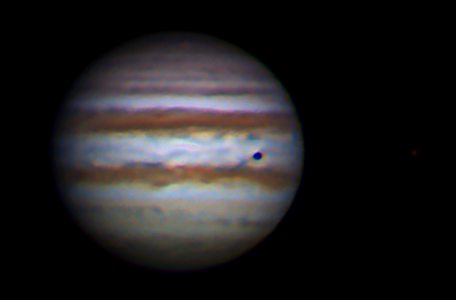
Image of the day

Captured by
John Roach

Jupiter IO Transit 12-10-26

My Account

New to Astromart?

Register an account...

Need Help?

Posts Made By: Curt Renz

September 2, 2005 05:52 PM Forum: Solar System Observing

September New Moon Contest - Beautiful Grouping

Posted By Curt Renz

Who will be first to spot the New Moon by naked-eye after its conjunction with the Sun on 2005 SEP 03 at 18:45 UT (13:45 CDT)?

The slender crescent Moon, a day or two old, was traditionally referred to as the New Moon. On the day of conjunction our ancestors called it the Dark Moon. However, most modern calendar makers insist on labeling the conjunction day as that of the New Moon.

September is the month during which the ecliptic makes its sharpest angle with the horizon after sunset for observers in mid-northern latitudes. That makes the spotting of a one-day-old Moon virtually impossible, especially when it is near apogee. However, most North Americans should be able to sight it when it is 2-days-old on the 5th. Then on the 6th Diana's Bow (3-day-old Moon) will form a beautiful grouping with Venus, Jupiter and Spica.

Since I began this series in 2004 March within several astronomical message boards, the overall champion is Navneeth (SN1987A) in Madras, India with a 2005 January sighting 24:51 hours after conjunction.

Please report your September observation within this thread, including location and time with zone. Even negative results would be interesting. Photos would be especially nice. No prizes, just bragging rights.

I've created graphics previewing the western sky 30 minutes after sunset on both the 5th and 6th as seen from Chicago's Adler Planetarium. Nevertheless, the diagrams should be useful for most North American observers. To see them, click:

http://www.curtrenz.com/astronomical.html

The graphics may be removed soon after the events occur. wink

September 7, 2005 06:19 PM Forum: Solar System Observing

Partial Lunar Eclipse - Oct 17

Posted By Curt Renz

There will be a Partial Lunar Eclipse during the early morning hours of 2005 OCT 17 (evening for those in the Far East.) Those in the eastern portion of North America will be shut out, but those west of there will be in the line of sight. Here in Chicagoland, maximum eclipse will occur shortly before sunrise/moonset.

The eclipse's magnitude will only be 0.061, meaning at best 6.1% of the Moon's diameter will be immersed in the umbra (dark portion of Earth's shadow.)

We are living during a long stretch within the 586-year eclipse cycle in which we get relatively few partial eclipses, and most of those we do get only dip narrowly into the umbra.

Your eclipse photos would be a welcome addition to this thread. wink

09:53 UT -- Moon enters penumbra (gray fringe shadow of Earth)
11:36 UT -- Moon enters umbra
12:03 UT -- Maximum eclipse
12:31 UT -- Moon exits umbra
14:13 UT -- Moon exits penumbra

I've create a graphical sequence of the eclipse events as they will be seen from Chicago's Adler Planetarium, although it should well serve anyone experiencing nighttime during the eclipse. To see it, click:

http://www.curtrenz.com/astronomical.html

The graphic may be removed soon after October 17.

September 13, 2005 12:59 AM Forum: Solar System Observing

Harvest Moon

Posted By Curt Renz

Near sunset on Saturday evening, September 17, the Harvest Moon will be seen rising just slightly south of the eastern point on the horizon. It will appear unusually large since it will be only about a day-and-a-half past perigee.

The Harvest Moon is the Full Moon that occurs nearest to the moment of the Autumnal Equinox, which is September 22 this year. It provides the moonlight for farmers to continue harvesting into the evening. This is true for several nights in a row because of the sharp angle the ecliptic strikes the horizon at sunset during this time of the year. The geometry allows the Moon to rise only a short time later during successive evenings. This will be especially true in Septembers 2005 and 2006 since the Moon will be in the zone of its 18.6-year nodal cycle during which the effect is exaggerated.

On average, the Moon rises 50.47 minutes later each day. But printed below are the Moon’s CDT rising times as viewed from Chicago’s Adler Planetarium later this month.

Sep 17 – 18:58
Sep 18 – 19:21 – 23 minutes later than the previous evening
Sep 19 – 19:44 – 23 minutes
Sep 20 – 20:09 – 25 minutes
Sep 21 – 20:38 – 29 minutes

If you’re not a farmer, then get ready to enjoy the beauty of the rising Harvest Moon. If you are one, then prepare to get to work. wink

September 26, 2005 07:32 PM Forum: Solar System Observing

October Astronomical Calendar

Posted By Curt Renz

I've created an October astronomical calendar that can be downloaded as your computer's desktop background wallpaper or printed to paper. It includes information on the naked-eye planets, Moon and eclipses. A recently added feature is the posting of planetary events and meteor showers on specific dates. wink

To see the calendar, click:
http://www.curtrenz.com/astronomical.html

For those interested in details, read on:

The lunar images and planetary visibility tables are topocentric and assume the observer is located at the Adler Planetarium in Chicago. Although, the calendar should well serve those in most northern hemisphere locations.

Each daily lunar image is depicted as it would appear on the night of the two dates it straddles. That includes the orientation of the Moon’s illuminated portion and its relative apparent size. A waxing Moon is shown as it would appear midway between sunset and moonset. A waning Moon is shown as it would appear midway between moonrise and sunrise. The effects of earthshine and the oppositional flash are also demonstrated.

The phases described at the bottom of the page are calculated for more classical and intuitive definitions, rather than the simplistic ones necessarily employed in more recent times but before the advent of computers. Dark Moon is the moment during the monthly cycle in which the apparent lunar disk is least illuminated. Full Moon is when the disk is most illuminated. Half Moon comes when the disk is 50% illuminated. The fraction illuminated is printed under each image.

The apogee and perigee data are geocentric: kilometers from center of Earth to center of Moon. Otherwise, this information might seem somewhat chaotic as the Earth's rotation causes a daily oscillation of the distance between a surface based observer and the Moon.

October 1, 2005 07:58 PM Forum: Solar System Observing

October New Moon Spotting Contest

Posted By Curt Renz

Who will be first to spot the New Moon after sunset by naked-eye following its conjunction with the Sun on 2005 OCT 03 at 10:28 UT?

The slender crescent Moon, a day or two old, was traditionally referred to as the New Moon. On the day of conjunction our ancestors called it the Dark of the Moon (or Change of the Moon.) However, most modern calendar makers insist on labeling the conjunction day as that of the New Moon.

October is one of the months during which the ecliptic makes a sharp angle with the horizon after sunset for observers in mid-northern latitudes. That makes the spotting of a one-day-old Moon virtually impossible. Even at age two-and-a half on the 5th, most North Americans may find it difficult.

Since I began this series in 2004 March within several astronomical message boards, the overall champion is Navneeth (SN1987A) in Madras, India with a 2005 January sighting 24:51 hours after conjunction.

Please report your October observation within this thread, including location and time with zone. Even negative results would be interesting. Photos would be especially nice. No prizes, just bragging rights.

I've created a graphic previewing the western sky 20 minutes after sunset on October 5 as seen from Chicago's Adler Planetarium. Nevertheless, the diagram should be useful for most North American observers. To see it, click:

http://www.curtrenz.com/astronomical.html

The graphic may be removed soon after October 5.

October 6, 2005 07:32 PM Forum: Solar System Observing

Mercury's Unfavorable Evening Apparition

Posted By Curt Renz

Mercury will reach its Greatest Eastern Elongation of 23.5° on November 3. One might expect that means an apparition of Mercury as an evening star. Not really for those of us observing from mid-northern latitudes. At this time of the year after sunset the ecliptic makes a sharp angle with the horizon. Even though the upcoming GEE is about average, Mercury will not attain much altitude above the horizon after the Sun has gone down.

I’ve created a graphic that illustrates Mercury’s upcoming struggle to enter the evening sky. To see it, click:
http://www.curtrenz.com/astronomical.html

The graphic will not remain as a permanent feature on the website. wink

October 12, 2005 06:35 PM Forum: Solar System Observing

Partial Lunar Eclipse - Oct 17

Posted By Curt Renz

There will be a Partial Lunar Eclipse during the early morning hours of 2005 OCT 17 (evening for those in the Far East.) Those in the eastern portion of North America will be shut out, but those west of there will be in the line of sight. Here in Chicagoland, maximum eclipse will occur shortly before sunrise/moonset.

The eclipse's magnitude will only be 0.061, meaning at best 6.1% of the Moon's diameter will be immersed in the umbra (dark portion of Earth's shadow.)

We are living during a long stretch within the 586-year eclipse cycle in which we get relatively few partial eclipses, and most of those we do get only dip narrowly into the umbra.

Your eclipse photos would be a welcome addition to this thread.

09:53 UT -- 04:53 CDT -- Moon enters penumbra (gray fringe shadow of Earth)
11:36 UT -- 06:36 CDT -- Moon enters umbra
12:03 UT -- 07:03 CDT -- Maximum eclipse
12:31 UT -- 07:31 CDT -- Moon exits umbra
14:13 UT -- 09:13 CDT -- Moon exits penumbra

From Chicago's Adler Planetarium the Sun will rise at 07:05 CDT and the Moon will set at 07:11.

I've create a graphical sequence of the eclipse events as they will be seen from the Adler Planetarium, although it should well serve anyone experiencing nighttime during the eclipse. To see it, click:

http://www.curtrenz.com/astronomical.html

The graphic may be removed soon after October 17. wink

October 29, 2005 04:14 PM Forum: Solar System Observing

November Lunar and Planetary Calendar

Posted By Curt Renz

I've created a November astronomical calendar that can be downloaded as your computer's desktop background wallpaper or printed to paper. It includes information on the naked-eye planets, Moon and eclipses. A recently added feature is the posting of planetary events and meteor showers on specific dates. wink

To see the calendar, click:
http://www.curtrenz.com/astronomical.html

For those interested in details, read on:

The lunar images and planetary visibility tables are topocentric and assume the observer is located at the Adler Planetarium in Chicago. Although, the calendar should well serve those in most northern hemisphere locations.

Each daily lunar image is depicted as it would appear on the night of the two dates it straddles. That includes the orientation of the Moon’s illuminated portion and its relative apparent size. A waxing Moon is shown as it would appear midway between sunset and moonset. A waning Moon is shown as it would appear midway between moonrise and sunrise. The effects of earthshine and the oppositional flash are also demonstrated.

The phases described at the bottom of the page are calculated for more classical and intuitive definitions, rather than the simplistic ones necessarily employed in more recent times but before the advent of computers. Dark Moon is the moment during the monthly cycle in which the apparent lunar disk is least illuminated. Full Moon is when the disk is most illuminated. Half Moon comes when the disk is 50% illuminated. The fraction illuminated is printed under each image.

The apogee and perigee data are geocentric: kilometers from center of Earth to center of Moon. Otherwise, this information might seem somewhat chaotic as the Earth's rotation causes a daily oscillation of the distance between a surface based observer and the Moon.

October 31, 2005 10:36 PM Forum: Solar System Observing

November New Moon Spotting Contest

Posted By Curt Renz

Who will be first to spot the New Moon after sunset by naked-eye following its conjunction with the Sun on 2005 NOV 02 at 01:25 UT?

The slender crescent Moon, a day or two old, was traditionally referred to as the New Moon. On the day of conjunction our ancestors called it the Dark of the Moon (or Change of the Moon.) However, most modern calendar makers insist on labeling the conjunction day as that of the New Moon.

November is one of the months during which the ecliptic makes a sharp angle with the horizon after sunset for observers in mid-northern latitudes. The 18.6-year nodal cycle is also positioned against observers. That makes the spotting of a one-day-old Moon virtually impossible for us northerners. Even at age two on the 3rd, most North Americans may find it difficult. However, the appearance of Mercury and Antares in the vicinity of the Moon may be helpful.

Since I began this series in 2004 March within several astronomical message boards, the overall champion is Navneeth (SN1987A) in Madras, India with a 2005 January sighting 24:51 hours after conjunction.

Please report your November observation within this thread, including location and time with zone. Even negative results would be interesting. Photos would be especially nice. No prizes, just bragging rights.

I've created a graphic representing a portion of the constellation Scorpius in the western sky 20 minutes after sunset on November 3 as seen from Chicago's Adler Planetarium. Nevertheless, the diagram should be useful for most North American observers. To see it, click:

http://www.curtrenz.com/astronomical.html

The graphic may be removed soon after November 3. smile

November 4, 2005 08:32 PM Forum: Religion

Vatican Warns Against Fundamentalism

Posted By Curt Renz

A Vatican cardinal said Thursday that the faithful should listen to what secular modern science has to offer, warning that religion risks turning into “fundamentalism” if it ignores scientific reason.

Here's the link: http://www.msnbc.msn.com/id/9913712/

An interesting call for reason from a ranking official of an organization that at one time favored the burning of those who would not accept its orthodoxy. I'd be interested in comments from others, especially Catholics and fundamentalists. wink
