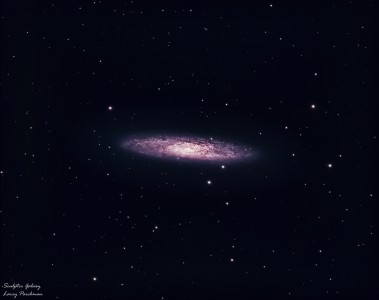
Image of the day

Captured by
Lawrence Parchman

Sculptor Galaxy (NGC 253)

My Account

New to Astromart?

Register an account...

Need Help?

Posts Made By: Dave Mitsky

August 18, 2003 01:50 PM Forum: Solar System Observing

The Moon and Mars From the Naylor Observatory

Posted By Dave Mitsky

For several hours Maura Smith and I had great views of Mars from the ASH Naylor Observatory on Friday night/Saturday morning (2003/8/16 UT). The transparency was not particularly good but the seeing was above average.

We used the 17" f/15 classical Cassegrain with a variety of filters (an Orion SkyGlow filter, an Orion variable polarizing filter, a neutral density filter, and Wratten #21, 23, 30, and 80A color filters), sometimes stacked (the SkyGlow and Wratten #30 was a great combination). At times I stopped down the scope with aperture masks of various diameters (6, 10, and 14 inches). Magnifications of 202, 231, 249, and 259x were employed. We captured a few good afocal photos of Mars with Maura's Sony digital camera as well.

During the session the CM advanced from 116 degrees to 164. The Eye of Mars (Solis Lacus) was visible as was Mare Sirenum and some morning limb clouds.

We also took a brief tour of the Moon at 202 and 259x before closing up the French Dome. The area surrounding the Lobster Claw (Gutenberg) and south of it was particularly interesting.

Dave Mitsky
Harrisburg, PA

August 22, 2003 09:49 AM Forum: Solar System Observing

The Eye of Mars Is upon You

Posted By Dave Mitsky

On Tuesday morning (2003/8/19) I had my all-time best view of Solis Lacus, the Eye of Mars, through my friend Tony Donnangelo's 14.5" Starmaster Sky Tracker Dob and homemade apodizing mask using magnifications up to 610x (Tele Vue Nagler zoom at 3mm) and a variety of color and nebula(r) filters. We tried Tony's H-beta filter with good results but I wasn't as impressed with it as I expected to be based on recent reports.

The seeing wasn't quite as good at a different dark site on Wednesday morning but did support 352x (5.2mm Pentax SMC XL) with ease and the Eye of Mars was again portrayed magnificently, especially with a Wratten #23A filter. The Starmaster's Zambuto mirror once again did its thing admirably.

And on Thursday morning I spent some time at the ASH Naylor Observatory using the 17" classical Cassegrain at a maximum of 259x (25mm Celestron orthoscopic) due to the poorer seeing. I stopped down the scope to 14" and briefly to an unobstructed 6". Appropriately enough a Wratten #25 red filter did a nice job on the Red Planet.

An observing report on another forum likened Solis Lacus to the CBS logo. I can't think of a better description.

Ed Grafton's image - http://www.ghg.net/egrafton/m8-21-03.jpg - portrays Solis Lacus rather dramatically.

Dave Mitsky

September 5, 2003 07:35 PM Forum: Solar System Observing

Late Night Mars, 2003/9/5 UT

Posted By Dave Mitsky

I was able to observe Mars for the first time in a week this morning using the 17" f/15 classical Cassegrain at the ASH Naylor Observatory (http://www.astrohbg.org) under conditions of variable seeing that ranged from average to poor. After the clouds began to clear (a bit later than originally forecasted) the transparency steadily improved. Magnifications used spanned the range of 162x to 404x; color filters employed were a Wratten #21, a Wratten #30, and a newly acquired 2" Wratten #85. When the seeing deteriorated I stopped the scope down to 10 and 6 inches.

The Pipe (Sinus Sabaeus and Sinus Meridiani) was very prominent. At 6:46 UT the the Bowl of the Pipe or the so-called Claw straddled the CM. Morning clouds were visible in the southern hemisphere of the following limb.

While I was in the area of Mars, I took a look at Uranus at 162, 259, and 404x.

I spent a little time doing some casual DSO viewing as well. M37, M38, M36, M2, NGC 7293 (with an Orion UltraBlock filter), M42, M43, and M15 were my targets at magnifications of 162 and sometimes 259x.

Dave Mitsky

September 5, 2003 08:33 PM Forum: Deep Sky Observing

The News So Far from CSSP, Part I

Posted By Dave Mitsky

Somehow I neglected to post this on-site report on Astromart. Operating on the premise better late than never here it is.

For the first time in a year I was back at the Stargazer's Paradise, namely Cherry Springs State Park in Potter County, Pennsylvania. The forecast wasn't the best for Monday night (2003/8/25) but the skies eventually cleared and the 20 or so folks encamped at CSSP were able to observe until approximately 3:00 a.m. It was interesting to see an almost continuous barrage of lightning far in the distance to the south and southwest.

In the early part of the night I puttered around with my 101mm Tele Vue Genesis sdf refractor, viewing a number of bright deep-sky objects. A bit later I walked down to the southwest corner of the observing field and met the folks who manufacture the Denkmeier binoviewers. I spent some time looking at M13, NGC 6207, M27, M24, M17, M8, and M20 through a homemade 20" equipped with the Denkmeier Binoviewer Two and twin 21mm Pentax SMC XL eyepieces.

When I returned to the campsite my friend Tony Donnangelo was busy with his 14.5" Starmaster Sky Tracker. Among the many objects we viewed were the Cygnus Loop, four galaxies south of NGC 7331, Stefan's Quintet, NGC 1023, and the 11.6 magnitude asteroid 172 Baucis.

By 2:00 a.m. Mars was well placed and Solic Lacus was nearing the CM. Using a 5.2mm Pentax XL, an apodizing mask, and a 23A color filter we saw a second "eye" to the northwest. It seemed that we were in for some subperb views of the Red Planet but before too long the skies grew cloudy.

It was clear but very hazy for a short time on Tuesday night. A fair amount of rain and lightning followed.


September 5, 2003 08:34 PM Forum: Deep Sky Observing

The News So Far from CSSP, Part II

Posted By Dave Mitsky

Wednesday night was an excellent one. The transparency was variable early on but began to improve around 5:00 UT. Tony was a regular observing machine. He polished off so many DSOs (including a great many galaxies in Hercules, Pegasus, Andromeda, Cetus, and Perseus) with his 14.5" Starmaster that I got tired just looking at them all. My Tele Vue Genesis sdf provided a good view of NGC 1499, the California Nebula, with the help of Tony's 48mm Lumicon H-beta filter and my 35mm Panoptic.

I saw the IC galaxy near M13, IC 4617, for the first time through Tom Whiting's new 30" Dob. M13 was incredible at 388x and NGC 6207 seemed very bright. We also looked at M57's central star and the dim nearby galaxy IC 1296. The planetary nebulae NGC 1514, NGC 6543, and NGC 7009 were fantastic through the large scope. Just 9' to the east of NGC 6543 was a dim galaxy, 14th magnitude NGC 6552, that I had never before seen.

I also spent some time observing with a fellow from New Hampshire who had a 25" Obsession and a man from New Jersey with an ATM 20" Dob.

Mars cast an easily discernible shadow and the zodiacal light was quite prominent.

Unfortunately, the seeing was not very good and high quality views of Mars were not forthcoming.

Dave Mitsky

September 7, 2003 08:02 AM Forum: Solar System Observing

Saturday Night Martian Fever (Preliminary Report)

Posted By Dave Mitsky

I've observed Mars for the past three nights from the ASH Naylor Observatory. (I've already posted a report on Thursday night.) There were some good moments from time to time during the first two nights but on Saturday night/Sunday morning (2003/9/7 UT) the seeing was simply outstanding. Views of the Red Planet through the 12.5" f/6.5 Cave Newtonian and the 17" f/15 classical Cassegrain (at magnifications up to 518x) were phenomenonal. I'll talk more about that in a follow-up report.

Some fellow ASH members and I set up the recently repaired StellaCam EX and recorded some excellent video footage.

Dave Mitsky

September 17, 2003 10:28 AM Forum: Solar System Observing

Mars and Other Stuff, 2003/9/17 UT

Posted By Dave Mitsky

Tuesday night was a very good one in south central Pennsylvania. Using the 17" f/15 classical Cassegrain at the ASH Naylor Observatory I observed Mars at length (at 202, 231, 249, and 259x with Wratten #30 and 85 filters), seeing the bright area known as Eridania as well as the prominent maria (Sirenum and Cimmerium) that straddled the CM at the time (~2:30 UT). The retreating SPC appeared as the merest sliver of white.

I spent some time on 53 Aquarii (162, 202, 231, and 259x), a sixth magnitude binary star that is in the vicinity of Mars at the moment. This close double has a current separation of about 1.5" and was just barely resolved at 162x.

Other objects viewed with the 17" included M17 and M8 (162x with an Orion UltraBlock filter) as well as M24 (162x), M30 (162 and 259x), Uranus (162 and 259x), and Neptune (162 and 259x).

I also looked at the cataclysmic variable star SS Cygni through the 12.5" f/6.5 Cave Newtonian. A fellow ASH member who was doing an estimate felt that it was shining at magnitude 8.7 or so.

Dave Mitsky

September 23, 2003 09:41 AM Forum: Deep Sky Observing

Saturday Night at the Fishing Creek Observatory

Posted By Dave Mitsky

I visited a friend's new roll-off observatory on Saturday night (2003/9/21 UT). The structure had survived Isabel in fine shape and the night was clear (if more than a little damp and dewy) and beckoning. Using his 12" LX200 the owner, yours truly, and two other Astronomical Society of Harrisburg members viewed a variety of objects including Mars, Uranus, M13, M57, M27, Albireo, NGC 7209, NGC 7243, NGC 891, M33, NGC 404, M74 (which was barely visible), NGC 7331, NGC 7662, M31, and M32. For the most part we employed magnifications of 98 (31mm Tele Vue Nagler type 5) and 177x (17mm Sirius Ploessl). A fine time was had by all before encroaching clouds got the better of us sometime around 04:30 UT.

Dave Mitsky

September 24, 2003 09:06 AM Forum: Solar System Observing

Three Notable Satellites, 2003/9/24 UT

Posted By Dave Mitsky

While I was at the ASH Naylor Observatory last night, I saw three "arties" worth mentioning. The first was an excellent ISS pass that began in the west southwest at 00:06 UT. When I first spotted the 100 billion dollar white elephant it was to the west of Zuben el Genubi. The ISS, as it seems is often the case, was much brighter than the predicted magnitude of -0.2. It was clearly brighter than -1.0 when compared to Mars and Vega. The ISS reached an altitude of 61 degrees at 00:09 UT and disappeared in the northeast at 00:12 UT.

Shortly thereafter (00:13 UT) lucky Iridium 13 (37 degrees altitude, 6 degrees north, -2 magnitude) blossomed in the north in the vicinity of Polaris. This particular Iridium flare didn't seem to be quite as bright as predicted.

A couple of hours later (at approximately 2:05 UT) while I was hunting down Neptune with the 17" f/15 classical Cassegrain I noticed a dim satellite traveling eastward through Capricornus at a rather leisurely rate. Within a few seconds it grew dramatically brighter. I had stumbled across a slow moving satellite that was tumbling with a period of about 5 seconds. I quickly replaced the 25mm University Optics MK-70 (259x) with a 40mm MK-70 (162x) and tracked the satellite for about 5 minutes, giving everyone who was interested a chance to see it. This mystery satellite was the best tumbler that I've ever seen through a telescope.

Dave Mitsky

September 25, 2003 02:57 PM Forum: Deep Sky Observing

Nova Sagittarii 2003 Number 2, 2003/9/25 UT

Posted By Dave Mitsky

One of the objects that I observed on Wednesday night with the 17" f/15 classical Cassegrain (162x) at the ASH Naylor Observatory near Lewisberry, PA, was Nova Sagittarii 2003 Number 2. This new nova, if you'll pardon the pun, was discovered by Nick Brown on September 19th and is located at R.A. = 18h10m10.42s, Declination. = -27d 45'35.2". Using the AAVSO finder chart and the second edition of the Uranometria 2000.0 (page 145) I was able to locate the nova at approximately 01:00 UT just to the east of a distinctive arrow-shaped asterism. Bob Young, an ASH member who is an experienced variable star observer, felt that the nova was shining at approximately 9.3 magnitude.

For further information on this nova see http://www.aavso.org/publications/newsflash/sp7.shtml and http://www.aavso.org/news/nsgr032.shtml

Dave Mitsky