
Hello:
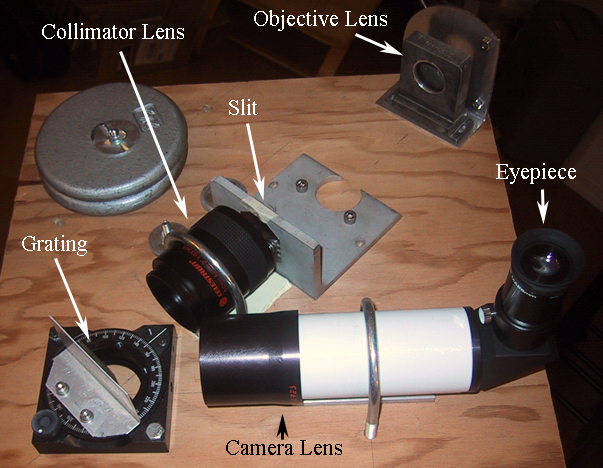
Here's a picture of a simple spectroscope that I built out of spare telescope parts and bits found around the lab. The objective is about 1" in diameter, with an adjustable iris in front. The slit is made of two razor blades bolted to a hunk of metal, in part so that the hunk of metal can be a heat sink to cool the slit. The collimator lens is a 50mm Plossl eyepiece, and puts the exit pupil near the camera lens. The grating is on a turning stage so you can look at different parts of the spectrum, and choose what order you want to look at since higher orders appear to have higher dispersion. The camera lens forms the image of the spectrum (together with the collimator, they just reimage the slit), and the eyepiece does the rest. The spectroscope works quite well. The lines appear sharper when the iris is small, probably because this thing isn't aligned very well and things are more forgiving at slower f/ratios. Nevertheless, the sodium lines in the solar spectrum are nicely resolved, and I think I can just see the calcium lines in the violet. The Halpha line is quite easy to see, but Hbeta and Hgamma are kind of lost among the metal lines. It was quite easy to build, and I highly recommend others to make one, especially if they do solar observing as part of public outreach efforts.
Cheers
Mike Connelley
Here's a picture of a simple spectroscope that I built out of spare telescope parts and bits found around the lab. The objective is about 1" in diameter, with an adjustable iris in front. The slit is made of two razor blades bolted to a hunk of metal, in part so that the hunk of metal can be a heat sink to cool the slit. The collimator lens is a 50mm Plossl eyepiece, and puts the exit pupil near the camera lens. The grating is on a turning stage so you can look at different parts of the spectrum, and choose what order you want to look at since higher orders appear to have higher dispersion. The camera lens forms the image of the spectrum (together with the collimator, they just reimage the slit), and the eyepiece does the rest. The spectroscope works quite well. The lines appear sharper when the iris is small, probably because this thing isn't aligned very well and things are more forgiving at slower f/ratios. Nevertheless, the sodium lines in the solar spectrum are nicely resolved, and I think I can just see the calcium lines in the violet. The Halpha line is quite easy to see, but Hbeta and Hgamma are kind of lost among the metal lines. It was quite easy to build, and I highly recommend others to make one, especially if they do solar observing as part of public outreach efforts.
Cheers
Mike Connelley
Attached Image:
