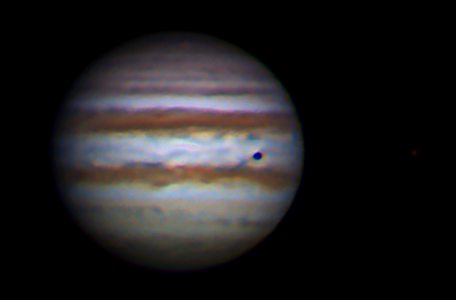
Image of the day

Captured by
John Roach

Jupiter IO Transit 12-10-26

My Account

New to Astromart?

Register an account...

Need Help?

Newby Looking for a place to start

Started by girard35, 03/30/2004 06:14AM
Posted 03/30/2004 06:14AM Opening Post
Equipment includes:10 hardin on an EQ MOUNT WITH RA clock drive Brand new unmodified Toucam Pro II 840k with moog adapter 2x Parks barlow. I have downloaded Registax and KC3ccd tools. Any information regarding frame rates,exposure control color correction and processing.Not very needy right? any help I get will greatly appreciated I look at all the pics you guys post and hope to master some of your skills.I've been been star gazing for about 9 months now and would like to try my hand at some planetary and lunar photos.Also I have a mini DV format video camera and 14mm radian with an adapter from televue to mount the Radian and camera to the scope for eyepiece projection.
Thanks
Rich
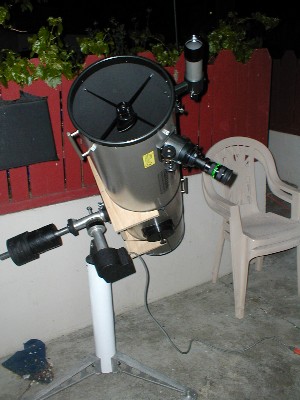

Attached Image:

girard35's attachment for post 14551
Posted 03/30/2004 02:37PM #1
Richard, congratulations, you got some nice equipment to get started with!

What I would do first is PLAY with it, get a feeling for what you have...

Shoot at the Moon first, BIG-EASY Target, practice your focusing techniques, play with frame rates/exposures/gain to see what's best for your setup...

There's no exact numbers/technique, only approximates, since changes in equipment/seeing conditions require different settings in the real world...


We will be around for any questions you might have while you play with your setup...


Clear skies, and enjoy!


Ivan
smile

Ivan Gastaldo 8)
Coconut Creek, FL

Ivan's Observatory
Lat 26N 16' 48" Long 80W 10' 48"
[COLOR="Red"]Personal Website:[/COLOR] http://www.ivangastaldo.com

CCD Imaging and Processing/Deep Sky - Moderator
I like to complain about everything - Moderator
Posted 03/31/2004 02:28AM #2
I second Ivan & Joe's suggestion. Shoot the moon first and get comfortable imaging craters and learning to point your scope, focus the image, and play with the camera settings. Try it without and then with the barlow. Learn how to re-focus when the barlow is in and out. After you've mastered that try your hand at Jupiter. It's a challenge at first finding the planet (turning the gain up high when searching for it makes it easier to spot and center). When focusing the planet, either use one of the nearby brighter stars or a Jovian moon, (again gain up high to find and center it, then back gain down to focus it as sharp as possible, then set the gain up high to find and center the planet.)

-Gary
    There is only one constant in our infinite universe; it is change.
    D&G 8” f/15, AP178 f/9, C11, C8, ED80, TV-85, TV101&102, SW120ED, 6"Cave f/8, Solarmax 40, ES127MC,
    DM-6, Losmandy Titan 50 GEQ, G11, AP800, ES Twilight-1, UA Unistar Deluxe, WO EZ-Touch, 
    Denk BVs, 7x50 Fujinons, 10x50 Nikons, 15x70 Astrophysics, 16x70 Fujinons, 22x100 Oberwerks, 
    Sim Picheloup CPT, Canon 40D, 60Da, Vixen Polarie, SXV-H9, DMK 41AU02, DBK 21AU618, 
    Shelyak Lhires Lite Spectroscope, Rainbow Optics Spectroscope, Field Tested Systems RSPEC,
    Chairman, Southwest Region of the Astronomical League (SWRAL)
    President Emeritus, Historian, AL Awards Coordinator, Texas Astronomical Society of Dallas (TAS)
    Member/Volunteer, 3RR Comanche Springs Astronomy Campus (CSAC)
    ALCOR, Advisor to the Board, Texas Star Party (TSP)
    NASA-JPL Solar System Ambassador Volunteer (SSA)
